
The Future of Orbital Sustainability: ISRU for the New Space Economy

Water propulsion system supporting the future space economy and ISRU infrastructure

The space industry changes rapidly. The “new space” sector is making missions more frequent, commercial, and decentralized. More small satellites are being launched into orbit, and new services are emerging. On top of that, there is a growing interest in lunar and near-lunar infrastructure.

However, sustainable space development demands more than just reducing launch costs. Consequently, the future space economy requires efficient logistics. Future missions must deliver, store, and utilise resources in space without constant dependence on Earth.

In-Situ Resource Utilisation (ISRU) plays a major role in the future of space exploration. This approach reduces the need for propellant delivery, water, and other resources from Earth.

Water is one of the most valuable resources. Besides supporting life, it can also power CubeSat propulsion systems, provide radiation shielding, and enable future near-lunar logistics. Hence, water is an important element that helps to develop ISRU, sustainable orbital infrastructure, and new space missions.

What ISRU Means for the New Space Economy

In simple terms, ISRU means using the resources that exist in space rather than bringing them from Earth. The new space economy is going to benefit greatly from ISRU. Furthermore, the more missions there are in orbit, near the Moon, and in deep space, the more difficult and expensive it will be to continuously send all the necessary supplies from Earth. In-Situ Resource Utilisation will help to build a more independent and sustainable space infrastructure.

Furthermore, national programs such as the Luxembourg Space Resources initiative also show that space resources are becoming an important part of the future commercial space economy.

Resource
Moon
Asteroids
Mars
Cislunar / Orbit
Water ice
Medium
Medium
High
Future supply
Oxygen
High
Medium
High
Future supply
Regolith
High
High
High
Limited
Metals
Medium
High
Medium
Limited
Solar energy
High
High
Medium
High

In addition, ESA also highlights the importance of lunar resources and materials, including regolith, oxygen and other materials that could support future exploration infrastructure.

Why Water is the Ultimate Strategic Resource for ISRU

Water is one of the most important resources for future space infrastructure. Unlike many other types of propellant, water is safe and convenient in terms of storage. As a result, water becomes an excellent choice for long-term missions and orbital services.

For example, in space, water can serve several purposes at once. Namely, propulsion systems, radiation shielding, thermal control, and crew life support.

Scientists have found water ice on the Moon and may find it on other celestial bodies. If future missions extract and process it on site, water could become part of future ISRU supply chains. Consequently, for near-lunar and deep-space missions, water can become an important logistical commodity. It will be possible to extract, store, transport, and use it wherever it is needed to support space infrastructure.

Water-Based Propulsion is a Step Toward Sustainable Mobility

Water-based propulsion systems are an efficient solution for small satellites and CubeSats. Water as a propellant is much safer than traditional types of propellant. As a result, integration, testing, transportation, and preparation are simplified.

In the future, water electrothermal thrusters will fit perfectly into the ISRU supply chains. Eventually, future missions could use extracted and stored water not only to support life but also to power the orbital mobility of satellites and other spacecraft.

Scaling from SmallSat Constellations to Cislunar Infrastructure

Today, propulsion systems enable CubeSats and small satellites to perform low Earth orbit (LEO) manoeuvres, adjusting their orbit, and managing the mission flexibly. Looking ahead, the next step is in-orbit mobility. In this environment, water-based propulsion systems are useful for orbital servicing, satellite inspection, rendezvous, collision avoidance, and the management of satellite constellations.

In the future, future missions could use water obtained through ISRU for refuelling and logistics in near-lunar space. This will make it possible to build a more sustainable infrastructure connecting Earth, the Moon, and other destinations.

Thus, water propulsion serves as a bridge between today’s small satellites and the space infrastructure of the future.

Combining Water Propulsion and 3D Printing for Space Mobility

The SteamJet propulsion system bridges the gap between water-based green propellant technology and additive manufacturing. By utilising 3D printing, we can manufacture highly compact, safe, and custom-shaped thruster components tailored for modern small satellites. As a result, additive manufacturing minimises total dry mass, simplifies assembly, and maximises layout flexibility within tight CubeSat form factors.

“Our strategic goal is to bring our sustainable propulsion systems to the Moon, asteroids, and beyond,” states Marco Pavan, CEO of SteamJet Space Systems. “Water propulsion technology is the foundation required to build an independent, efficient, and truly sustainable space infrastructure.”

About SteamJet Space Systems

SteamJet Space Systems is a leading UK-based provider of high-performance satellite propulsion solutions. We specialise in water-based propulsion solutions designed specifically for CubeSats and Small Satellites (SmallSats), prioritising operational safety and rapid launch integration. 

By pioneering the use of green propellants and intelligent thermal engineering, SteamJet enables complex LEO (Low Earth Orbit) manoeuvres — including orbital maintenance, collision avoidance, and de-orbiting — without the risks associated with toxic hydrazine or high-pressure cold gas systems, advancing green propulsion for space missions.

Steamjet Propulsion Technology

Our modular systems are engineered for seamless integration and maximum safety compliance:

Steam TunaCan Thruster: A compact, high-efficiency solution for 1U-3U CubeSats.

Steam TunaTank Thruster: A safe, high-performance electrothermal propulsion system.

Steam Thruster One: Scalable propulsion for larger SmallSat constellations.

Discover how SteamJet’s sustainable space propulsion innovations are providing the safety and reliability required for the next generation of crewed and robotic missions. Contact our engineering team for technical specifications and ICDs.

Reducing Satellite Launch Lead Times with Water Propulsion Systems

Water propulsion system for small satellite launch preparation and integration

While thrust, power, specific impulse, and mass dictate a small satellite’s delta-v capabilities and mission profile, overall schedule risk depends heavily on ground operations. A successful mission requires assessing how seamlessly a satellite propulsion system can be integrated, tested, transported, and cleared for launch.  Propellant that requires complex safety procedures, special infrastructure, or additional approvals extend the mission preparation time and increase the risk of delays. Therefore, at the planning stage, it is important to consider not only the thruster’s capabilities but also the predictability of the satellite’s preparation for launch.

Water Propulsion Simplifies Mission Integration

Water-based electrothermal propulsion offers a benign, non-toxic alternative that drastically simplifies spacecraft ground operations.

As a result, water propulsion offers several operational advantages:

  • Streamlined Operations: Eliminates the need for self-contained breathing apparatus (SCBA), blast facilities, specialised HVAC ventilation, or toxic fueling infrastructure. 
  • Simplified Logistics: Facilitates standard commercial shipping and unrestricted transport between laboratories, environment test centers, and launch sites. 
  • Late-Stage Launch Pad Access: Allows low-risk refuelling and non-hazardous inspections late in the integration flow, mitigating critical path schedule delays. 
  • Fewer potential bottlenecks: documentation and approvals are still required. However, water propulsion reduces the complexity of procedures on the ground. It also helps bring the satellite to launch readiness more quickly.

Water Propulsion Reduces Schedule Risk for Small Satellite Teams

Because of this, the ground operations team usually does not need to go through complicated procedures related to hazardous materials, since water is a safe and non-toxic propellant. Consequently, mission managers and system engineers spend less time on additional safety reviews, approvals, designated refuelling areas, and restrictions on launch site operations.

As a result, mission preparation becomes more predictable. Teams can effectively plan integration, testing, and final checks before launch. Consequently, they significantly reduce the risk of schedule delays in the later stages of the mission.

Easier Testing and Verification for Engineering Teams

Water propulsion makes the testing and verification processes more straightforward. By lowering facility requirements and removing high-pressure or toxic storage hazards, engineering teams and university laboratories can execute ambient and vacuum chamber testing safely without specialised hazardous material infrastructure.

Furthermore, the requirements for facilities, equipment, and safety procedures are lower. This is particularly important for university laboratories and research organisations. They can move more quickly from development to practical testing without spending a lot of time and resources dealing with hazardous propellants.

Better Fit for Rideshare Launch Environments

Water propulsion is well-suited for rideshare launches with multiple payloads carried on a single rocket. Moreover, a safe and non-toxic propellant reduces risks and simplifies joint integration.

This is important for a multi-payload launch stack. In addition, fewer restrictions on hazardous materials make it easier to coordinate the satellite’s placement alongside other payloads. As a result, teams can reduce integration complexities, minimise launch-provider restrictions, and speed up launch preparations.

The SteamJet Water Thruster was selected for a K-RadCube critical orbit correction as a part of Artemis II mission. You can read about the mission in detail here.

Water propulsion is a green and safe technology for small satellites. Moreover, it helps small satellites move faster from integration to launch readiness. In addition, a safe and non-toxic propellant simplifies testing, approvals, operations at the launch site, and integration with other payloads. As a result, teams reduce the risk of delays and reach the launch readiness phase more quickly.

About SteamJet Space Systems

SteamJet Space Systems is a leading UK-based provider of high-performance satellite propulsion solutions. We specialise in water-based propulsion solutions designed specifically for CubeSats and Small Satellites (SmallSats), prioritising operational safety and rapid launch integration. 

By pioneering the use of green propellants and intelligent thermal engineering, SteamJet enables complex LEO (Low Earth Orbit) manoeuvres — including orbital maintenance, collision avoidance, and de-orbiting — without the risks associated with toxic hydrazine or high-pressure cold gas systems, advancing green propulsion for space missions.

Steamjet Propulsion Technology

Our modular systems are engineered for seamless integration and maximum safety compliance:

Steam TunaCan Thruster: A compact, high-efficiency solution for 1U-3U CubeSats.

Steam TunaTank Thruster: A safe, high-performance electrothermal propulsion system.

Steam Thruster One: Scalable propulsion for larger SmallSat constellations.

Discover how SteamJet’s sustainable space propulsion innovations are providing the safety and reliability required for the next generation of crewed and robotic missions. Contact our engineering team for technical specifications and ICDs.

Modular Propulsion: Optimizing CubeSat Volume Efficiency with Custom Tanks

CubeSat propulsion system with custom titanium propellant tank by SteamJet

Engineers often consider thrust, specific impulse, system mass, and total impulse when selecting a propulsion system for CubeSat. NASA’s Small Spacecraft Technology State of the Art report demonstrates that these are the key factors for small spacecraft propulsion systems. However, small satellites have another limitation that, in most cases, becomes the major one. Namely, the internal volume.

In simple terms, volume efficiency refers to how effectively the system utilizes the available space inside the satellite. If more propellant can be stored within the same CubeSat dimensions, the spacecraft gains additional maneuvering capability without increasing its external size.

As a result, this directly affects mission capability. If other parameters are unchanged, a larger usable propellant mass can increase the available ΔV margin. As a result, the satellite can support additional orbit adjustments, unscheduled maneuvers, extended mission duration, or end-of-life deorbit.

Therefore, engineers should evaluate not only the thruster parameters, but also how efficiently the propulsion system uses the satellite’s internal volume. A well-integrated fuel tank can enhance a mission’s capabilities even without modifying the engine itself.

Why Cold Gas Systems Limit CubeSat Volume Efficiency

In cold gas propulsion systems, the propellant remains in a pressurised gaseous state. The tank becomes a high-pressure container, rendering its geometric profile critical for uniform stress distribution and structural integrity under high pressure. Simple shapes, such as spheres or cylinders, are usually the most efficient for this type of tank. They distribute internal pressure better and help reduce structural risks.

However, for a CubeSat, it presents a design challenge. The interior of a satellite is typically rectangular and tightly packed with other systems, so a spherical tank does not fit well in such a space. There are empty spaces left around the tank that are impossible to use for payload, electronics, and additional propellant storage. Thus, even if a cold gas propulsion system fits well in terms of the thrust and the mass, its tank may be using the internal volume inefficiently.

Unpressurized Propellant Gives More Freedom in Tank Design

In SteamJet thrusters, the propellant is not stored under high pressure. Hence, engineers can design the tank in a wider range of shapes than in cold gas propulsion systems. This removes one of the main geometric constraints. A tank does not have to be spherical or cylindrical.

Instead, our engineers adapt tanks to the available space inside a CubeSat or Small Satellite. If there is an irregularly shaped space inside the unit, it is no longer a “dead space” but an additional propellant storage capacity.

Titanium Additive Manufacturing Enables Complex Tank Geometry

We use titanium direct metal laser sintering (DMLS) to manufacture tanks. It allows the production of tanks with complex shapes that are difficult or impossible to manufacture using traditional methods. Instead of adapting the satellite’s internal layout to fit a standard tank, the tank can be designed to fit a specific available space inside the satellite.

This is especially important for CubeSats and Small Satellites, where every centimeter counts. After electronics, payload, and other systems have been installed, the tank can be 3D-printed to match the space as precisely as possible. As a result, the satellite may carry more propellant without increasing its size.

Patented Tank Architecture Supports Сonformal Propellant Tanks for Small Satellites

Our patented tank design enables the engine to operate with tanks of various shapes, not just standard ones. This is important because the capability to 3D-print the tank doesn’t solve the issue. The thruster has to receive a steady supply of propellant and function properly with this configuration. The tank that may be adapted to the internal volume of the CubeSat or Small Satellite gives engineers greater flexibility when integrating the propulsion system.

More Usable Propellant Volume Without Increasing CubeSat Size

The custom tank’s main advantage is its capability to increase the volume of propellant without increasing the size of the CubeSat. It can replicate the available geometry inside the satellite. As a result, the custom tank converts more of the internal space into usable propellant capacity rather than remaining as “dead volume”.

For the mission, it means:

  • greater flexibility for orbit adjustments;
  • longer operational lifespan;
  • additional margin for unforeseen maneuvers;
  • the ability to perform deorbit at the end of the mission.

The deorbiting process is no longer optional. At the moment, it is a prerequisite. The FCC introduced a 5-year deorbit rule for LEO satellites, while ESA promotes sustainable mission design through its ESA Zero Debris Charter.

About SteamJet Space Systems

SteamJet Space Systems is a leading UK-based provider of high-performance satellite propulsion solutions. We specialise in green water propulsion for CubeSats  and Small Satellites (SmallSats), with a strong focus on thruster safety.

By pioneering the use of green propellants and intelligent thermal engineering, SteamJet enables complex LEO (Low Earth Orbit) manoeuvres — including orbital maintenance, collision avoidance, and de-orbiting — without the risks associated with toxic hydrazine or high-pressure cold gas systems, advancing green propulsion for space missions.

Steamjet Propulsion Technology

Our modular systems are engineered for seamless integration and maximum safety compliance:

Steam TunaCan Thruster: A compact, high-efficiency solution for 1U-3U CubeSats.

Steam TunaTank Thruster: A safe, high-performance electrothermal propulsion system.

Steam Thruster One: Scalable propulsion for larger SmallSat constellations.

Discover how SteamJet’s sustainable space propulsion innovations are providing the safety and reliability required for the next generation of crewed and robotic missions. Contact our engineering team for technical specifications and ICDs.

Proactive Collision Avoidance: How Higher Thrust Water Systems Save Assets

SteamJet water propulsion thruster for satellite collision avoidance in laboratory environment

Space debris has become a prominent issue in orbit, along with the growing number of satellites launched on a regular basis. Old satellites, fragments left by collisions, and uncontrolled objects are increasing. Collision avoidance becomes an essential part of planning to ensure the safety of the mission. Even a minor collision can result in the loss of the satellite and the creation of new debris in orbit.

Satellite loss leads to financial setbacks, missing data, mission failure, service disruptions, and other risks for the company. That is why thrusters play a bigger role these days. Modern propulsion systems not only maintain the orbit but also deliver rapid and effective maneuvers for collision avoidance. They protect the satellite and help to save the mission.

Why Low-Thrust Propulsion Systems Limit Collision Avoidance Capabilities

Many propulsion systems for small satellites are designed to be small and consume little energy. However, these systems have a major drawback, namely, low thrust.

For the purpose of collision avoidance, it becomes a problem. More time is required to perform the maneuver if the thrust is low. As a result, the opportunity to prevent potentially dangerous situations is lost.

This is particularly important during conjunction events. The situations in which there is a risk of collision with another object in orbit. Low-thrust propulsion systems face serious complications:

  • orbit correction happens too slowly;
  • the window of opportunity for the maneuver becomes longer;
  • operators have less flexibility for decision-making.

On top of that, slow maneuvers extend the workload on the mission team. The situation has to be monitored, trajectories recalculated, and any uncertainties taken into account by specialists. All of these factors complicate mission control and increase risks.

Higher Thrust Water Propulsion for Faster Collision Avoidance Maneuvers

One of the solutions for the collision avoidance is higher thrust water propulsion systems. These thrusters allow for faster maneuvers. They respond more effectively to potential threats in orbit.

In these systems, water is used as a propellant, offering several important advantages over traditional chemical alternatives. Firstly, water is non-toxic, which means that handling and operating the propulsion unit becomes easier and safer for mission teams. Secondly, satellite storage, transportation, and refueling procedures require fewer safety constraints. The integration process is also more straightforward, reducing overall operational complexity.

High thrust is one of the main advantages of these systems. It allows for quick orbit change and reduction of the time required to perform the maneuver. Higher thrust systems are essential when the collision warning is issued too late. If the propulsion system’s response is swift, the likelihood of safely avoiding a collision without significantly impacting the mission is greater.

Low-Thrust vs Higher thrust Systems for Collision Avoidance

Parameter
Low-Thrust System
Higher Thrust Water System
Maneuver response time
Slow
Much faster
Orbit correction speed
Limited
Rapid
Flexibility during conjunction events
Lower
Higher
Collision avoidance efficiency
Moderate
High
Operational complexity
Higher
Lower
Propellant safety
Depends on propellant
Non-toxic water
Integration constraints
More restrictive
Simpler integration
End-of-life deorbit capability
Limited
Supported

Operational Advantages of Water Propulsion Beyond Collision Avoidance

Collision avoidance is not the only benefit of water propulsion systems. They provide the satellite with enhanced functionality for effective operations during the entire mission.

  1. Improved orbit control for the satellite. Operators can perform necessary corrections more quickly and precisely to maintain the correct position.
  2. Refined flexibility in managing satellite constellations. This is particularly significant for constellations where it is necessary to coordinate a large number of satellites in orbit.

Furthermore, the same propulsion system may be used for collision avoidance and end-of-life controlled deorbit. This reduces the number of systems on board and simplifies the satellite’s design. Also, operational complexity is decreased compared to hazardous propellants. Since water is non-toxic, the processes involved in its preparation, transportation, and use require fewer restrictions and safety measures.

Collision avoidance becomes the standard requirement for modern satellite missions. Rapid maneuverability is a major benefit for operators and allows for mitigating in-orbit risks. Higher thrust water propulsion systems enable more effective satellite protection, ensuring mission stability and simplifying operational processes.

About SteamJet Space Systems

SteamJet Space Systems is a leading UK-based provider of high-performance satellite propulsion solutions. We specialise in water-based thrusters designed specifically for CubeSats and Small Satellites (SmallSats), with a strong focus on water-based thruster safety.

By pioneering the use of green propellants and intelligent thermal engineering, SteamJet enables complex LEO (Low Earth Orbit) manoeuvres — including orbital maintenance, collision avoidance, and de-orbiting — without the risks associated with toxic hydrazine or high-pressure cold gas systems, advancing green propulsion for space missions.

Steamjet Propulsion Technology

Our modular systems are engineered for seamless integration and maximum safety compliance:

Discover how SteamJet’s sustainable space propulsion innovations are providing the safety and reliability required for the next generation of crewed and robotic missions. Contact our engineering team for technical specifications and ICDs.

Zero-Debris Mandates: Using Water Thrusters for Guaranteed Deorbit

Marco Pavan CEO of SteamJet Space - Expert in water-based satellite propulsion

In recent years, the number of satellites in orbit has increased significantly. It poses an important challenge, namely space debris. Discarded satellites, collision debris, and uncontrolled objects gradually fill orbit. On top of that, space debris complicates new missions.

Today it is not just an environmental issue. Regulators insist that satellites deorbit once their missions are complete. Without these guarantees, the launch may be denied, and the mission faces additional risks and restrictions.

Space debris is becoming a critical challenge for satellite missions, and it must be taken into account during the design phase.

The Growing Problem of Space Debris

Space debris refers to everything left in orbit after satellites have completed their missions: non-functional spacecraft, their fragments, debris from collisions, and even tiny particles. These are uncontrolled objects that remain in motion.

Why is it a problem:

  • The number of launches increased tremendously, particularly for CubeSats and small satellites
  • Low Earth orbit (LEO) rapidly becomes overcrowded. This phenomenon is also known as orbital congestion
  • More and more objects end up in orbit without a clear deorbiting plan

What are the risks:

  • Satellite collisions may damage or destroy valuable equipment
  • The Kessler effect is a chain reaction in which a single collision creates thousands of new pieces of debris
  • Mission failures and expensive satellite malfunctions

Debris mitigation is becoming a key factor in the design of any satellite mission.

Zero-Debris Regulations and Requirements

The requirements for satellite missions are becoming more and more strict. The deorbiting process used to be optional, but now it is a prerequisite. The FCC introduced a 5-year deorbit rule for LEO satellites, while ESA promotes sustainable mission design through its ESA Zero Debris Charter.

Post-mission disposal (PMD) means that the satellite has to deorbit at the end of the mission. Regulators often set specific deadlines. The general trend today is that space debris mitigation regulations are becoming more rigorous. Zero-debris mandates declare requirements to minimize a mission’s contribution to space debris.

These changes in regulations are important because without a clear deorbiting plan, the mission may not be approved. Also, insurance risks increase along with costs. And investors consider how well a mission aligns with new sustainability requirements and standards.

As a result, a well-thought-out and guaranteed deorbiting plan becomes not just a technical challenge, but an essential part of a successful mission.

Water Thrusters as a Reliable Deorbit Solution

Taking into account new requirements for reducing space debris, satellite operators need propulsion systems that allow for controlled and predictable deorbit. This is one of the reasons why water-based propulsion systems attract more attention today. One of its advantages is the capability to perform pre-calculated deorbit.

Safe and Non-Toxic Propellant

Unlike chemical thrusters, water is non-toxic. This means that integration, transportation, and storage are significantly simpler. On top of that, non-toxic satellite propulsion helps lower safety requirements for operating the satellite and reduces the number of restrictions during mission preparation.

Sufficient Thrust for Controlled Deorbit

For successful deorbiting, it is important not to just wait for passive decay. It may take years and depends on multiple factors. Steam TunaCan Thruster (ideal for 3U external mounting) and Thruster One (optimized for 6U-16U internal integration) allow for fast and controlled deorbit. The satellite receives enough thrust to carry out precise maneuver when it is necessary.

Water Propulsion Improves Deorbit Capability

Propulsion Type
Typical Specific Impulse (Isp)
Deorbit Capability
Propellant Safety
Traditional Cold Gas
~50–70 s
Limited for complex maneuvers
Usually safe
Water-Based Propulsion
~172 s
Reliable controlled deorbit
Non-toxic
Chemical Propulsion
Higher performance
High maneuverability
Toxic and complex

Designed for CubeSat and SmallSat Missions

Modern water thrusters are designed with the constraints of small satellites in mind:

  • compact size
  • limited power

These systems are perfect for CubeSat and SmallSat missions, where it is especially important to maintain a balance between performance, weight, and available space inside the satellite.

Unlike chemical thrusters that can leave residue on sensitive lenses or sensors, water vapor is “clean,” making it a primary SEO differentiator for Earth Observation (EO) missions.

The space debris problem is a new reality for the industry. The number of satellites grows, which means that deorbit requirements become strict. Today, compliance is no longer just an added benefit, but an essential part of any modern mission. Water propulsion systems help make this process simpler and more reliable. They enable controlled deorbiting, simplify compliance with new requirements, and provide greater control over the mission throughout its entire lifecycle.

About SteamJet Space Systems

SteamJet Space Systems is a leading UK-based provider of high-performance satellite propulsion solutions. We specialise in water-based thrusters designed specifically for CubeSats and Small Satellites (SmallSats), with a strong focus on water-based thruster safety.

By pioneering the use of green propellants and intelligent thermal engineering, SteamJet enables complex LEO (Low Earth Orbit) manoeuvres — including orbital maintenance, collision avoidance, and de-orbiting — without the risks associated with toxic hydrazine or high-pressure cold gas systems, advancing green propulsion for space missions.

Steamjet Propulsion Technology

Our modular systems are engineered for seamless integration and maximum safety compliance:

Steam TunaCan Thruster: A compact, high-efficiency solution for 1U-3U CubeSats.

Steam TunaTank Thruster: A safe, high-performance electrothermal propulsion system.

Steam Thruster One: Scalable propulsion for larger SmallSat constellations.

Discover how SteamJet’s sustainable space propulsion innovations are providing the safety and reliability required for the next generation of crewed and robotic missions. Contact our engineering team for technical specifications and ICDs.
Bi-Propellant Chemical Propulsion for Small Satellites

water-based propulsion system for small satellites using safe propellant

Benefits, Challenges, and Alternatives

A bi-propellant chemical propulsion is a system that utilizes two components  – fuel and oxidizer. Once they come into contact, the ignition occurs and delivers thrust.

This type of thruster is often used for satellites and in deep space. They are used for maneuvers and orbit correction.

Bi-propellant chemical thrusters are a solution that is used often because they can generate high thrust and respond quickly. These characteristics make them indispensable for complex and precise space missions.

What Is a Bi-Propellant Chemical Propulsion?

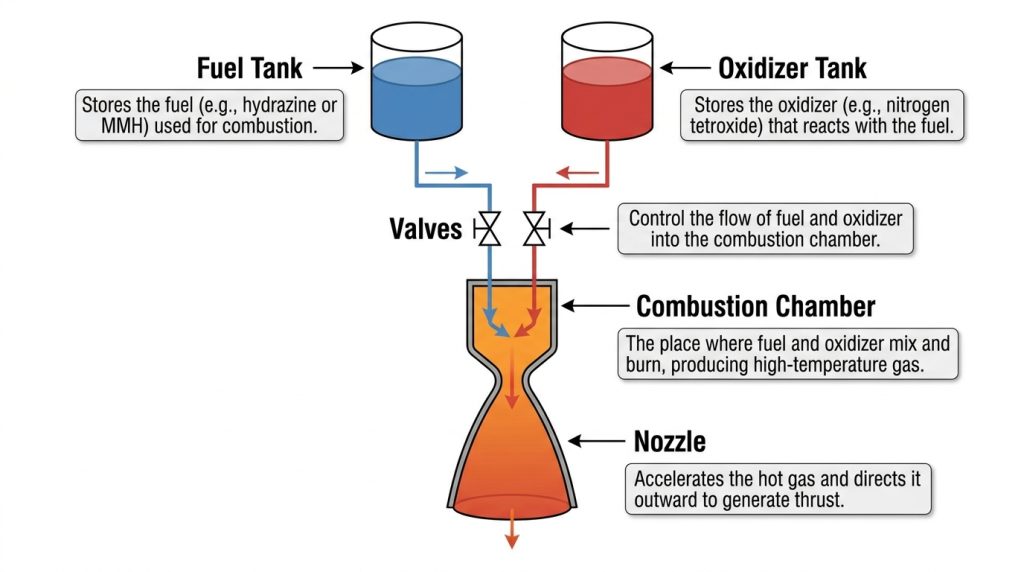
Unlike other types of thrusters, bi-propellant chemical thrusters use two different components. In the hypergolic case,two separate propellants are injected into the combustion chamber, where they react and ignite. As a result, the chemical reaction generates high-temperature and high-pressure gas. Non-hypergolic propellants require dedicated spark-ignition hardware, which adds mass and software complexity to the CubeSat bus, or catalytic system to ignite.

The term “bi-propellant” refers precisely to the use of two components (bi = two): fuel and oxidizer. This allows for greater thrust compared to other types of engines.

Hydrazine and monomethylhydrazine are the most common propellants. Nitrogen tetroxide is usually utilized as an oxidizer. These components are very effective and produce a powerful thrust. However, they are toxic and require strict storage and handling conditions.

Currently, there are safer propellant options. For example, nitrous oxide and propene. They are less toxic and easier to handle. It allows for the reduction of the risks and costs of the missions. These propellants are much better suited for small satellites. While these alternatives reduce toxicity risks, they shift the engineering burden toward high-pressure fluid management and complex thermal conditioning to prevent phase changes in the feed lines.

How Bi-Propellant Chemical Thrusters Work

bi-propellant chemical propulsion diagram showing fuel and oxidizer interaction

This type of thruster operates due to the precise interaction of the two components. Propellant and oxidizer must be stored separately and delivered into the combustion chamber at the right moment. Valves regulate the flow and ensure the correct ratio for effective combustion.

This configuration allows for high power output and rapid changes in thrust, but requires a complex design and precise system control.

Advantages of Bi-Propellant Thrusters

Bi-propellant chemical thrusters are valued for their high power and reliability:

  • High thrust
    These thrusters are capable of generating high thrust in a short time. It is important for complicated and energy-demanding maneuvers.
  • Quick response
    The system turns on and off rapidly to guarantee the precise control of the thrust.
  • Perfect for maneuvering
    Orbit correction and other complex applications in space.

Limitations of Bi-Propellant Thrusters

Despite their high power, bi-propellant thrusters have significant limitations. Especially when it comes to the small satellites.

  • Toxic propellants
    The components used for combustion are dangerous for people and require strict safety measures.
  • Complicated storage system
    Propellant and oxidizer have to be stored separately. Also, it is important to maintain pressure and temperature, which makes the design more sophisticated.
  • Thermal Management
    For CubeSats, the structural interface must act as a thermal break to protect the bus electronics  from “thermal soakback”, and the software must include “thermal wait” periods between pulses to allow for heat dissipation.
  • High cost
    Due to their complex systems and safety requirements, these thrusters are expensive.
  • Safety challenges
    Toxic components increase risks at all the operating stages.
  • Sophisticated integration
    Installation of this kind of thruster requires more resources and time, particularly for small satellites.

Bi-propellant thrusters are not the most convenient solution for CubeSats and small satellites, where simplicity, safety, and affordability are of the utmost importance.

Bi-Propellant vs Other Propulsion Systems

There are various types of propulsion systems available today.

The monopropellant system utilizes one component, the design is simpler, but the thrust is not as powerful.

Cold gas propulsion is the least complicated system. It is safe and reliable, but the efficiency is low.

Water-based propulsion is a modern and safe solution. Instead of toxic propellant, it uses water. Thus, it is easier to store and suits well for CubeSats and small satellites.

Bi-Propellant vs Water-Based Propulsion

Parameter
Bi-Propellant
Water-Based
Propellant
Toxic chemicals
Water
Complexity
Very high
Low
Safety
Low
High
Cost
High
Low
Integration
Complex
Simple

When to Choose a Bi-Propellant Thruster

Bi-propellant chemical thrusters are a powerful and effective solution, however they are not versatile. This system works well for large satellites and sophisticated missions that demand high thrust and rapid response. Although, for small satellites it usually turns out to be too complicated, expensive, and demanding in terms of safety concerns. If simplicity, low cost, safe operation, and quick integration are crucial for the mission, it is better to consider other alternatives.

When Water-Based Propulsion Is a Better Choice

Compact size and simple operations are vital for CubeSats and small satellites. Water-based propulsion systems are much easier to integrate, hence it is usually more suitable for missions that have limited resources. Water-based systems, like those from SteamJet, offer superior “volumetric specific impulse” because water can be stored unpressurized in conformally shaped tanks.

About SteamJet Space Systems

SteamJet Space Systems is a leading UK-based provider of high-performance satellite propulsion solutions. We specialise in water-based thrusters designed specifically for CubeSats and Small Satellites (SmallSats), with a strong focus on water-based thruster safety.

By pioneering the use of green propellants and intelligent thermal engineering, SteamJet enables complex LEO (Low Earth Orbit) manoeuvres — including orbital maintenance, collision avoidance, and de-orbiting — without the risks associated with toxic hydrazine or high-pressure cold gas systems, advancing green propulsion for space missions.

Steamjet Propulsion Technology

Our modular systems are engineered for seamless integration and maximum safety compliance:

Steam TunaCan Thruster: A compact, high-efficiency solution for 1U-3U CubeSats.

Steam Thruster One: Scalable propulsion for larger SmallSat constellations.

Discover how SteamJet’s sustainable space propulsion innovations are providing the safety and reliability required for the next generation of crewed and robotic missions. Contact our engineering team for technical specifications and ICDs.

Hall-effect Thruster: Electric Propulsion for CubeSats and Small Satellites

Thruster One in the foil

A Hall thruster, or Hall-effect thruster, is a type of electric propulsion system often used in space for satellite navigation. It generates thrust by accelerating charged particles, typically xenon.

This type of thruster is usually utilized for various tasks:

  • CubeSat and small satellite missions in deep space
  • orbit correction
  • station keeping

Hall-effect thrusters are among the most widely used electric propulsion technologies. Its effectiveness and stability make it suitable for long-duration space missions.

What Is a Hall-effect Thruster?

A Hall-effect thruster is an electric thruster that doesn’t burn fuel, but functions due to the acceleration of charged particles (ions).

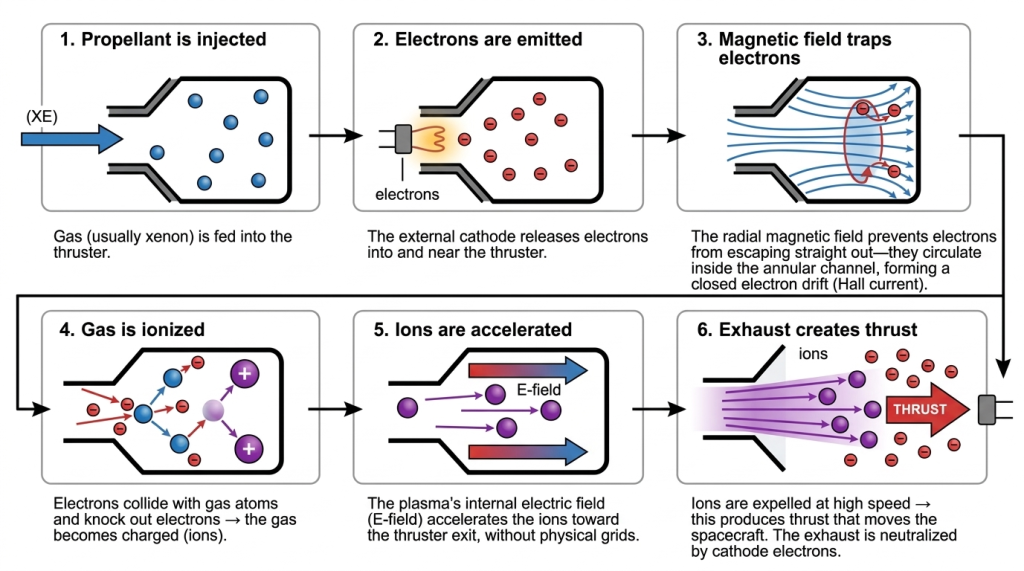
The operating principle is based on electric thrust. A radial magnetic field traps electrons that ionize the propellant inside the thruster. After that, these positive ions are accelerated with electric and magnetic fields, creating thrust.

The name “Hall” is connected to the Hall effect. It is a physics phenomenon that helps to control electrons in the thruster, which in turn makes the acceleration process more efficient.

How Hall-effect Thrusters Work

Hall Thruster Scheme: Step-by-Step Electric Propulsion Process

Advantages of Hall Thrusters

Hall-effect thrusters have several important advantages:

  • High efficiency specific impulse. These thrusters use less propellant compared to other types. Thus, they can operate longer with the same amount of propellant.
  • Stable thrust. These thrusters provide stable and predictable thrust, which is crucial for precise maneuvering in space.
  • Suitable for long-duration missions. Due to its stability and efficiency, these thrusters are well prepared to perform in missions that last months and even years.

Limitations of Hall Thrusters

Although hall-effect thrusters are very efficient, they too have a number of limitations. Especially when it comes to CubeSats and small satellites.

  • Xenon is an expensive gas that is not easy to store and transport in space.
  • A complicated system to inject the propellant, which makes the design more sophisticated.
  • Over time, the thruster’s internal walls wear out due to channel erosion. It shortens the service life.
  • This type of thruster demands significant electric resources that are not always available in small satellites.
  • Not always suitable for CubeSats.

Alternatives to Hall-effect Thrusters

There are various propulsion systems that create thrust in space.

Cold gas – simple systems that release gas. It is safe, but low efficiency.

Chemical propulsion – traditional propulsion systems. They are powerful, but expensive and complicated for small satellites.

Ion thrusters – electric systems similar to Hall-effect thrusters. These types of thrusters are effective; they demand advanced equipment and rare gases.

Water-based propulsion – a safe and available alternative. They use water instead of xenon; they are easier to store and work well for CubeSats and small satellites.

Water-Based Thrusters vs Hall Thrusters

Parameter
Hall Thruster
Water-Based Thruster
Propellant
Xenon
Water
Complexity
High
Lower
Cost
High
Low
Safety
Moderate
High
Storage
Complex
Simple

Hall-effect thrusters are well-suited for high-power missions that demand high thrust. Also, deep space and long-duration missions, where the thruster is expected to perform for months and even years.

Water-based thrusters are especially compatible with CubeSats and small satellites. They are perfect for cost-sensitive missions that require rapid deployment and simplicity in operations.

Hall-effect thrusters are powerful, but complicated and expensive thrusters. The space electric propulsion market is evolving, with an increasing focus on simpler and more affordable solutions. Water-based propulsion is a practical alternative, especially for small satellites and CubeSats.

About SteamJet Space Systems

SteamJet Space Systems is a leading UK-based provider of high-performance satellite propulsion solutions. We specialise in water-based thrusters designed specifically for CubeSats and Small Satellites (SmallSats), with a strong focus on water-based thruster safety.

By pioneering the use of green propellants and intelligent thermal engineering, SteamJet enables complex LEO (Low Earth Orbit) manoeuvres — including orbital maintenance, collision avoidance, and de-orbiting — without the risks associated with toxic hydrazine or high-pressure cold gas systems, advancing green propulsion for space missions.

Steamjet Propulsion Technology

Our modular systems are engineered for seamless integration and maximum safety compliance:

Steam TunaCan Thruster: A compact, high-efficiency solution for 1U-3U CubeSats.

Steam Thruster One: Scalable propulsion for larger SmallSat constellations.

Discover how SteamJet’s sustainable space propulsion innovations are providing the safety and reliability required for the next generation of crewed and robotic missions. Contact our engineering team (link) for technical specifications and ICDs.

From Lab to Orbit: Achieving Mission Assurance in CubeSat Propulsion

Mission assurance in CubeSat propulsion system testing and validation

Today, CubeSat technology is becoming more and more sophisticated. The cost of making a mistake in orbit is as high as ever, because these errors are often impossible to correct. That’s why building in mission assurance from the start is essential for keeping operations reliable, safe, and predictable. Especially so in the case of subsystems like propulsion. SteamJet delivers not just hardware, but dependable, mission-ready performance.

Successful testing on Earth doesn’t always guarantee that the propulsion system will provide the same performance in orbit. In space, the thruster is subjected to extreme temperatures, fluctuating pressure, and prolonged continuous stress. Frequently, many propulsion systems fail not because of the design, but due to the lack of a well-defined operational framework across the entire mission.

Engineering Mission Assurance from Day One

At SteamJet, we not only verify the system during the final testing, but also ensure to build in the mission reliability from the very start of the development. We follow ECSS standards and NASA’s Fault Management principles to develop our engineering solutions.

Traceability, Repeatability, and Validation

This is how we make sure that all decisions can be traced and the results can be reproduced. We continue validation at every stage. We don’t “test” reliability, we build it in from the start.

Fault Management: The Core of Mission Assurance

FDIR  (Fault Detection, Isolation, and Recovery) is a key process to provide reliability. It is especially important for CubeSats, because of the limited resources and the lack of constant monitoring from Earth, the system must be capable of responding autonomously to abnormal situations.

SteamJet thrusters are designed to “think” through anomalies. Using a sophisticated Fault Management (FM) architecture, we map out scenarios like thermal rises or pressure leaks to ensure rapid recovery.

At the fault detection stage, the system monitors telemetry parameters in real time. Namely, pressure, temperature, and more. The main goal is to identify discrepancies right away. The next stage is isolation. At this stage, we identify what exactly happened. And if it was a temporary sensor malfunction or an actual hardware problem. A false alarm may lead to an unnecessary mission shutdown.

The final stage is recovery. At this stage, the system turns back to the safe mode. It allows for adjusting operating parameters and reducing the load to maintain operational capabilities.

The Result: Predictable and Reliable Propulsion

By aligning with the NASA Fault Management Handbook, we guarantee a high level of mission assurance. As a result, the client not only receives a thruster itself, but a predictable and controllable part of the satellite that doesn’t create additional risks for the missions. SteamJet propulsion systems guarantee stable performance, resilience to malfunctions, and predictable behavior in orbit, even under the most challenging conditions.

About SteamJet Space Systems

SteamJet Space Systems is a leading UK-based provider of high-performance satellite propulsion solutions. We specialize in water-based thrusters designed specifically for CubeSats and Small Satellites (SmallSats), with a strong focus on water-based thruster safety.

By pioneering the use of green propellants and intelligent thermal engineering, SteamJet enables complex LEO (Low Earth Orbit) maneuvers — including orbital maintenance, collision avoidance, and de-orbiting — without the risks associated with toxic hydrazine or high-pressure cold gas systems, advancing green propulsion for space missions.

Steamjet Propulsion Technology

Our modular systems are engineered for seamless integration and maximum safety compliance:

Steam TunaCan Thruster: A compact, high-efficiency solution for 1U-3U CubeSats.

Steam Thruster One: Scalable propulsion for larger SmallSat constellations.

Discover how SteamJet’s sustainable space propulsion innovations are providing the safety and reliability required for the next generation of crewed and robotic missions. Contact our engineering team for technical specifications and ICDs.
What Is a FEEP Thruster? Field-Emission Electric Propulsion for Small Satellites

Steamjet TunaCan Thruster as a hight-thrust alternative for the CubeSats

The small satellite market has been expanding rapidly over the past decade. CubeSats are no longer used solely for educational purposes but have evolved into a vital tool for Earth observation, telecommunications, scientific research, and commercial constellations. As the mission complexity grows, so do the requirements for propulsion systems.

Missions that use CubeSats previously relied on passive orbital lifetimes. However, today’s mission operators demand precise orbit maneuvering, station-keeping, collision avoidance, constellation phasing, and reliable end-of-life deorbiting. Thus, propulsion systems have to deliver controlled thrust with high efficiency. On top of that, it has to remain compatible in terms of mass, volume, and power constraints.

What Is Field-Emission Electric Propulsion (FEEP)

Field emission electric propulsion (FEEP) is an electrostatic propulsion method. An ion thruster, which uses liquid metal as a propellant. Usually, this type of thruster uses caesium, indium, or mercury.

Thrust is generated by electrostatic acceleration of metal ions. Ionization occurs due to liquid fuel: a strong electric field is created between the metal propellant and a special electrode. Under its influence, propellant particles become charged (they become ions).

The propellant is liquified only once, in space or during vacuum testing on Earth. Therefore, during assembly, integration, and launch, the FEEP system remains solid and inert. The propellant is supplied automatically: capillary forces and surface tension cause it to flow from the tank to the emitter without pumps or pressure. Even after the mission is complete, the system does not need to be additionally deactivated; it self-passivates.

Advantages of FEEP

The FEEP system simplifies assembly, testing, and launch. It is delivered fully assembled and fueled, with the tank and propellant already inside. No additional refueling is required at the satellite manufacturing facility or at the launch site.

There are no pressurized components in the system, and propellant is safe: it is non-toxic, non-reactive, and non-radioactive. This eliminates the need for complex safety measures, saving satellite manufacturers time and money.

Main advantages include:

  • There are no high-pressure components in the design
  • No additional safety procedures are required
  • There is no refueling process before launch
  • Safe materials are used, with no toxicity, reactivity, or radiation
  • There are no special conditions for launch preparation

Limitations and Challenges of FEEP

Despite its many benefits, FEEP does have certain drawbacks.

  • Low thrust. Ion thrusters generate low thrust levels, approximately at the micronewton level. Thus, it requires long burn times to achieve significant velocity changes.
  • Erosion of the grid. Due to the impact of ions, the grids are influenced by erosion, which limits the lifetime of the thruster. 
  • System complexity. The system requires power supplies and complicated control systems.

FEEP vs. Alternative Propulsion Technologies for Small Satellites

Parameter
FEEP
Cold Gas
SteamJet Propulsion
Thrust Level
Very Low
Low–Medium
Low–Medium
Precision
Extremely High
Moderate
High
Isp
Very High
Low
Moderate
Power Consumption per Unit Thrust
Highest
Lowest
Low
Propellant Safety
High (solid, non-toxic)
Lower (pressurized gas)
Highest
Scalability
Limited
Good
Very Good
Structural Complexity
Highest
Moderate
Lowest
System size
Small
Largest
Smallest (0U)
Cost
Highest
Lower
Low

In conclusion, propulsion systems are critically important for small satellite missions. These systems enable orbital maneuvers, enhance operational flexibility, and significantly expand overall mission capabilities. In addition, propulsion extends mission lifetime by allowing station-keeping, collision avoidance, drag compensation, and controlled deorbiting at end-of-life..

Each mission has its own unique set of requirements. Different types of propulsion systems are designed to address specific needs. Field-Emission Electric Propulsion (FEEP) is well-suited for missions that demand excellent thrust control and minimal disturbance. According to NASA’s State-of-the-Art Small Spacecraft Technology report, FEEP systems are uniquely capable of delivering the fine thrust control required for complex maneuvers like station-keeping and drag compensation in Low Earth Orbit. At the same time, broader commercial and constellation missions may prioritize scalability, safety, ease of integration, and cost efficiency.

About SteamJet Space Systems

SteamJet Space Systems is a leading UK-based provider of high-performance satellite propulsion solutions. We specialise in water-based thrusters designed specifically for CubeSats and Small Satellites (SmallSats), with a strong focus on water-based thruster safety.

By pioneering the use of green propellants and intelligent thermal engineering, SteamJet enables complex LEO (Low Earth Orbit) manoeuvres — including orbital maintenance, collision avoidance, and de-orbiting — without the risks associated with toxic hydrazine or high-pressure cold gas systems, advancing green propulsion for space missions.

Steamjet Propulsion Technology

Our modular systems are engineered for seamless integration and maximum safety compliance:

Steam TunaCan Thruster: A compact, high-efficiency solution for 1U-3U CubeSats.

Steam Thruster One: Scalable propulsion for larger SmallSat constellations.

Discover how SteamJet’s sustainable space propulsion innovations are providing the safety and reliability required for the next generation of crewed and robotic missions. Contact our engineering team for technical specifications and ICDs.

SteamJet Space at Space-Comm Expo Europe 2026

SteamJet Space at SpaceComm conference 2026

SteamJet Space will attend the Space-Comm Expo Europe on 4-5 March 2026. It is one of the key space industry events in Europe that is going to take place in London.

SpaceComm Conference 2026

Satellite Propulsion Technology at the SpaceComm Conference

At Space-Comm Expo Europe 2026, our CEO Marco Pavan will introduce propulsion technologies that allows to:

  • deploy and maintain satellite constellations effectively
  • deliver precision manoeuvring and orbit control
  • perform in-orbit operations and servicing
  • preserve long-term mission sustainability

We would like  to expand the professional network in the space industry, directly engage with satellite manufacturers, integrators and mission planners.

On top of that, it is important to demonstrate the practical benefits of SteamJet’s propulsion technology for the ideal customer:

  • environmentally friendly propulsion system
  • reliability and low-risk operation
  • ITAR-free, which enables international collaboration
  • simple integration to reduce mission complexity

You are welcome to experience SteamJet propulsion models firsthand at our display.

Why the SpaceComm Conference Matters for the Space Industry

Space-Comm Expo Europe will bring together government representatives, investors, innovators and space leaders from all over the world. There will be six world-class conferences over two days, which are designed as strategic platforms to move the space industry forward.

For SteamJet Space the exhibition provides an important opportunity to engage with satellite manufacturers, in-orbit service providers, institutional and commercial stakeholders.

If you are planning to visit Space-Comm Expo Europe 2026, we are inviting you to connect with Marco Pavan, CEO and Co-Founder of SteamJet Space at stand SU6. He will be available to discuss satellite propulsion system capabilities, manoeuvring solutions, and potential collaboration opportunities.

The space sector continues to evolve and efficient, reliable propulsion systems are crucial for mission success. Our team is committed to delivering advanced propulsion systems that enhance satellite performance, extend mission lifetimes and enable sustainable in-orbit operations.

Event: Space-Comm Expo Europe 2026

Date: 4–5 March 2026

Location: London, United Kingdom

Booth: SU6

You are welcome to connect with the SteamJet Space team in advance for more information or to arrange a meeting during the exhibition.

About SteamJet Space Systems

SteamJet Space Systems is a leading UK-based provider of high-performance satellite propulsion solutions. We specialize in water-based thrusters designed specifically for CubeSats and Small Satellites (SmallSats), with a strong focus on water-based thruster safety.

By pioneering the use of green propellants and intelligent thermal engineering, SteamJet enables complex LEO (Low Earth Orbit) maneuvers — including orbital maintenance, collision avoidance, and de-orbiting — without the risks associated with toxic hydrazine or high-pressure cold gas systems, advancing green propulsion for space missions.

Steamjet Propulsion Technology

Our modular systems are engineered for seamless integration and maximum safety compliance:

Steam TunaCan Thruster: A compact, high-efficiency solution for 1U-3U CubeSats.

Steam Thruster One: Scalable propulsion for larger SmallSat constellations.

Discover how SteamJet’s sustainable space propulsion innovations are providing the safety and reliability required for the next generation of crewed and robotic missions.