
CubeSat Propulsion: How Water-Powered Systems Make Small Satellite Missions Safer

CubeSat Propulsion system powered with water

CubeSat propulsion systems are becoming an essential capability for modern small satellite missions. As CubeSats evolve from simple technology demonstrations to operational spacecraft, propulsion is required to maintain and adjust orbits, perform collision avoidance manoeuvres, manage satellite constellations, and enable controlled de-orbiting at the end of the mission.

The rapid growth of low Earth orbit activity has increased congestion and raised the importance of safe and sustainable propulsion solutions. Reliable propulsion is now a key enabler for mission longevity, regulatory compliance, and responsible use of space.
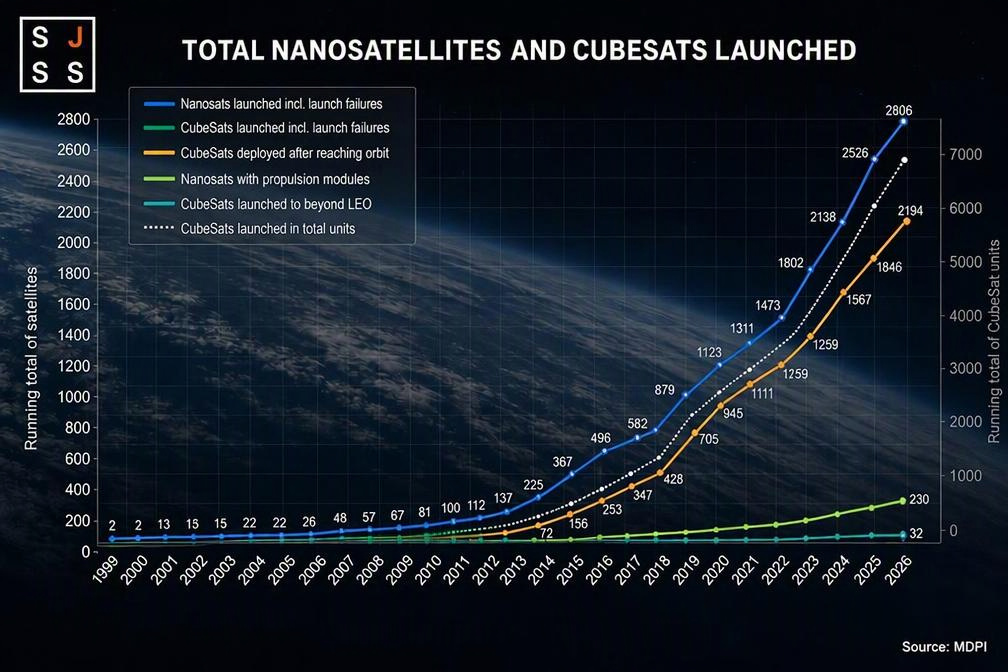
Chart showing CubeSat propulsion and launch trends from 1999 to 2026

Water-Based CubeSat Propulsion for Sustainable Space Missions

Water-based propulsion is a breakthrough technology designed to improve both mission capability and sustainability. These systems use water as the primary propellant, converting it into thrust through thermal or resistive processes. By avoiding toxic chemicals, water-powered propulsion offers a safer and more environmentally responsible alternative to conventional propulsion technologies. In practice, these advantages translate into longer mission lifetimes and greater flexibility in orbital manoeuvres.

Configuration
Service life
Orbital change
Without a propulsion system
1.6 years
None
SteamJet Thruster One
8.3 years
±170 km
SteanJet TunaCan
3 years
±35 km

Using water as a propellant makes propulsion systems easier to integrate, more affordable to operate, and safer to handle during manufacturing, testing, and launch preparation.

Low-Pressure Water as a Safe Propellant for CubeSat Propulsion

The choice of propellant has a major impact on the safety and cost of CubeSat propulsion systems. The hazards vary by substance: hydrazine, for example, is highly toxic, so its handling requires specific precautions. During fueling, hydrazine must be transported in a special tank; fueling requires leak detectors and emergency breathing equipment, evacuation of non-essential personnel, and operators wearing SCAPE suits supplied with air from outside the building (“Hydrazine: Toxic for Humans, but Satellites Love It”). These risks require strict safety procedures and often increase integration complexity and mission costs.

Water is a non-toxic, chemically stable, and widely available propellant. When used in low-pressure propulsion systems, it significantly reduces safety concerns while still providing reliable thrust for orbit control and manoeuvring. This makes water particularly well suited for CubeSat propulsion.

CubeSats are frequently launched as secondary payloads alongside larger spacecraft. In these shared launch environments, propulsion systems using hazardous propellants can pose risks to other payloads and to the launch vehicle. Water-based CubeSat propulsion minimises these risks while maintaining compatibility with rideshare missions.


Common Propulsion Use Cases

Modern propulsion systems enable a wide range of mission-critical operations that were previously difficult or impossible for small spacecraft:

  • Collision Avoidance
    Propulsion allows spacecraft to quickly change orbit in case of possible collision with another space object
  • Orbit Insertion and Correction
    Propulsion allows spacecraft to reach and fine-tune their target orbit after deployment, improving mission accuracy and flexibility.
  • Orbit Maintenance
    Atmospheric drag in low Earth orbit gradually reduces altitude. Propulsion compensates for this effect, helping maintain orbital parameters and extend mission lifetime.
  • Constellation Management
    For missions involving multiple satellites, propulsion enables precise spacing, phasing, and formation control, allowing coordinated constellation operations.
  • End-of-Life De-Orbiting
    Responsible space operations require controlled disposal. Propulsion systems provide the capability to safely de-orbit spacecraft, reducing long-term space debris.

About SteamJet Space Systems

SteamJet Space Systems is a leading UK-based provider of high-performance satellite propulsion solutions. We specialise in water-based propulsion solutions designed specifically for CubeSats and Small Satellites (SmallSats), prioritising operational safety and rapid launch integration. 

By pioneering the use of green propellants and intelligent thermal engineering, SteamJet enables complex LEO (Low Earth Orbit) manoeuvres — including orbital maintenance, collision avoidance, and de-orbiting — without the risks associated with toxic hydrazine or high-pressure cold gas systems, advancing green propulsion for space missions.

Steamjet Propulsion Technology

Our modular systems are engineered for seamless integration and maximum safety compliance:

SteamJet TunaCan Thruster: A compact, high-efficiency solution for 1U-3U CubeSats.

SteamJet TunaTank Thruster: A safe, high-performance electrothermal propulsion system.

SteamJet Thruster One: Scalable propulsion for larger SmallSat constellations.

Discover how SteamJet’s sustainable space propulsion innovations are providing the safety and reliability required for the next generation of crewed and robotic missions. Contact our engineering team for technical specifications and ICDs.
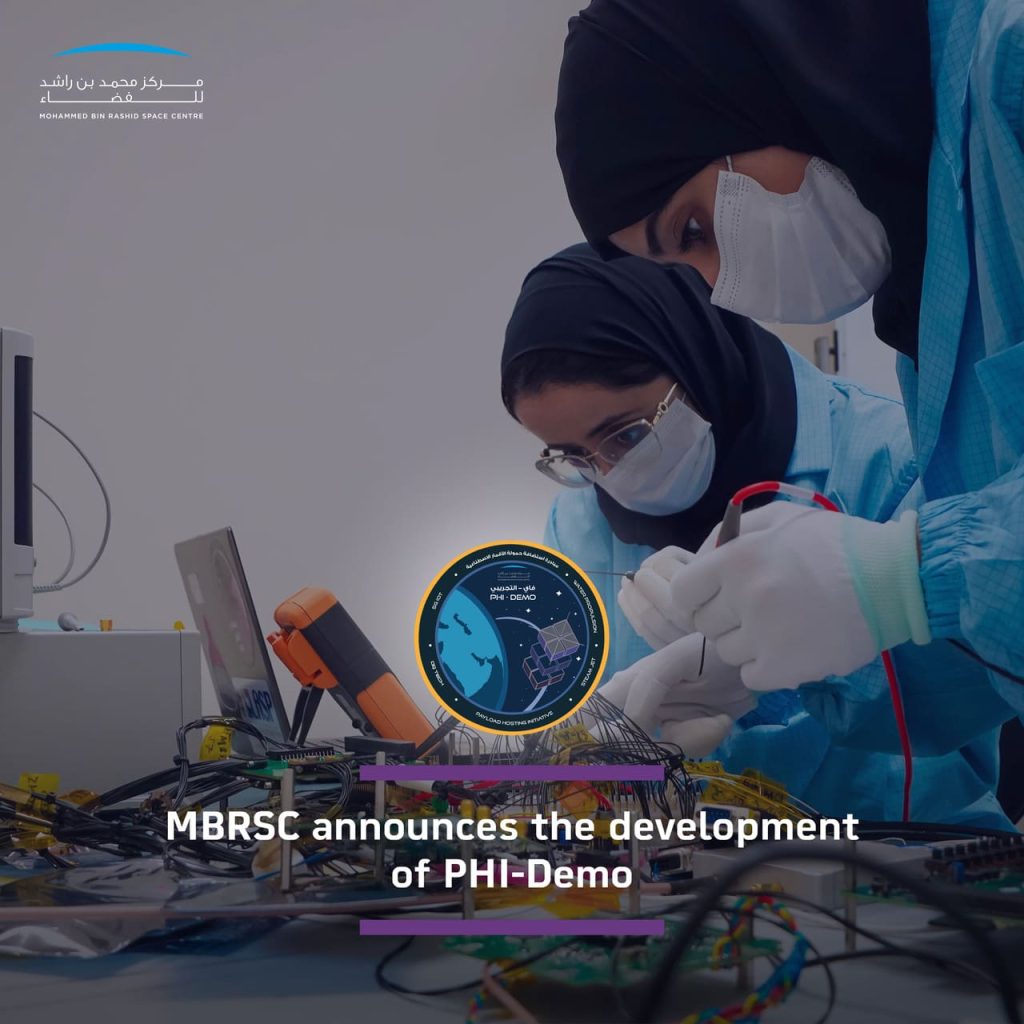
SteamJet selected by MBRSC for its first PHI-Demo mission

CubeSat Propulsion system powered with water

The Mohammed Bin Rashid Space Centre (MBRSC) announced that the first mission of the Payload Hosting Initiative (PHI)-Demo was scheduled to launch on June 27, 2023, at 15:34 GST from Russia’s Vostochny Cosmodrome aboard a Soyuz-2 rocket. The Initiative aims to provide an effective satellite platform that can host payloads for multiple purposes. The project includes a 12U modular satellite platform to be designed in partnership with OQ Technology and SteamJet Space Systems. Specifically, SteamJet Space Systems is a company specialising in sustainable CubeSat propulsion. As a result, the UAE intends to strengthen its position in space innovations.

The Payload Hosting Initiative is designed to deliver partner entities’ payloads to space and provide operational support. According to MBRSC project manager Zakaria Al Shamsi, PHI-Demo will also serve as a pathfinder for future missions under the programme and support organisations in the region in pursuing their space ambitions.

Sustainable CubeSat propulsion

Photo Source: MBRSC, https://mediaoffice.ae/en

SteamJet’s Role in PHI-Demo

Together with an innovative IoT communication payload, developed by OQ Technology, a UAE-based start-up under MBRSC’s Space Ventures initiative, and designed to store and forward data collected from IoT devices in remote areas, industries, and autonomous vehicles using state-of-the-art 5G technology, PHI-Demo will also test SteamJet’s environmentally friendly propulsion subsystem. In particular, Thruster One is going to showcase sustainable CubeSat propulsion in real mission conditions. Thruster One is a flexible water-powered resistojet. It provides high thrust while consuming very little power. Consequently, this makes it a significant innovation in sustainable CubeSat propulsion technology. Moreover, another major benefit of Thruster One is the possibility to customise its water tank size and shape to meet the mission requirements. It also improves the subsystem final integration into the spacecraft, further enhancing integration into the spacecraft and advancing CubeSat propulsion efficiency.

SteamJet Thruster One technical specifications

METRIC
VALUE
ENGINEERING IMPACT
SYSTEM WET MASS
~1.70 kg
Minimal impact on CoG and moment of inertia.
SPECIFIC IMPULSE
172 s
Efficient for orbital manoeuvring.
THRUST LEVEL
5 – 20 mN
High-fidelity control for constellation phasing.
PROPELLANT TYPE
Water/ Water-Alcohol
Green-label; simplified Range Safety approval.
TOTAL IMPULSE
1200 Ns
1200 Ns
INPUT POWER
< 20 W (Peak)
Compatible with standard CubeSat power rails.
COMMUNICATION PROTOCOL
RS 422, TTL UART
Defined by mission requirements

According to the Director-General of the MBRSC, His Excellency Salem Humaid AlMarri, this collaboration gave more opportunities for countries and entities to deploy and operate their own satellites in space. In addition, it would contribute to the advancement of satellite-related technologies.

Mission Impact and Strategic Importance

Marco Pavan, CEO of SteamJet Space Systems, expressed his appreciation for having been selected for the first PHI mission. Moreover, he sees the partnership with MBRSC as an essential step towards a greener and safer approach to propulsion in the small satellite industry.

The PHI-Demo mission demonstrates how sustainable CubeSat propulsion is shaping the future of eco-friendly, efficient, and safe satellite missions.

Last year, Mohammed Bin Rashid Space Centre (MBRSC) and the United Nations Office for Outer Space Affairs (UNOOSA) announced the Payload Hosting Initiative (“PHI”) and the signing of the Memorandum of Understanding for satellite payload hosting. The program starts in 2022 and plans to hold two satellite missions annually.

About SteamJet Space Systems

SteamJet Space Systems is a leading UK-based provider of high-performance satellite propulsion solutions. We specialise in water-based propulsion solutions designed specifically for CubeSats and Small Satellites (SmallSats), prioritising operational safety and rapid launch integration. 

By pioneering the use of green propellants and intelligent thermal engineering, SteamJet enables complex LEO (Low Earth Orbit) manoeuvres — including orbital maintenance, collision avoidance, and de-orbiting — without the risks associated with toxic hydrazine or high-pressure cold gas systems, advancing green propulsion for space missions.

Steamjet Propulsion Technology

Our modular systems are engineered for seamless integration and maximum safety compliance:

SteamJet TunaCan Thruster: A compact, high-efficiency solution for 1U-3U CubeSats.

SteamJet TunaTank Thruster: A safe, high-performance electrothermal propulsion system.

SteamJet Thruster One: Scalable propulsion for larger SmallSat constellations.

Discover how SteamJet’s sustainable space propulsion innovations are providing the safety and reliability required for the next generation of crewed and robotic missions. Contact our engineering team for technical specifications and ICDs.

SteamJet’ TunaCan Thrusters a part of the “Above the Clouds” mission

CubeSat in-Orbit Propulsion on the “Above the Clouds” Mission

Virgin Orbit announced the changes in the “Above the Clouds” mission where SteamJet Space Systems will participate with its CubeSat water propulsion thruster.

According to Virgin Orbit, the Spire CubeSat will join the smallsats of the Space Test Program and SatRevolution on the next LauncherOne mission. Notably, this will be the rocket’s fourth flight since the first launch in May 2020. Meanwhile, the “Above the Clouds” mission with a Virgin Orbit LauncherOne rocket is scheduled for launch on January 12, 2022 (UTC).

The mission “Above the Clouds” was first announced in November. At that time, the participants were the Defence Department’s Space Test Program (STP) and SatRevolution. SatRevolution is a Polish manufacturer of nanosatellite technologies. The satellite aimed to collect information about “micro” space debris in low Earth orbit. It will be done with the help of a short-range radar provided by Spire. Furthermore, SatRevolution planned to test two projects: STORK-3 as an imaging satellite and SteamSat-2, based on SteamJet’s TunaCan Thruster. SteamJet TunaCan Thruster is a compact resistojet with a unique water-powered propulsion technology, produced by SteamJet Space Systems. It demonstrates CubeSat in-orbit propulsion using a compact, water-powered resistojet designed for small satellite missions. Moreover, the TunaCan Thruster has been specifically designed for CubeSat platforms, keeping in mind all the limitations in terms of volume, power, and safety while enabling reliable in-orbit propulsion for CubeSats.

SteamJet Tunacan Thruster technical specifications

METRIC
VALUE
ENGINEERING IMPACT
SYSTEM WET MASS
~0.54 kg
Minimal impact on CoG and moment of inertia.
SPECIFIC IMPULSE
172 s
Efficient for orbital manoeuvring.
THRUST LEVEL
5 – 20 mN
High-fidelity control for constellation phasing.
PROPELLANT TYPE
Water
Green-label; simplified Range Safety approval.
TOTAL IMPULSE
Up to 219 Ns
Sufficient for multi-year station keeping & deorbiting.
INPUT POWER
< 20 W (Peak)
Compatible with standard CubeSat power rails.
COMMUNICATION PROTOCOL
RS 422, TTL UART
Defined by mission requirements.

TunaCan Thruster for External CubeSat Installation

One of the key benefits of the SteamJet TunaCan Thruster is its external installation in the TunaCan volume, which sits outside the CubeSat structure. Therefore, it has the ability to deliver CubeSat in-orbit propulsion while occupying almost no internal satellite volume. In fact, it is the only propulsion unit in the market that needs almost no volume inside the satellite. Moreover, the TunaCan Thruster is environmentally friendly, as water is the main propellant, provides a high thrust, and has a low power consumption. For more details, technical information about the TunaCan Thruster is available on our website.

About SteamJet Space Systems

SteamJet Space Systems is a leading UK-based provider of high-performance satellite propulsion solutions. We specialise in water-based propulsion solutions designed specifically for CubeSats and Small Satellites (SmallSats), prioritising operational safety and rapid launch integration. 

By pioneering the use of green propellants and intelligent thermal engineering, SteamJet enables complex LEO (Low Earth Orbit) manoeuvres — including orbital maintenance, collision avoidance, and de-orbiting — without the risks associated with toxic hydrazine or high-pressure cold gas systems, advancing green propulsion for space missions.

Steamjet Propulsion Technology

Our modular systems are engineered for seamless integration and maximum safety compliance:

SteamJet TunaCan Thruster: A compact, high-efficiency solution for 1U-3U CubeSats.

SteamJet TunaTank Thruster: A safe, high-performance electrothermal propulsion system.

SteamJet Thruster One: Scalable propulsion for larger SmallSat constellations.

Discover how SteamJet’s sustainable space propulsion innovations are providing the safety and reliability required for the next generation of crewed and robotic missions. Contact our engineering team for technical specifications and ICDs.