Bi-Propellant Chemical Propulsion for Small Satellites

water-based propulsion system for small satellites using safe propellant

Benefits, Challenges, and Alternatives

A bi-propellant chemical propulsion is a system that utilizes two components  – fuel and oxidizer. Once they come into contact, the ignition occurs and delivers thrust.

This type of thruster is often used for satellites and in deep space. They are used for maneuvers and orbit correction.

Bi-propellant chemical thrusters are a solution that is used often because they can generate high thrust and respond quickly. These characteristics make them indispensable for complex and precise space missions.

What Is a Bi-Propellant Chemical Propulsion?

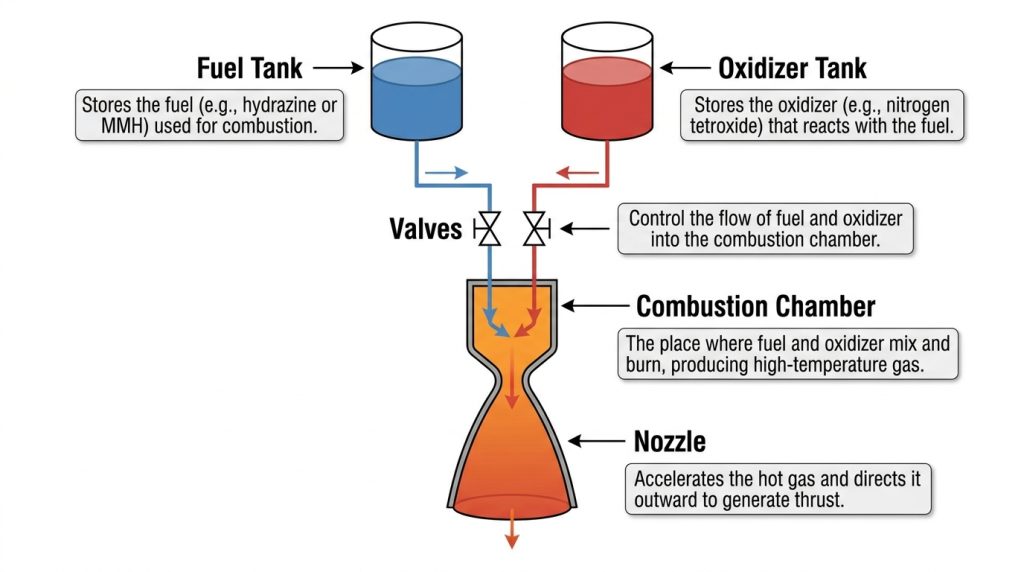
Unlike other types of thrusters, bi-propellant chemical thrusters use two different components. In the hypergolic case,two separate propellants are injected into the combustion chamber, where they react and ignite. As a result, the chemical reaction generates high-temperature and high-pressure gas. Non-hypergolic propellants require dedicated spark-ignition hardware, which adds mass and software complexity to the CubeSat bus, or catalytic system to ignite.

The term “bi-propellant” refers precisely to the use of two components (bi = two): fuel and oxidizer. This allows for greater thrust compared to other types of engines.

Hydrazine and monomethylhydrazine are the most common propellants. Nitrogen tetroxide is usually utilized as an oxidizer. These components are very effective and produce a powerful thrust. However, they are toxic and require strict storage and handling conditions.

Currently, there are safer propellant options. For example, nitrous oxide and propene. They are less toxic and easier to handle. It allows for the reduction of the risks and costs of the missions. These propellants are much better suited for small satellites. While these alternatives reduce toxicity risks, they shift the engineering burden toward high-pressure fluid management and complex thermal conditioning to prevent phase changes in the feed lines.

How Bi-Propellant Chemical Thrusters Work

bi-propellant chemical propulsion diagram showing fuel and oxidizer interaction

This type of thruster operates due to the precise interaction of the two components. Propellant and oxidizer must be stored separately and delivered into the combustion chamber at the right moment. Valves regulate the flow and ensure the correct ratio for effective combustion.

This configuration allows for high power output and rapid changes in thrust, but requires a complex design and precise system control.

Advantages of Bi-Propellant Thrusters

Bi-propellant chemical thrusters are valued for their high power and reliability:

  • High thrust
    These thrusters are capable of generating high thrust in a short time. It is important for complicated and energy-demanding maneuvers.
  • Quick response
    The system turns on and off rapidly to guarantee the precise control of the thrust.
  • Perfect for maneuvering
    Orbit correction and other complex applications in space.

Limitations of Bi-Propellant Thrusters

Despite their high power, bi-propellant thrusters have significant limitations. Especially when it comes to the small satellites.

  • Toxic propellants
    The components used for combustion are dangerous for people and require strict safety measures.
  • Complicated storage system
    Propellant and oxidizer have to be stored separately. Also, it is important to maintain pressure and temperature, which makes the design more sophisticated.
  • Thermal Management
    For CubeSats, the structural interface must act as a thermal break to protect the bus electronics  from “thermal soakback”, and the software must include “thermal wait” periods between pulses to allow for heat dissipation.
  • High cost
    Due to their complex systems and safety requirements, these thrusters are expensive.
  • Safety challenges
    Toxic components increase risks at all the operating stages.
  • Sophisticated integration
    Installation of this kind of thruster requires more resources and time, particularly for small satellites.

Bi-propellant thrusters are not the most convenient solution for CubeSats and small satellites, where simplicity, safety, and affordability are of the utmost importance.

Bi-Propellant vs Other Propulsion Systems

There are various types of propulsion systems available today.

The monopropellant system utilizes one component, the design is simpler, but the thrust is not as powerful.

Cold gas propulsion is the least complicated system. It is safe and reliable, but the efficiency is low.

Water-based propulsion is a modern and safe solution. Instead of toxic propellant, it uses water. Thus, it is easier to store and suits well for CubeSats and small satellites.

Bi-Propellant vs Water-Based Propulsion

Parameter
Bi-Propellant
Water-Based
Propellant
Toxic chemicals
Water
Complexity
Very high
Low
Safety
Low
High
Cost
High
Low
Integration
Complex
Simple

When to Choose a Bi-Propellant Thruster

Bi-propellant chemical thrusters are a powerful and effective solution, however they are not versatile. This system works well for large satellites and sophisticated missions that demand high thrust and rapid response. Although, for small satellites it usually turns out to be too complicated, expensive, and demanding in terms of safety concerns. If simplicity, low cost, safe operation, and quick integration are crucial for the mission, it is better to consider other alternatives.

When Water-Based Propulsion Is a Better Choice

Compact size and simple operations are vital for CubeSats and small satellites. Water-based propulsion systems are much easier to integrate, hence it is usually more suitable for missions that have limited resources. Water-based systems, like those from SteamJet, offer superior “volumetric specific impulse” because water can be stored unpressurized in conformally shaped tanks.

About SteamJet Space Systems

SteamJet Space Systems is a leading UK-based provider of high-performance satellite propulsion solutions. We specialise in water-based thrusters designed specifically for CubeSats and Small Satellites (SmallSats), with a strong focus on water-based thruster safety.

By pioneering the use of green propellants and intelligent thermal engineering, SteamJet enables complex LEO (Low Earth Orbit) manoeuvres — including orbital maintenance, collision avoidance, and de-orbiting — without the risks associated with toxic hydrazine or high-pressure cold gas systems, advancing green propulsion for space missions.

Steamjet Propulsion Technology

Our modular systems are engineered for seamless integration and maximum safety compliance:

Steam TunaCan Thruster: A compact, high-efficiency solution for 1U-3U CubeSats.

Steam Thruster One: Scalable propulsion for larger SmallSat constellations.

Discover how SteamJet’s sustainable space propulsion innovations are providing the safety and reliability required for the next generation of crewed and robotic missions. Contact our engineering team for technical specifications and ICDs.

Hall-effect Thruster: Electric Propulsion for CubeSats and Small Satellites

Thruster One in the foil

A Hall thruster, or Hall-effect thruster, is a type of electric propulsion system often used in space for satellite navigation. It generates thrust by accelerating charged particles, typically xenon.

This type of thruster is usually utilized for various tasks:

  • CubeSat and small satellite missions in deep space
  • orbit correction
  • station keeping

Hall-effect thrusters are among the most widely used electric propulsion technologies. Its effectiveness and stability make it suitable for long-duration space missions.

What Is a Hall-effect Thruster?

A Hall-effect thruster is an electric thruster that doesn’t burn fuel, but functions due to the acceleration of charged particles (ions).

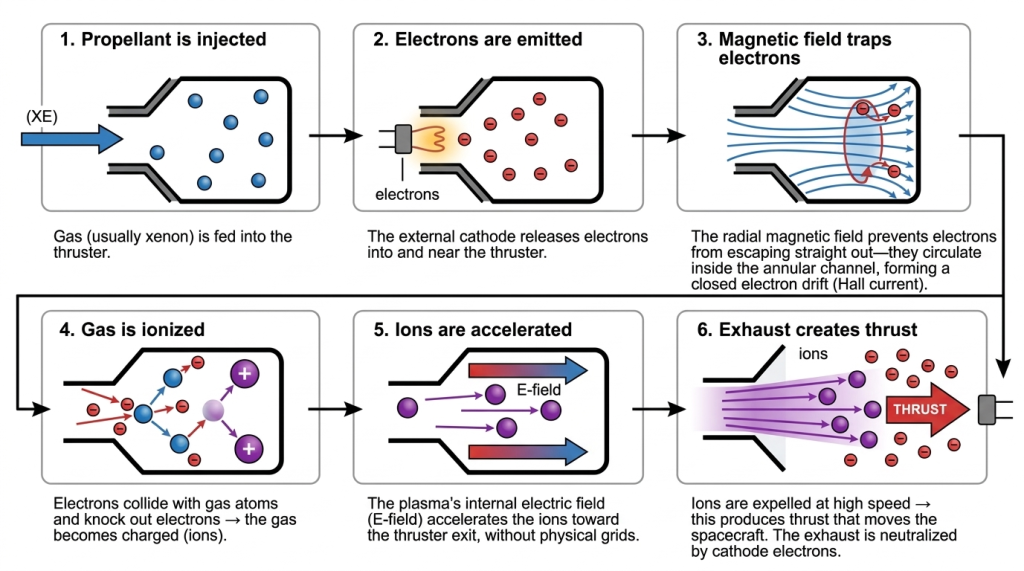
The operating principle is based on electric thrust. A radial magnetic field traps electrons that ionize the propellant inside the thruster. After that, these positive ions are accelerated with electric and magnetic fields, creating thrust.

The name “Hall” is connected to the Hall effect. It is a physics phenomenon that helps to control electrons in the thruster, which in turn makes the acceleration process more efficient.

How Hall-effect Thrusters Work

Hall Thruster Scheme: Step-by-Step Electric Propulsion Process

Advantages of Hall Thrusters

Hall-effect thrusters have several important advantages:

  • High efficiency specific impulse. These thrusters use less propellant compared to other types. Thus, they can operate longer with the same amount of propellant.
  • Stable thrust. These thrusters provide stable and predictable thrust, which is crucial for precise maneuvering in space.
  • Suitable for long-duration missions. Due to its stability and efficiency, these thrusters are well prepared to perform in missions that last months and even years.

Limitations of Hall Thrusters

Although hall-effect thrusters are very efficient, they too have a number of limitations. Especially when it comes to CubeSats and small satellites.

  • Xenon is an expensive gas that is not easy to store and transport in space.
  • A complicated system to inject the propellant, which makes the design more sophisticated.
  • Over time, the thruster’s internal walls wear out due to channel erosion. It shortens the service life.
  • This type of thruster demands significant electric resources that are not always available in small satellites.
  • Not always suitable for CubeSats.

Alternatives to Hall-effect Thrusters

There are various propulsion systems that create thrust in space.

Cold gas – simple systems that release gas. It is safe, but low efficiency.

Chemical propulsion – traditional propulsion systems. They are powerful, but expensive and complicated for small satellites.

Ion thrusters – electric systems similar to Hall-effect thrusters. These types of thrusters are effective; they demand advanced equipment and rare gases.

Water-based propulsion – a safe and available alternative. They use water instead of xenon; they are easier to store and work well for CubeSats and small satellites.

Water-Based Thrusters vs Hall Thrusters

Parameter
Hall Thruster
Water-Based Thruster
Propellant
Xenon
Water
Complexity
High
Lower
Cost
High
Low
Safety
Moderate
High
Storage
Complex
Simple

Hall-effect thrusters are well-suited for high-power missions that demand high thrust. Also, deep space and long-duration missions, where the thruster is expected to perform for months and even years.

Water-based thrusters are especially compatible with CubeSats and small satellites. They are perfect for cost-sensitive missions that require rapid deployment and simplicity in operations.

Hall-effect thrusters are powerful, but complicated and expensive thrusters. The space electric propulsion market is evolving, with an increasing focus on simpler and more affordable solutions. Water-based propulsion is a practical alternative, especially for small satellites and CubeSats.

About SteamJet Space Systems

SteamJet Space Systems is a leading UK-based provider of high-performance satellite propulsion solutions. We specialise in water-based thrusters designed specifically for CubeSats and Small Satellites (SmallSats), with a strong focus on water-based thruster safety.

By pioneering the use of green propellants and intelligent thermal engineering, SteamJet enables complex LEO (Low Earth Orbit) manoeuvres — including orbital maintenance, collision avoidance, and de-orbiting — without the risks associated with toxic hydrazine or high-pressure cold gas systems, advancing green propulsion for space missions.

Steamjet Propulsion Technology

Our modular systems are engineered for seamless integration and maximum safety compliance:

Steam TunaCan Thruster: A compact, high-efficiency solution for 1U-3U CubeSats.

Steam Thruster One: Scalable propulsion for larger SmallSat constellations.

Discover how SteamJet’s sustainable space propulsion innovations are providing the safety and reliability required for the next generation of crewed and robotic missions. Contact our engineering team (link) for technical specifications and ICDs.

From Lab to Orbit: Achieving Mission Assurance in CubeSat Propulsion

Mission assurance in CubeSat propulsion system testing and validation

Today, CubeSat technology is becoming more and more sophisticated. The cost of making a mistake in orbit is as high as ever, because these errors are often impossible to correct. That’s why building in mission assurance from the start is essential for keeping operations reliable, safe, and predictable. Especially so in the case of subsystems like propulsion. SteamJet delivers not just hardware, but dependable, mission-ready performance.

Successful testing on Earth doesn’t always guarantee that the propulsion system will provide the same performance in orbit. In space, the thruster is subjected to extreme temperatures, fluctuating pressure, and prolonged continuous stress. Frequently, many propulsion systems fail not because of the design, but due to the lack of a well-defined operational framework across the entire mission.

Engineering Mission Assurance from Day One

At SteamJet, we not only verify the system during the final testing, but also ensure to build in the mission reliability from the very start of the development. We follow ECSS standards and NASA’s Fault Management principles to develop our engineering solutions.

Traceability, Repeatability, and Validation

This is how we make sure that all decisions can be traced and the results can be reproduced. We continue validation at every stage. We don’t “test” reliability, we build it in from the start.

Fault Management: The Core of Mission Assurance

FDIR  (Fault Detection, Isolation, and Recovery) is a key process to provide reliability. It is especially important for CubeSats, because of the limited resources and the lack of constant monitoring from Earth, the system must be capable of responding autonomously to abnormal situations.

SteamJet thrusters are designed to “think” through anomalies. Using a sophisticated Fault Management (FM) architecture, we map out scenarios like thermal rises or pressure leaks to ensure rapid recovery.

At the fault detection stage, the system monitors telemetry parameters in real time. Namely, pressure, temperature, and more. The main goal is to identify discrepancies right away. The next stage is isolation. At this stage, we identify what exactly happened. And if it was a temporary sensor malfunction or an actual hardware problem. A false alarm may lead to an unnecessary mission shutdown.

The final stage is recovery. At this stage, the system turns back to the safe mode. It allows for adjusting operating parameters and reducing the load to maintain operational capabilities.

The Result: Predictable and Reliable Propulsion

By aligning with the NASA Fault Management Handbook, we guarantee a high level of mission assurance. As a result, the client not only receives a thruster itself, but a predictable and controllable part of the satellite that doesn’t create additional risks for the missions. SteamJet propulsion systems guarantee stable performance, resilience to malfunctions, and predictable behavior in orbit, even under the most challenging conditions.

About SteamJet Space Systems

SteamJet Space Systems is a leading UK-based provider of high-performance satellite propulsion solutions. We specialize in water-based thrusters designed specifically for CubeSats and Small Satellites (SmallSats), with a strong focus on water-based thruster safety.

By pioneering the use of green propellants and intelligent thermal engineering, SteamJet enables complex LEO (Low Earth Orbit) maneuvers — including orbital maintenance, collision avoidance, and de-orbiting — without the risks associated with toxic hydrazine or high-pressure cold gas systems, advancing green propulsion for space missions.

Steamjet Propulsion Technology

Our modular systems are engineered for seamless integration and maximum safety compliance:

Steam TunaCan Thruster: A compact, high-efficiency solution for 1U-3U CubeSats.

Steam Thruster One: Scalable propulsion for larger SmallSat constellations.

Discover how SteamJet’s sustainable space propulsion innovations are providing the safety and reliability required for the next generation of crewed and robotic missions. Contact our engineering team for technical specifications and ICDs.

What Is a FEEP Thruster? Field-Emission Electric Propulsion for Small Satellites

Steamjet TunaCan Thruster as a hight-thrust alternative for the CubeSats

The small satellite market has been expanding rapidly over the past decade. CubeSats are no longer used solely for educational purposes but have evolved into a vital tool for Earth observation, telecommunications, scientific research, and commercial constellations. As the mission complexity grows, so do the requirements for propulsion systems.

Missions that use CubeSats previously relied on passive orbital lifetimes. However, today’s mission operators demand precise orbit maneuvering, station-keeping, collision avoidance, constellation phasing, and reliable end-of-life deorbiting. Thus, propulsion systems have to deliver controlled thrust with high efficiency. On top of that, it has to remain compatible in terms of mass, volume, and power constraints.

What Is Field-Emission Electric Propulsion (FEEP)

Field emission electric propulsion (FEEP) is an electrostatic propulsion method. An ion thruster, which uses liquid metal as a propellant. Usually, this type of thruster uses caesium, indium, or mercury.

Thrust is generated by electrostatic acceleration of metal ions. Ionization occurs due to liquid fuel: a strong electric field is created between the metal propellant and a special electrode. Under its influence, propellant particles become charged (they become ions).

The propellant is liquified only once, in space or during vacuum testing on Earth. Therefore, during assembly, integration, and launch, the FEEP system remains solid and inert. The propellant is supplied automatically: capillary forces and surface tension cause it to flow from the tank to the emitter without pumps or pressure. Even after the mission is complete, the system does not need to be additionally deactivated; it self-passivates.

Advantages of FEEP

The FEEP system simplifies assembly, testing, and launch. It is delivered fully assembled and fueled, with the tank and propellant already inside. No additional refueling is required at the satellite manufacturing facility or at the launch site.

There are no pressurized components in the system, and propellant is safe: it is non-toxic, non-reactive, and non-radioactive. This eliminates the need for complex safety measures, saving satellite manufacturers time and money.

Main advantages include:

  • There are no high-pressure components in the design
  • No additional safety procedures are required
  • There is no refueling process before launch
  • Safe materials are used, with no toxicity, reactivity, or radiation
  • There are no special conditions for launch preparation

Limitations and Challenges of FEEP

Despite its many benefits, FEEP does have certain drawbacks.

  • Low thrust. Ion thrusters generate low thrust levels, approximately at the micronewton level. Thus, it requires long burn times to achieve significant velocity changes.
  • Erosion of the grid. Due to the impact of ions, the grids are influenced by erosion, which limits the lifetime of the thruster. 
  • System complexity. The system requires power supplies and complicated control systems.

FEEP vs. Alternative Propulsion Technologies for Small Satellites

Parameter
FEEP
Cold Gas
SteamJet Propulsion
Thrust Level
Very Low
Low–Medium
Low–Medium
Precision
Extremely High
Moderate
High
Isp
Very High
Low
Moderate
Power Consumption per Unit Thrust
Highest
Lowest
Low
Propellant Safety
High (solid, non-toxic)
Lower (pressurized gas)
Highest
Scalability
Limited
Good
Very Good
Structural Complexity
Highest
Moderate
Lowest
System size
Small
Largest
Smallest (0U)
Cost
Highest
Lower
Low

In conclusion, propulsion systems are critically important for small satellite missions. These systems enable orbital maneuvers, enhance operational flexibility, and significantly expand overall mission capabilities. In addition, propulsion extends mission lifetime by allowing station-keeping, collision avoidance, drag compensation, and controlled deorbiting at end-of-life..

Each mission has its own unique set of requirements. Different types of propulsion systems are designed to address specific needs. Field-Emission Electric Propulsion (FEEP) is well-suited for missions that demand excellent thrust control and minimal disturbance. According to NASA’s State-of-the-Art Small Spacecraft Technology report, FEEP systems are uniquely capable of delivering the fine thrust control required for complex maneuvers like station-keeping and drag compensation in Low Earth Orbit. At the same time, broader commercial and constellation missions may prioritize scalability, safety, ease of integration, and cost efficiency.

About SteamJet Space Systems

SteamJet Space Systems is a leading UK-based provider of high-performance satellite propulsion solutions. We specialise in water-based thrusters designed specifically for CubeSats and Small Satellites (SmallSats), with a strong focus on water-based thruster safety.

By pioneering the use of green propellants and intelligent thermal engineering, SteamJet enables complex LEO (Low Earth Orbit) manoeuvres — including orbital maintenance, collision avoidance, and de-orbiting — without the risks associated with toxic hydrazine or high-pressure cold gas systems, advancing green propulsion for space missions.

Steamjet Propulsion Technology

Our modular systems are engineered for seamless integration and maximum safety compliance:

Steam TunaCan Thruster: A compact, high-efficiency solution for 1U-3U CubeSats.

Steam Thruster One: Scalable propulsion for larger SmallSat constellations.

Discover how SteamJet’s sustainable space propulsion innovations are providing the safety and reliability required for the next generation of crewed and robotic missions. Contact our engineering team for technical specifications and ICDs.

SteamJet Space at Space-Comm Expo Europe 2026

SteamJet Space at SpaceComm conference 2026

SteamJet Space will attend the Space-Comm Expo Europe on 4-5 March 2026. It is one of the key space industry events in Europe that is going to take place in London.

SpaceComm Conference 2026

Satellite Propulsion Technology at the SpaceComm Conference

At Space-Comm Expo Europe 2026, our CEO Marco Pavan will introduce propulsion technologies that allows to:

  • deploy and maintain satellite constellations effectively
  • deliver precision manoeuvring and orbit control
  • perform in-orbit operations and servicing
  • preserve long-term mission sustainability

We would like  to expand the professional network in the space industry, directly engage with satellite manufacturers, integrators and mission planners.

On top of that, it is important to demonstrate the practical benefits of SteamJet’s propulsion technology for the ideal customer:

  • environmentally friendly propulsion system
  • reliability and low-risk operation
  • ITAR-free, which enables international collaboration
  • simple integration to reduce mission complexity

You are welcome to experience SteamJet propulsion models firsthand at our display.

Why the SpaceComm Conference Matters for the Space Industry

Space-Comm Expo Europe will bring together government representatives, investors, innovators and space leaders from all over the world. There will be six world-class conferences over two days, which are designed as strategic platforms to move the space industry forward.

For SteamJet Space the exhibition provides an important opportunity to engage with satellite manufacturers, in-orbit service providers, institutional and commercial stakeholders.

If you are planning to visit Space-Comm Expo Europe 2026, we are inviting you to connect with Marco Pavan, CEO and Co-Founder of SteamJet Space at stand SU6. He will be available to discuss satellite propulsion system capabilities, manoeuvring solutions, and potential collaboration opportunities.

The space sector continues to evolve and efficient, reliable propulsion systems are crucial for mission success. Our team is committed to delivering advanced propulsion systems that enhance satellite performance, extend mission lifetimes and enable sustainable in-orbit operations.

Event: Space-Comm Expo Europe 2026

Date: 4–5 March 2026

Location: London, United Kingdom

Booth: SU6

You are welcome to connect with the SteamJet Space team in advance for more information or to arrange a meeting during the exhibition.

About SteamJet Space Systems

SteamJet Space Systems is a leading UK-based provider of high-performance satellite propulsion solutions. We specialize in water-based thrusters designed specifically for CubeSats and Small Satellites (SmallSats), with a strong focus on water-based thruster safety.

By pioneering the use of green propellants and intelligent thermal engineering, SteamJet enables complex LEO (Low Earth Orbit) maneuvers — including orbital maintenance, collision avoidance, and de-orbiting — without the risks associated with toxic hydrazine or high-pressure cold gas systems, advancing green propulsion for space missions.

Steamjet Propulsion Technology

Our modular systems are engineered for seamless integration and maximum safety compliance:

Steam TunaCan Thruster: A compact, high-efficiency solution for 1U-3U CubeSats.

Steam Thruster One: Scalable propulsion for larger SmallSat constellations.

Discover how SteamJet’s sustainable space propulsion innovations are providing the safety and reliability required for the next generation of crewed and robotic missions.

Cold Gas Propulsion for Small Satellites

Steam TunaCan Thruster

As the space industry shifts toward more compact and agile platforms, selecting the right small satellite propulsion system has become a critical mission-design decision. Among the various technologies available, cold gas propulsion for small satellites remains one of the most reliable and widely adopted solutions due to its inherent simplicity and safety. By utilizing the controlled expansion of a pressurized gas to generate thrust, these systems offer a low-complexity alternative to more power-intensive electric propulsion, making them an ideal choice for the growing CubeSat and SmallSat markets.

Propulsion is essential for today’s small satellite operations. They enable:

  • Collision avoidance
  • Constellation management
  • Orbital maneuvers
  • Deorbiting
  • Station keeping
  • Attitude control

There are various propulsion systems available for small satellites. Cold gas propulsion systems are one of them. And it is one of the simplest and most reliable solutions.

What Is Cold Gas Propulsion?

Cold gas propulsion generates thrust without heating the propellant. It relies on the expansion of pressurized gas.

The system consists of:

  • Propellant tank (high-pressure storage)
  • Filter
  • Valve system
  • Nozzle

The propellant is stored under high pressure. It flows through the valve into the nozzle. Thrust is produced when the gas expands. The thrust generated is proportional to the pressure inside the tank.

Since there is no heater, the system doesn’t add thermal energy to the working fluid. Instead, it converts stored pressure energy into kinetic energy at the nozzle exit.

System Layout

Basic construction includes a tank, solenoid valve, and nozzle.

The pressure is reduced before the propellant reaches the thruster, allowing controlled and repeatable pulses.

Cold Gas vs. Electrothermal Propulsion

The primary difference between cold gas and electrothermal propulsion lies in the heater.

An electrothermal propulsion system includes:

  • Heat exchanger
  • Electric heater

In this type of system, the propellant (for example, water) is heated before expansion. Increasing temperature increases exhaust velocity and improves specific impulse.

When the heater and heat exchanger are removed, the system effectively becomes a cold gas thruster.

Performance Trade-Off

Cold gas systems do not add thermal energy. That is why their performance is typically 2–3 times lower compared to electrothermal systems.

However, there are certain benefits to eliminating the heater:

  • Lower electrical power demand
  • Reduced component count
  • Higher overall reliability
  • Simpler integration

In some missions, this simplicity is more valuable than peak efficiency.

Propellants Used in Cold Gas Systems

Cold gas propulsion requires propellants that can operate without additional heating.

Compressed gases:

  • Nitrogen (N₂)
  • Hydrogen (H₂)
  • Argon (Ar)
  • Helium (He)

Liquids stored at saturation conditions:

  • Nitrous oxide (N₂O)
  • Propane
  • Ethane
  • Carbon dioxide (CO₂)

Water is not suitable for cold gas mode. Without heating, it evaporates too slowly to generate meaningful thrust. That is why water-based propulsion systems operate in electrothermal mode.

Cold Gas Propulsion Limitations

The system is simple, but it has several important drawbacks:

  1.  Lower Specific Impulse
    Compared to electrothermal or electric propulsion systems, cold gas engines deliver significantly lower efficiency.

  2. High-Pressure Storage Requirements
    The system uses high-pressure tanks, which require rigorous leak testing and safety validation.

  3. System Complexity in Gas Handling
    While the thrust generation principle is simple, the storage and regulation of high-pressure gas involves regulators, valves, sensors, and safety components that must operate reliably in space.

Cold gas propulsion represents one of the most mature and reliable propulsion technologies available for small satellites. By relying solely on stored pressure energy, it eliminates the need for heaters and complex thermal subsystems.

While its specific impulse is lower than electrothermal alternatives, its robustness, simplicity, and operational predictability ensure that cold gas propulsion continues to play an important role. As noted in the NASA State-of-the-Art for Small Satellite Propulsion Systems, these systems remain a baseline for SmallSat missions due to their high reliability and low integration risk.

Comparison: Cold Gas vs. Electrothermal Propulsion

Feature
Cold Gas Propulsion
Electrothermal Propulsion
Heating Mechanism
No heater; relies on expansion of pressurized gas.
Includes an electric heater and heat exchanger.
Performance (Specific Impulse)
Typically 2–3 times lower efficiency.
Higher exhaust velocity and improved specific impulse.
Power Consumption
Lower electrical power demand.
Higher power required to operate the heating system.
System Complexity
Simpler with fewer components (no thermal subsystems).
More complex due to added heaters and heat exchangers.
Reliability
Higher overall reliability due to simplicity.
Slightly reduced due to more components and thermal stress.
Common Propellants
Nitrogen, Hydrogen, Argon, Helium, CO₂.
Water (requires heating to evaporate and generate thrust).

The primary difference between cold gas and electrothermal propulsion is that cold gas systems lack a heater, making them simpler and more reliable, while electrothermal systems offer 2-3 times higher performance by heating the propellant.

About SteamJet Space Systems

SteamJet Space Systems is a leading UK-based provider of high-performance satellite propulsion solutions. We specialise in water-based thrusters designed specifically for CubeSats and Small Satellites (SmallSats), with a strong focus on water-based thruster safety.

By pioneering the use of green propellants and intelligent thermal engineering, SteamJet enables complex LEO (Low Earth Orbit) manoeuvres — including orbital maintenance, collision avoidance, and de-orbiting — without the risks associated with toxic hydrazine or high-pressure cold gas systems, advancing green propulsion for space missions.

Steamjet Propulsion Technology

Our modular systems are engineered for seamless integration and maximum safety compliance:

Discover how SteamJet’s sustainable space propulsion innovations are providing the safety and reliability required for the next generation of crewed and robotic missions. Contact our engineering team (link) for technical specifications and ICDs.

SteamJet Thruster One: Testing and Flight Readiness for Artemis II Mission

SteamJet Thruster One

SteamJet Thruster One will perform an orbit correction for South Korea’s K-Rad Cube satellite during the upcoming Artemis II mission. South Korean NaraSpace designed and built the K-Rad Cube satellite for NASA’s historic Artemis II mission, the first crewed lunar mission in over 50 years.

Once deployed into a highly elliptical orbit, the satellite will face an immediate challenge because its first perigee passes through Earth’s upper atmosphere. SteamJet Thruster One will provide the orbital correction required to prevent the satellite’s re-entry into the atmosphere.

Before any mission, SteamJet thrusters undergo a meticulous testing process to guarantee performance and reliability. Fuel tank burst pressure testing was also completed to meet the elevated safety standards required for the crewed Artemis II mission.

In addition to burst testing, engineers conducted acceptance testing on the SteamJet Thruster One for Artemis II, following established industry practices. Acceptance test campaign consists of several phases:

  • Functional test
  • Vibration dynamic test
  • Thermal vacuum test
  • Leak rate

Functional test

Functional testing verifies the thruster’s performance in all operational modes. The flight profile details all settings relevant for in-orbit operation aboard the satellite. For the Artemis II mission there are two main operational modes: commissioning and thrust.

The commissioning mode is the first operational state activated post-launch. It purges residual gases from the fuel lines.

For the Artemis II mission the thruster was optimized to deliver high thrust, operating nearly in continuous mode. This configuration ensures the mission objective is met, raising the orbit perigee to over 180 km during the first orbit.

An impulse of 240 Ns was generated in order to accomplish this goal. The test consisted of a sequence of cycles that included thrust generation, heating without firing and system health checks.  The manoeuvre was split in two parts, with a cooling period in between.

Telemetry data of a firing block:

Telemetry data of a firing block

The results of the overall functional thrust mode test are as follows:

  • Water Tanks initial condition: 350g of water on each tank at a pressure of 3.4 atm
  • Water consumed: 167.0 g
  • Total Impulse: 240 – 260 Ns
  • Thrust: 15 – 17 mN
  • Test duration: 11h 25m (including cool down period)

Vibration dynamic test

During the vibration dynamic test, engineers simulate operational conditions to ensure all components meet quality standards.

The vibration stand main specifications were the following:

Parameter
Value
Stand
ETS_L620M.std
Maximum payload weight [kg]
300.0
Reduced mass of the moving system [kg]
6.0
Operating frequency range [Hz]
3.00 – 3500.00
Buoyancy force [N]
6000.00
Maximum speed [m/s]
1.80
Maximum movement [mm]
25.00
Maximum acceleration [m/s2]
980.00

Thruster mounting for vibrations testing along X,Y,Z:

Thruster mounting for vibrations testing

During and after vibration dynamic testing, all thruster parameters remained within normal limits and met specifications.

Thermal vacuum test

The main goal of the thermal vacuum test is to check that the thruster performs and survives extreme temperatures encountered in space. Additionally, the test reveals any hidden issues early, reducing the chance of problems during the first hours of flight.

Engineers successfully completed all functional checks at the different dwell temperatures. The total mass loss during Thermal Vacuum was 0.7g, or 0.059 %, which confirms that the integrity of the thruster is maintained.

Leak rate

After the thermal vacuum test, engineers measured the leak rate. The thruster was fuelled and left for 20 hours in vacuum conditions while monitoring pressure and temperature values. Engineers detected no leaks during this 20-hour period.

Thruster telemetry during leak rate test:

Thruster telemetry during leak rate test

Conclusion

SteamJet Thruster One has successfully completed all testing required for the Artemis II mission. Functional, vibration, thermal vacuum, and leak rate tests confirmed that the thruster performs reliably in all operational modes, maintains its integrity under extreme conditions, and meets mission requirements. With verified performance and no detected leaks, the thruster is fully flight-ready to perform the critical orbital correction for the K-Rad Cube satellite.

About SteamJet Space Systems

SteamJet Space Systems is a leading UK-based provider of high-performance satellite propulsion solutions. We specialize in water-based thrusters designed specifically for CubeSats and Small Satellites (SmallSats), with a strong focus on water-based thruster safety.

By pioneering the use of green propellants and intelligent thermal engineering, SteamJet enables complex LEO (Low Earth Orbit) maneuvers — including orbital maintenance, collision avoidance, and de-orbiting — without the risks of toxic hydrazine or high-pressure cold gas systems. This approach advances green propulsion for space missions.

Steamjet Propulsion Technology

Our modular systems are engineered for seamless integration and maximum safety compliance:

Steam TunaCan Thruster: A compact, high-efficiency solution for 1U-3U CubeSats.

Steam Thruster One: Scalable propulsion for larger SmallSat constellations.

Discover how SteamJet’s sustainable space propulsion innovations are providing the safety and reliability required for the next generation of crewed and robotic missions. Contact our engineering team for technical specifications and ICDs.

Fuel Tank Burst Pressure Testing for Artemis II Mission Qualification

tank burst test

Spacecraft Propulsion Safety for a Crewed Artemis II Mission

Tank burst safety is a critical requirement for crewed space missions. For Artemis II mission, SteamJet Space Systems is preparing to demonstrate spacecraft propulsion capabilities by performing an in-orbit correction for South Korea’s K-RadCube satellite. As a result, this manoeuvre is designed to prevent premature atmospheric re-entry and relies on a simple principle: using water as the propellant.

Artemis II Mission Safety Requirements

Artemis II is a manned mission; therefore, safety and reliability are imperative. Every element of the propulsion system must withstand conditions well beyond nominal operation. In particular, the pressurised, space-grade propellant tank must safely tolerate extreme internal pressures. This capability is a critical factor for CubeSat safety and crewed mission compatibility.

For this reason, the SteamJet team performed fuel tank burst pressure testing last year to confirm that the pressurized tank meets the Design Burst Pressure requirement defined in ANSI/AIAA S-080A-2018, Section 10.4.10, as part of CubeSat mission qualification.

Why Fuel Tank Burst Testing Is Required

A fuel tank must demonstrate compliance with a burst factor (BF) of 2.5. In this case, the maximum Design Pressure (MDP) is 5.67 bar. Therefore, the required design burst pressure (DBP) is calculated as 2.5 times MDP, which results in 14.18 bar.

Design Burst Pressure = BF x ECF x MDP = 2.5 x 1.0 x 5.67 = 14.18 bar

Test Environmental Conditions

The test was conducted near ambient temperature, approximately 20°C. As a result, the environmental correction factor (ECF) remained 1.0.

During the test, pressure increased progressively at a controlled rate. This approach prevented transient load spikes or dynamic effects, thereby ensuring representative water-based thruster safety conditions.

Tank Burst Test Setup

The team positioned the pressurised tank inside a safe container to protect against shrapnel or fluid jetting in the event of rupture. Next, they connected it to a water pump designed to exceed the required burst pressure through pressure-rated fittings and hoses. Pressure gauges and sensors continuously monitored the internal pressure. In addition, temperature sensors monitored ambient conditions. The team placed them near the tank, which is consistent with space-grade propellant tank testing practices.

Instrumentation and Monitoring

The team checked the system for leaks and functionality in advance and then filled it with water. After that, all instrumentation connected to a data acquisition system for continuous monitoring and recording throughout the test. 

Because the electronic pressure sensor was limited to 30 bar, the team monitored higher pressure levels using an analogue gauge. A schematic of the test setup is shown below.

fuel tank burst testing setup

Tank Burst Test Procedure

The test began with a leak check at 5.67 bar to confirm the system was secure. Pressure was then gradually increased until it reached the calculated Design Burst Pressure of 14.18 bar. At this stage, the team held the pressure for about two minutes to verify tank integrity in line with CubeSat safety requirements.

Because the digital sensor could only measure up to 30 bar, it was removed, and the system was depressurised before continuing with the analogue gauge. Afterwards, pressure increased steadily until the tank burst. The team recorded the exact burst pressure, along with time, temperature, and the location and type of failure. Throughout the test, the team continuously monitored the system and logged all data from a safe distance.

fuel tank

Failure Location and Structural Behaviour

The tank was first pressurised up to 30 bar without rupture. After depressurisation and removal of the digital pressure sensors, the team re-pressurised the tank in a continuous event. The tank burst at 90 bar. Notably, this observed burst pressure far exceeds the required design burst pressure of 14.18 bar.

As a result, the test confirmed that the fuel tank is capable of exceeding the minimum requirement with a substantial margin, supporting CubeSat mission qualification and crewed mission safety.

tank burst test

Failure Mode and Stress Concentration

The failure happened along the edge of the tank, where stress concentrations are highest. It is consistent with the results of stress analysis. The tank edges and the centers of the smaller faces are the key areas of stress concentration.

Parameter
Required (DBP)
Actual Result
Safety Margin
Pressure (bar)
14.18 bar
90 bar
~ 6.3x
Standard
ANSI/AIAA S-080A-2018
Compliant
Temperature
20°C (Ambient)
20°C

In conclusion, the design burst pressure of 14.18 was successfully verified. The final burst pressure recorded was 90 bar. Therefore, the results demonstrate an excellent safety margin of the tank design for space-grade propellant tanks used in green propulsion systems.

About SteamJet Space Systems

SteamJet Space Systems is a leading UK-based provider of high-performance satellite propulsion solutions. We specialize in water-based thrusters designed specifically for CubeSats and Small Satellites (SmallSats), with a strong focus on water-based thruster safety.

By pioneering the use of green propellants and intelligent thermal engineering, SteamJet enables complex LEO (Low Earth Orbit) maneuvers — including orbital maintenance, collision avoidance, and de-orbiting — without the risks associated with toxic hydrazine or high-pressure cold gas systems, advancing green propulsion for space missions.


SteamJet Propulsion Technology

Our modular systems are engineered for seamless integration and maximum safety compliance:

Discover how SteamJet’s sustainable space propulsion innovations are providing the safety and reliability required for the next generation of crewed and robotic missions. Contact our engineering team for technical specifications and ICDs.

Longest In-Orbit Burn with Steam-Based Propulsion Set for Artemis II CubeSat

SteamJet space propulsion system

SteamJet Space Systems will demonstrate spacecraft propulsion during the upcoming Artemis II mission with an orbiting correction for South Korea’s K-RadCube satellite to prevent its re-entry into the atmosphere. The manoeuvre uses a straightforward application of water.

K-Rad Cube satellite, developed by South Korean NaraSpace, will be onboard NASA’s historic Artemis II mission, the first manned lunar mission in over 50 years. The CubeSat will face a challenge after it is deployed into a highly elliptical orbit. Its first perigee is within Earth’s upper atmosphere. Without orbital correction, the satellite will be lost.

That’s where SteamJet’s water thruster steps in.

“This mission is about demonstrating what water-based propulsion can do in high-stakes, real-world conditions,” said Marco Pavan, CEO of SteamJet Space Systems. “We’re performing a high-thrust, high-precision manoeuvre that was once reserved for chemical systems.”

Configuring the thruster to operate safely and efficiently over the prolonged burn presented one of the mission’s key challenges. For this reason, the team had to ensure the engine would not overheat. At the same time, the satellite needed to remain within safe temperature limits. In addition, sufficient heat was required to generate the needed thrust. All systems had to remain stable and operate smoothly for approximately 12 hours.

Mission Objective

The primary mission of the K-RadCube is to monitor cosmic radiation and analyse its effects on astronauts as it passes through the Van Allen radiation belts, located more than 1,000 kilometres above Earth. However, to extend its mission duration and avoid atmospheric re-entry after the first orbit, the satellite must raise its perigee to 200 km.

To achieve this, SteamJet’s spacecraft propulsion system will conduct a prolonged 12-hour burn, one of the longest single burns ever performed by a water-based thruster in space. The manoeuvre is intended to extend the operational mission lifespan.

Key Mission Parameters:

Launch Orbit: Highly elliptical, ~70,000 km apogee

Corrective Action: 12-hour prolonged burn to raise perigee to ~200 km

Propulsion System: SteamJet Thruster One (water-powered)

According to our calculations, the thruster will deliver more than 250 Ns of impulse, corresponding to roughly 170 g of water — about a quarter of the capacity of our tanksAs a result, a significant propellant margin remains for the mission.

SteamJet Water Thruster Powers Critical Artemis II CubeSat Maneuver

Redefining the Frontiers of Green Propulsion

Previously, CubeSats that operate in these harsh environments would have required chemical propulsion — a costly, toxic, and complex solution. In contrast, SteamJet’s spacecraft propulsion technology offers the same performance without the hazards, a scalable option for deep-space and high-energy orbit missions.

Overall, the mission is a demonstration of sustainable propulsion for demanding orbit applications, enabling future CubeSats to conduct complex missions that were not possible without sacrificing safety or sustainability.

About SteamJet Space Systems

SteamJet Space Systems is a UK-based space propulsion company offering high-performance, water-based thrusters for CubeSats and Small Satellites. By utilising green propellants and intelligent engineering, SteamJet enables complex in-space missions without resorting to toxic or high-pressure systems.

Detailed technical specifications, test data, and CAD models for the Steam Thruster One are available on the website. Discover how SteamJet innovations are shaping the future of sustainable satellite propulsion.

SteamJet Water Thruster Selected for Artemis II CubeSat Critical Orbit Correction

SteamJet Water Thruster Powers Critical Artemis II CubeSat Maneuver

UK-based startup SteamJet Space Systems has been selected to provide the propulsion unit for an ambitious CubeSat mission flying as part of Artemis II, NASA’s first crewed return to the Moon in more than 50 years. The mission represents a major milestone for both SteamJet and sustainable in-space propulsion technologies.

The CubeSat, developed by South Korea’s NaraSpace, will operate in a highly elliptical Earth orbit. Once released, SteamJet’s water-based propulsion system will play a critical role in preventing atmospheric re-entry and enabling the spacecraft to carry out its scientific mission.

SteamJet Propulsion Supporting the Artemis II Mission

“Our participation in a mission that is part of NASA’s Artemis II programme is a major milestone for our team,” said Marco Pavan, CEO of SteamJet Space Systems.

“This selection validates our technology as both sustainable and capable of operating in complex orbital environments. It demonstrates that CubeSats and small satellites no longer need to compromise on performance to adopt green propulsion solutions.”

The CubeSat, named K‑RadCube, will initially be placed into a highly elliptical orbit with an apogee of approximately 70,000 km and a critically low perigee. Without corrective manoeuvres, the spacecraft would re-enter Earth’s atmosphere during its very first orbit.

High-Performance Orbital Manoeuvre Using Water-Based Propulsion

Traditionally, only chemical propulsion systems, with their high thrust and specific impulse, could perform such rapid and demanding orbital corrections. SteamJet’s propulsion system however, achieves comparable performance using water as propellant.

Shortly after deployment, the thruster will execute a continuous 12-hour burn to raise the perigee to approximately 200 km. This manoeuvre will prevent atmospheric re-entry and allow the spacecraft to operate safely within Earth’s radiation belts.

If successful, this operation will represent one of the longest continuous in-orbit burns ever performed by a water-based propulsion system, setting a new benchmark for sustainable in-space propulsion.

SteamJet Water Thruster Powers Critical Artemis II CubeSat Maneuver

Key Objectives of the SteamJet Thruster on Artemis II

 
  1. Perigee correction to approximately 200 km
  2. Orbit adjustment and stabilisation
  3. Extension of the CubeSat operational lifetime
This mission therefore demonstrates how sustainable propulsion technologies can now support advanced orbital operations for CubeSats and small satellites. SteamJet’s system delivers high performance without the use of toxic or high-pressure propellants, offering a safer and greener alternative to traditional chemical propulsion.
About SteamJet Space Systems

SteamJet Space Systems is a UK-based startup developing water-based propulsion systems for CubeSats and Small Satellites. Its proprietary steam-generation technology offers a green, safe, and sustainable alternative for in-space manoeuvres, enabling precise orbital control without the use of toxic or high-pressure propellants.

Detailed technical specifications, test data, and CAD models for the Steam Thruster One are available on the website. Discover how SteamJet innovations are shaping the future of sustainable satellite propulsion.