
Benefits, Challenges, and Alternatives
A bi-propellant chemical propulsion is a system that utilizes two components – fuel and oxidizer. Once they come into contact, the ignition occurs and delivers thrust.
This type of thruster is often used for satellites and in deep space. They are used for maneuvers and orbit correction.
Bi-propellant chemical thrusters are a solution that is used often because they can generate high thrust and respond quickly. These characteristics make them indispensable for complex and precise space missions.
What Is a Bi-Propellant Chemical Propulsion?
Unlike other types of thrusters, bi-propellant chemical thrusters use two different components. In the hypergolic case,two separate propellants are injected into the combustion chamber, where they react and ignite. As a result, the chemical reaction generates high-temperature and high-pressure gas. Non-hypergolic propellants require dedicated spark-ignition hardware, which adds mass and software complexity to the CubeSat bus, or catalytic system to ignite.
The term “bi-propellant” refers precisely to the use of two components (bi = two): fuel and oxidizer. This allows for greater thrust compared to other types of engines.
Hydrazine and monomethylhydrazine are the most common propellants. Nitrogen tetroxide is usually utilized as an oxidizer. These components are very effective and produce a powerful thrust. However, they are toxic and require strict storage and handling conditions.
Currently, there are safer propellant options. For example, nitrous oxide and propene. They are less toxic and easier to handle. It allows for the reduction of the risks and costs of the missions. These propellants are much better suited for small satellites. While these alternatives reduce toxicity risks, they shift the engineering burden toward high-pressure fluid management and complex thermal conditioning to prevent phase changes in the feed lines.
How Bi-Propellant Chemical Thrusters Work
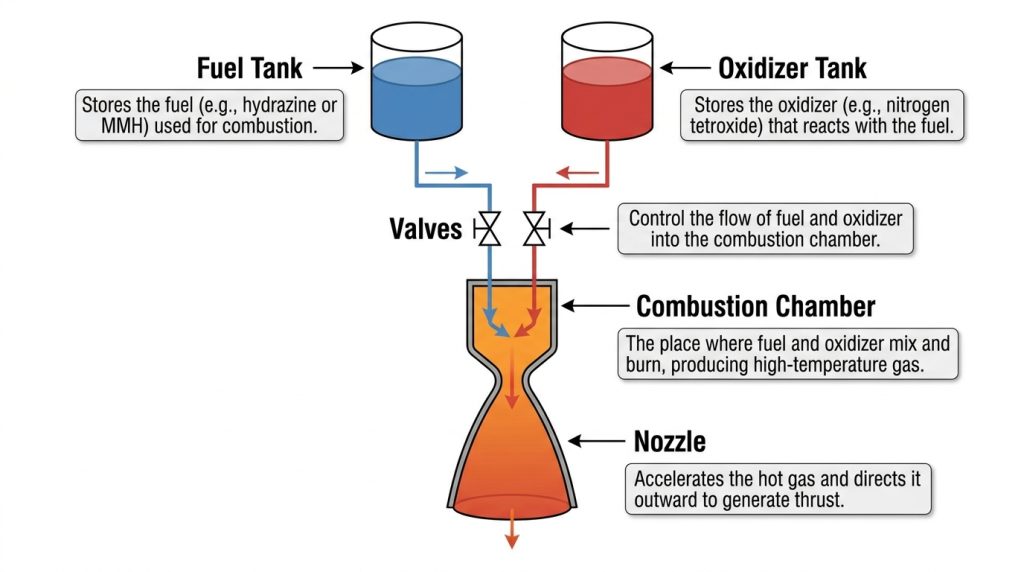
This type of thruster operates due to the precise interaction of the two components. Propellant and oxidizer must be stored separately and delivered into the combustion chamber at the right moment. Valves regulate the flow and ensure the correct ratio for effective combustion.
This configuration allows for high power output and rapid changes in thrust, but requires a complex design and precise system control.
Advantages of Bi-Propellant Thrusters
Bi-propellant chemical thrusters are valued for their high power and reliability:
- High thrust
These thrusters are capable of generating high thrust in a short time. It is important for complicated and energy-demanding maneuvers. - Quick response
The system turns on and off rapidly to guarantee the precise control of the thrust. - Perfect for maneuvering
Orbit correction and other complex applications in space.
Limitations of Bi-Propellant Thrusters
Despite their high power, bi-propellant thrusters have significant limitations. Especially when it comes to the small satellites.
- Toxic propellants
The components used for combustion are dangerous for people and require strict safety measures. - Complicated storage system
Propellant and oxidizer have to be stored separately. Also, it is important to maintain pressure and temperature, which makes the design more sophisticated. - Thermal Management
For CubeSats, the structural interface must act as a thermal break to protect the bus electronics from “thermal soakback”, and the software must include “thermal wait” periods between pulses to allow for heat dissipation. - High cost
Due to their complex systems and safety requirements, these thrusters are expensive. - Safety challenges
Toxic components increase risks at all the operating stages. - Sophisticated integration
Installation of this kind of thruster requires more resources and time, particularly for small satellites.
Bi-propellant thrusters are not the most convenient solution for CubeSats and small satellites, where simplicity, safety, and affordability are of the utmost importance.
Bi-Propellant vs Other Propulsion Systems
There are various types of propulsion systems available today.
The monopropellant system utilizes one component, the design is simpler, but the thrust is not as powerful.
Cold gas propulsion is the least complicated system. It is safe and reliable, but the efficiency is low.
Water-based propulsion is a modern and safe solution. Instead of toxic propellant, it uses water. Thus, it is easier to store and suits well for CubeSats and small satellites.
Bi-Propellant vs Water-Based Propulsion
Parameter | Bi-Propellant | Water-Based |
|---|---|---|
Propellant | Toxic chemicals | Water |
Complexity | Very high | Low |
Safety | Low | High |
Cost | High | Low |
Integration | Complex | Simple |
When to Choose a Bi-Propellant Thruster
Bi-propellant chemical thrusters are a powerful and effective solution, however they are not versatile. This system works well for large satellites and sophisticated missions that demand high thrust and rapid response. Although, for small satellites it usually turns out to be too complicated, expensive, and demanding in terms of safety concerns. If simplicity, low cost, safe operation, and quick integration are crucial for the mission, it is better to consider other alternatives.
When Water-Based Propulsion Is a Better Choice
Compact size and simple operations are vital for CubeSats and small satellites. Water-based propulsion systems are much easier to integrate, hence it is usually more suitable for missions that have limited resources. Water-based systems, like those from SteamJet, offer superior “volumetric specific impulse” because water can be stored unpressurized in conformally shaped tanks.
About SteamJet Space Systems
SteamJet Space Systems is a leading UK-based provider of high-performance satellite propulsion solutions. We specialise in water-based thrusters designed specifically for CubeSats and Small Satellites (SmallSats), with a strong focus on water-based thruster safety.
By pioneering the use of green propellants and intelligent thermal engineering, SteamJet enables complex LEO (Low Earth Orbit) manoeuvres — including orbital maintenance, collision avoidance, and de-orbiting — without the risks associated with toxic hydrazine or high-pressure cold gas systems, advancing green propulsion for space missions.
Steamjet Propulsion Technology
Our modular systems are engineered for seamless integration and maximum safety compliance:
SteamJet TunaCan Thruster: A compact, high-efficiency solution for 1U-3U CubeSats.
SteamJet TunaTank Thruster: A safe, high-performance electrothermal propulsion system.
SteamJet Thruster One: Scalable propulsion for larger SmallSat constellations.
Discover how SteamJet’s sustainable space propulsion innovations are providing the safety and reliability required for the next generation of crewed and robotic missions. Contact our engineering team for technical specifications and ICDs.