Bi-Propellant Chemical Propulsion for Small Satellites

water-based propulsion system for small satellites using safe propellant

Benefits, Challenges, and Alternatives

A bi-propellant chemical propulsion is a system that utilizes two components  – fuel and oxidizer. Once they come into contact, the ignition occurs and delivers thrust.

This type of thruster is often used for satellites and in deep space. They are used for maneuvers and orbit correction.

Bi-propellant chemical thrusters are a solution that is used often because they can generate high thrust and respond quickly. These characteristics make them indispensable for complex and precise space missions.

What Is a Bi-Propellant Chemical Propulsion?

Unlike other types of thrusters, bi-propellant chemical thrusters use two different components. In the hypergolic case,two separate propellants are injected into the combustion chamber, where they react and ignite. As a result, the chemical reaction generates high-temperature and high-pressure gas. Non-hypergolic propellants require dedicated spark-ignition hardware, which adds mass and software complexity to the CubeSat bus, or catalytic system to ignite.

The term “bi-propellant” refers precisely to the use of two components (bi = two): fuel and oxidizer. This allows for greater thrust compared to other types of engines.

Hydrazine and monomethylhydrazine are the most common propellants. Nitrogen tetroxide is usually utilized as an oxidizer. These components are very effective and produce a powerful thrust. However, they are toxic and require strict storage and handling conditions.

Currently, there are safer propellant options. For example, nitrous oxide and propene. They are less toxic and easier to handle. It allows for the reduction of the risks and costs of the missions. These propellants are much better suited for small satellites. While these alternatives reduce toxicity risks, they shift the engineering burden toward high-pressure fluid management and complex thermal conditioning to prevent phase changes in the feed lines.

How Bi-Propellant Chemical Thrusters Work

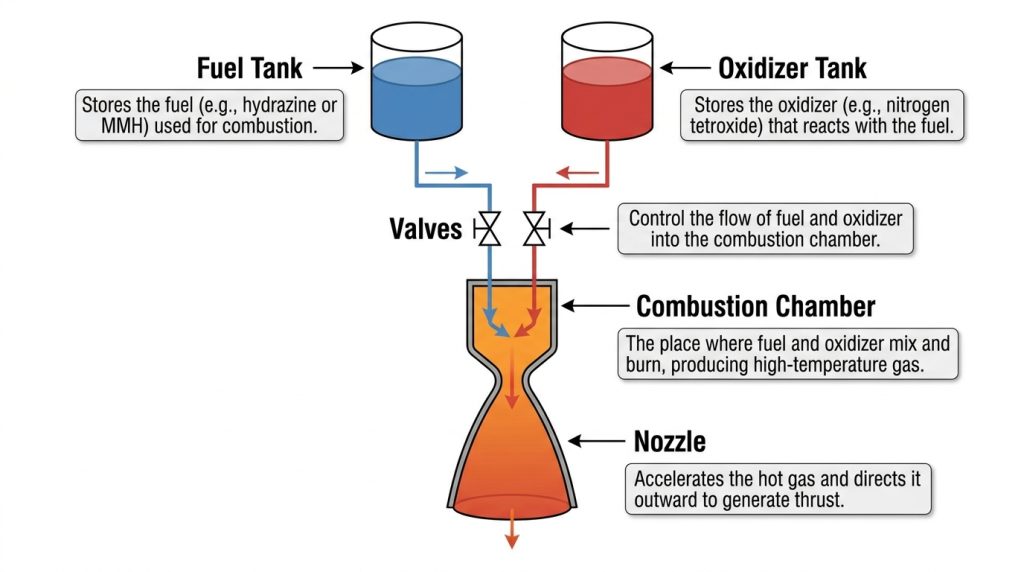
bi-propellant chemical propulsion diagram showing fuel and oxidizer interaction

This type of thruster operates due to the precise interaction of the two components. Propellant and oxidizer must be stored separately and delivered into the combustion chamber at the right moment. Valves regulate the flow and ensure the correct ratio for effective combustion.

This configuration allows for high power output and rapid changes in thrust, but requires a complex design and precise system control.

Advantages of Bi-Propellant Thrusters

Bi-propellant chemical thrusters are valued for their high power and reliability:

  • High thrust
    These thrusters are capable of generating high thrust in a short time. It is important for complicated and energy-demanding maneuvers.
  • Quick response
    The system turns on and off rapidly to guarantee the precise control of the thrust.
  • Perfect for maneuvering
    Orbit correction and other complex applications in space.

Limitations of Bi-Propellant Thrusters

Despite their high power, bi-propellant thrusters have significant limitations. Especially when it comes to the small satellites.

  • Toxic propellants
    The components used for combustion are dangerous for people and require strict safety measures.
  • Complicated storage system
    Propellant and oxidizer have to be stored separately. Also, it is important to maintain pressure and temperature, which makes the design more sophisticated.
  • Thermal Management
    For CubeSats, the structural interface must act as a thermal break to protect the bus electronics  from “thermal soakback”, and the software must include “thermal wait” periods between pulses to allow for heat dissipation.
  • High cost
    Due to their complex systems and safety requirements, these thrusters are expensive.
  • Safety challenges
    Toxic components increase risks at all the operating stages.
  • Sophisticated integration
    Installation of this kind of thruster requires more resources and time, particularly for small satellites.

Bi-propellant thrusters are not the most convenient solution for CubeSats and small satellites, where simplicity, safety, and affordability are of the utmost importance.

Bi-Propellant vs Other Propulsion Systems

There are various types of propulsion systems available today.

The monopropellant system utilizes one component, the design is simpler, but the thrust is not as powerful.

Cold gas propulsion is the least complicated system. It is safe and reliable, but the efficiency is low.

Water-based propulsion is a modern and safe solution. Instead of toxic propellant, it uses water. Thus, it is easier to store and suits well for CubeSats and small satellites.

Bi-Propellant vs Water-Based Propulsion

Parameter
Bi-Propellant
Water-Based
Propellant
Toxic chemicals
Water
Complexity
Very high
Low
Safety
Low
High
Cost
High
Low
Integration
Complex
Simple

When to Choose a Bi-Propellant Thruster

Bi-propellant chemical thrusters are a powerful and effective solution, however they are not versatile. This system works well for large satellites and sophisticated missions that demand high thrust and rapid response. Although, for small satellites it usually turns out to be too complicated, expensive, and demanding in terms of safety concerns. If simplicity, low cost, safe operation, and quick integration are crucial for the mission, it is better to consider other alternatives.

When Water-Based Propulsion Is a Better Choice

Compact size and simple operations are vital for CubeSats and small satellites. Water-based propulsion systems are much easier to integrate, hence it is usually more suitable for missions that have limited resources. Water-based systems, like those from SteamJet, offer superior “volumetric specific impulse” because water can be stored unpressurized in conformally shaped tanks.

About SteamJet Space Systems

SteamJet Space Systems is a leading UK-based provider of high-performance satellite propulsion solutions. We specialise in water-based thrusters designed specifically for CubeSats and Small Satellites (SmallSats), with a strong focus on water-based thruster safety.

By pioneering the use of green propellants and intelligent thermal engineering, SteamJet enables complex LEO (Low Earth Orbit) manoeuvres — including orbital maintenance, collision avoidance, and de-orbiting — without the risks associated with toxic hydrazine or high-pressure cold gas systems, advancing green propulsion for space missions.

Steamjet Propulsion Technology

Our modular systems are engineered for seamless integration and maximum safety compliance:

Steam TunaCan Thruster: A compact, high-efficiency solution for 1U-3U CubeSats.

Steam Thruster One: Scalable propulsion for larger SmallSat constellations.

Discover how SteamJet’s sustainable space propulsion innovations are providing the safety and reliability required for the next generation of crewed and robotic missions. Contact our engineering team for technical specifications and ICDs.

Hall-effect Thruster: Electric Propulsion for CubeSats and Small Satellites

Thruster One in the foil

A Hall thruster, or Hall-effect thruster, is a type of electric propulsion system often used in space for satellite navigation. It generates thrust by accelerating charged particles, typically xenon.

This type of thruster is usually utilized for various tasks:

  • CubeSat and small satellite missions in deep space
  • orbit correction
  • station keeping

Hall-effect thrusters are among the most widely used electric propulsion technologies. Its effectiveness and stability make it suitable for long-duration space missions.

What Is a Hall-effect Thruster?

A Hall-effect thruster is an electric thruster that doesn’t burn fuel, but functions due to the acceleration of charged particles (ions).

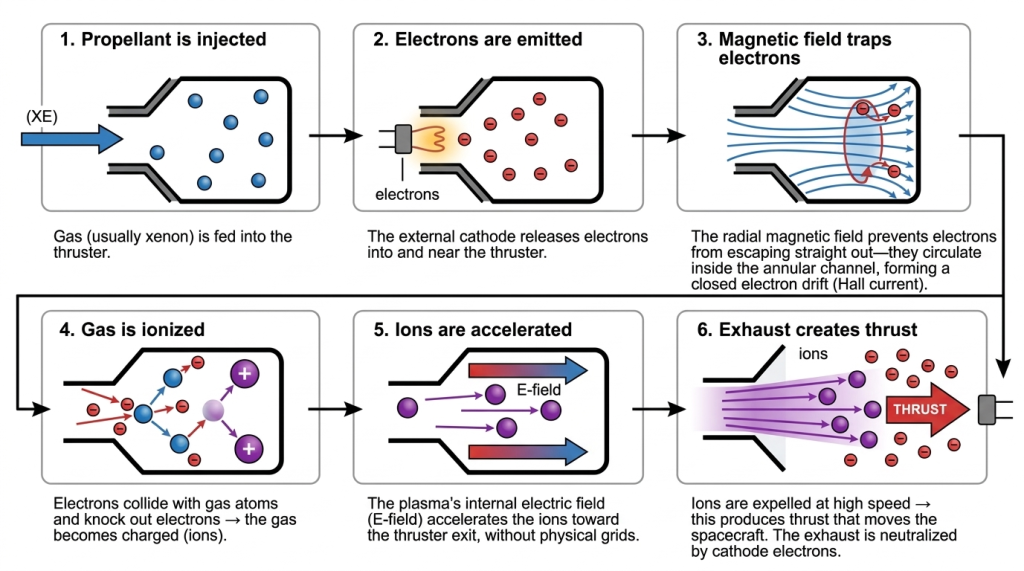
The operating principle is based on electric thrust. A radial magnetic field traps electrons that ionize the propellant inside the thruster. After that, these positive ions are accelerated with electric and magnetic fields, creating thrust.

The name “Hall” is connected to the Hall effect. It is a physics phenomenon that helps to control electrons in the thruster, which in turn makes the acceleration process more efficient.

How Hall-effect Thrusters Work

Hall Thruster Scheme: Step-by-Step Electric Propulsion Process

Advantages of Hall Thrusters

Hall-effect thrusters have several important advantages:

  • High efficiency specific impulse. These thrusters use less propellant compared to other types. Thus, they can operate longer with the same amount of propellant.
  • Stable thrust. These thrusters provide stable and predictable thrust, which is crucial for precise maneuvering in space.
  • Suitable for long-duration missions. Due to its stability and efficiency, these thrusters are well prepared to perform in missions that last months and even years.

Limitations of Hall Thrusters

Although hall-effect thrusters are very efficient, they too have a number of limitations. Especially when it comes to CubeSats and small satellites.

  • Xenon is an expensive gas that is not easy to store and transport in space.
  • A complicated system to inject the propellant, which makes the design more sophisticated.
  • Over time, the thruster’s internal walls wear out due to channel erosion. It shortens the service life.
  • This type of thruster demands significant electric resources that are not always available in small satellites.
  • Not always suitable for CubeSats.

Alternatives to Hall-effect Thrusters

There are various propulsion systems that create thrust in space.

Cold gas – simple systems that release gas. It is safe, but low efficiency.

Chemical propulsion – traditional propulsion systems. They are powerful, but expensive and complicated for small satellites.

Ion thrusters – electric systems similar to Hall-effect thrusters. These types of thrusters are effective; they demand advanced equipment and rare gases.

Water-based propulsion – a safe and available alternative. They use water instead of xenon; they are easier to store and work well for CubeSats and small satellites.

Water-Based Thrusters vs Hall Thrusters

Parameter
Hall Thruster
Water-Based Thruster
Propellant
Xenon
Water
Complexity
High
Lower
Cost
High
Low
Safety
Moderate
High
Storage
Complex
Simple

Hall-effect thrusters are well-suited for high-power missions that demand high thrust. Also, deep space and long-duration missions, where the thruster is expected to perform for months and even years.

Water-based thrusters are especially compatible with CubeSats and small satellites. They are perfect for cost-sensitive missions that require rapid deployment and simplicity in operations.

Hall-effect thrusters are powerful, but complicated and expensive thrusters. The space electric propulsion market is evolving, with an increasing focus on simpler and more affordable solutions. Water-based propulsion is a practical alternative, especially for small satellites and CubeSats.

About SteamJet Space Systems

SteamJet Space Systems is a leading UK-based provider of high-performance satellite propulsion solutions. We specialise in water-based thrusters designed specifically for CubeSats and Small Satellites (SmallSats), with a strong focus on water-based thruster safety.

By pioneering the use of green propellants and intelligent thermal engineering, SteamJet enables complex LEO (Low Earth Orbit) manoeuvres — including orbital maintenance, collision avoidance, and de-orbiting — without the risks associated with toxic hydrazine or high-pressure cold gas systems, advancing green propulsion for space missions.

Steamjet Propulsion Technology

Our modular systems are engineered for seamless integration and maximum safety compliance:

Steam TunaCan Thruster: A compact, high-efficiency solution for 1U-3U CubeSats.

Steam Thruster One: Scalable propulsion for larger SmallSat constellations.

Discover how SteamJet’s sustainable space propulsion innovations are providing the safety and reliability required for the next generation of crewed and robotic missions. Contact our engineering team (link) for technical specifications and ICDs.

From Lab to Orbit: Achieving Mission Assurance in CubeSat Propulsion

Mission assurance in CubeSat propulsion system testing and validation

Today, CubeSat technology is becoming more and more sophisticated. The cost of making a mistake in orbit is as high as ever, because these errors are often impossible to correct. That’s why building in mission assurance from the start is essential for keeping operations reliable, safe, and predictable. Especially so in the case of subsystems like propulsion. SteamJet delivers not just hardware, but dependable, mission-ready performance.

Successful testing on Earth doesn’t always guarantee that the propulsion system will provide the same performance in orbit. In space, the thruster is subjected to extreme temperatures, fluctuating pressure, and prolonged continuous stress. Frequently, many propulsion systems fail not because of the design, but due to the lack of a well-defined operational framework across the entire mission.

Engineering Mission Assurance from Day One

At SteamJet, we not only verify the system during the final testing, but also ensure to build in the mission reliability from the very start of the development. We follow ECSS standards and NASA’s Fault Management principles to develop our engineering solutions.

Traceability, Repeatability, and Validation

This is how we make sure that all decisions can be traced and the results can be reproduced. We continue validation at every stage. We don’t “test” reliability, we build it in from the start.

Fault Management: The Core of Mission Assurance

FDIR  (Fault Detection, Isolation, and Recovery) is a key process to provide reliability. It is especially important for CubeSats, because of the limited resources and the lack of constant monitoring from Earth, the system must be capable of responding autonomously to abnormal situations.

SteamJet thrusters are designed to “think” through anomalies. Using a sophisticated Fault Management (FM) architecture, we map out scenarios like thermal rises or pressure leaks to ensure rapid recovery.

At the fault detection stage, the system monitors telemetry parameters in real time. Namely, pressure, temperature, and more. The main goal is to identify discrepancies right away. The next stage is isolation. At this stage, we identify what exactly happened. And if it was a temporary sensor malfunction or an actual hardware problem. A false alarm may lead to an unnecessary mission shutdown.

The final stage is recovery. At this stage, the system turns back to the safe mode. It allows for adjusting operating parameters and reducing the load to maintain operational capabilities.

The Result: Predictable and Reliable Propulsion

By aligning with the NASA Fault Management Handbook, we guarantee a high level of mission assurance. As a result, the client not only receives a thruster itself, but a predictable and controllable part of the satellite that doesn’t create additional risks for the missions. SteamJet propulsion systems guarantee stable performance, resilience to malfunctions, and predictable behavior in orbit, even under the most challenging conditions.

About SteamJet Space Systems

SteamJet Space Systems is a leading UK-based provider of high-performance satellite propulsion solutions. We specialize in water-based thrusters designed specifically for CubeSats and Small Satellites (SmallSats), with a strong focus on water-based thruster safety.

By pioneering the use of green propellants and intelligent thermal engineering, SteamJet enables complex LEO (Low Earth Orbit) maneuvers — including orbital maintenance, collision avoidance, and de-orbiting — without the risks associated with toxic hydrazine or high-pressure cold gas systems, advancing green propulsion for space missions.

Steamjet Propulsion Technology

Our modular systems are engineered for seamless integration and maximum safety compliance:

Steam TunaCan Thruster: A compact, high-efficiency solution for 1U-3U CubeSats.

Steam Thruster One: Scalable propulsion for larger SmallSat constellations.

Discover how SteamJet’s sustainable space propulsion innovations are providing the safety and reliability required for the next generation of crewed and robotic missions. Contact our engineering team for technical specifications and ICDs.

SteamJet Thruster One: Testing and Flight Readiness for Artemis II Mission

SteamJet Thruster One

SteamJet Thruster One will perform an orbit correction for South Korea’s K-Rad Cube satellite during the upcoming Artemis II mission. South Korean NaraSpace designed and built the K-Rad Cube satellite for NASA’s historic Artemis II mission, the first crewed lunar mission in over 50 years.

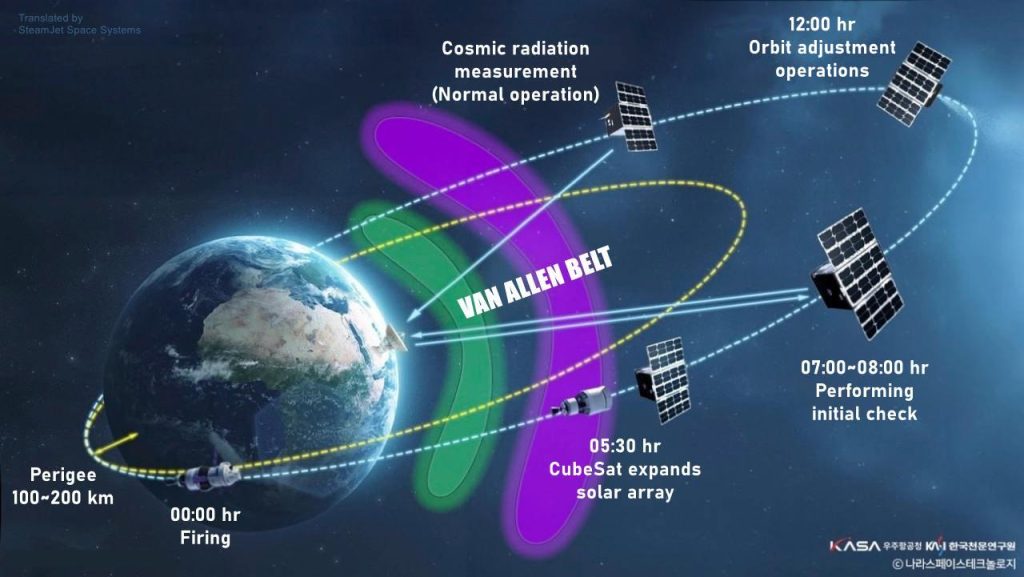
Once deployed into a highly elliptical orbit, the satellite will face an immediate challenge because its first perigee passes through Earth’s upper atmosphere. SteamJet Thruster One will provide the orbital correction required to prevent the satellite’s re-entry into the atmosphere.

Before any mission, SteamJet thrusters undergo a meticulous testing process to guarantee performance and reliability. Fuel tank burst pressure testing was also completed to meet the elevated safety standards required for the crewed Artemis II mission.

In addition to burst testing, engineers conducted acceptance testing on the SteamJet Thruster One for Artemis II, following established industry practices. Acceptance test campaign consists of several phases:

  • Functional test
  • Vibration dynamic test
  • Thermal vacuum test
  • Leak rate

Functional test

Functional testing verifies the thruster’s performance in all operational modes. The flight profile details all settings relevant for in-orbit operation aboard the satellite. For the Artemis II mission there are two main operational modes: commissioning and thrust.

The commissioning mode is the first operational state activated post-launch. It purges residual gases from the fuel lines.

For the Artemis II mission the thruster was optimized to deliver high thrust, operating nearly in continuous mode. This configuration ensures the mission objective is met, raising the orbit perigee to over 180 km during the first orbit.

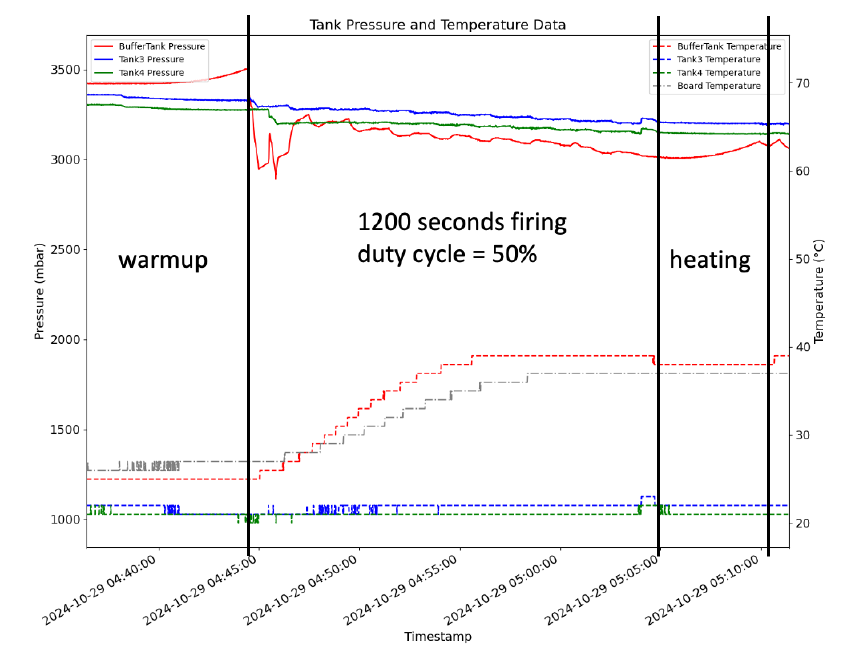
An impulse of 240 Ns was generated in order to accomplish this goal. The test consisted of a sequence of cycles that included thrust generation, heating without firing and system health checks.  The manoeuvre was split in two parts, with a cooling period in between.

Telemetry data of a firing block:

Telemetry data of a firing block

The results of the overall functional thrust mode test are as follows:

  • Water Tanks initial condition: 350g of water on each tank at a pressure of 3.4 atm
  • Water consumed: 167.0 g
  • Total Impulse: 240 – 260 Ns
  • Thrust: 15 – 17 mN
  • Test duration: 11h 25m (including cool down period)

Vibration dynamic test

During the vibration dynamic test, engineers simulate operational conditions to ensure all components meet quality standards.

The vibration stand main specifications were the following:

Parameter
Value
Stand
ETS_L620M.std
Maximum payload weight [kg]
300.0
Reduced mass of the moving system [kg]
6.0
Operating frequency range [Hz]
3.00 – 3500.00
Buoyancy force [N]
6000.00
Maximum speed [m/s]
1.80
Maximum movement [mm]
25.00
Maximum acceleration [m/s2]
980.00

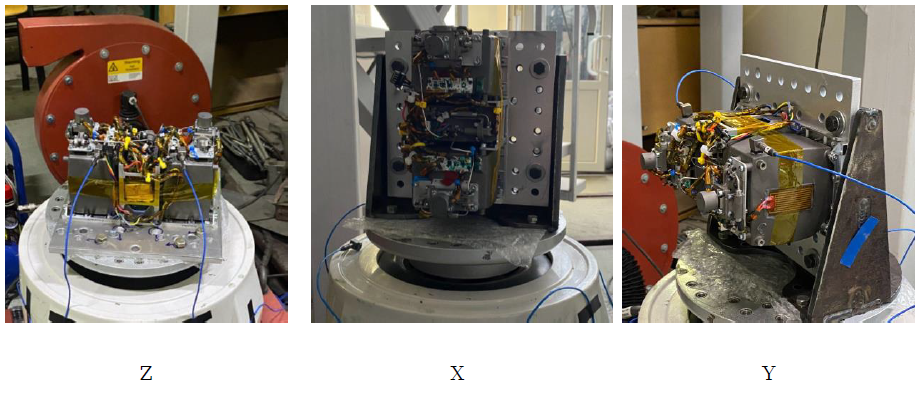
Thruster mounting for vibrations testing along X,Y,Z:

Thruster mounting for vibrations testing

During and after vibration dynamic testing, all thruster parameters remained within normal limits and met specifications.

Thermal vacuum test

The main goal of the thermal vacuum test is to check that the thruster performs and survives extreme temperatures encountered in space. Additionally, the test reveals any hidden issues early, reducing the chance of problems during the first hours of flight.

Engineers successfully completed all functional checks at the different dwell temperatures. The total mass loss during Thermal Vacuum was 0.7g, or 0.059 %, which confirms that the integrity of the thruster is maintained.

Leak rate

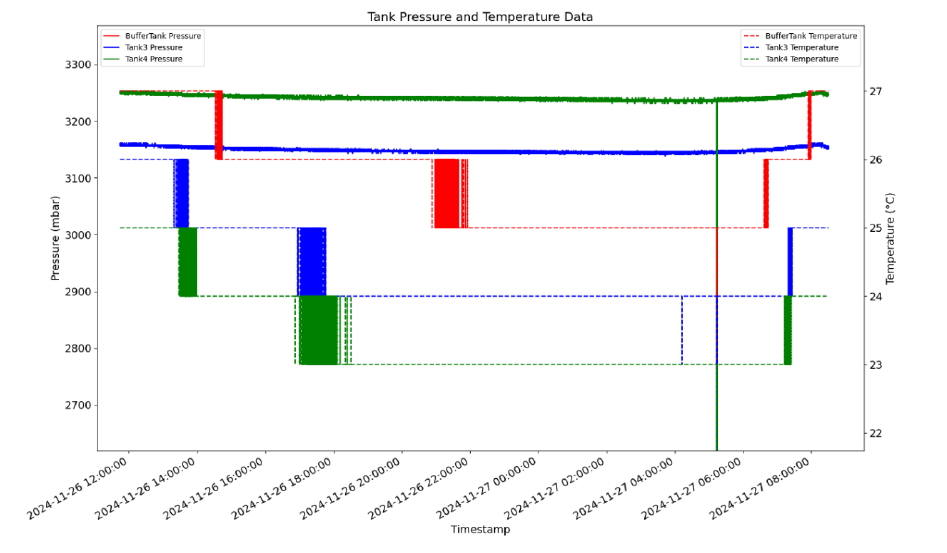
After the thermal vacuum test, engineers measured the leak rate. The thruster was fuelled and left for 20 hours in vacuum conditions while monitoring pressure and temperature values. Engineers detected no leaks during this 20-hour period.

Thruster telemetry during leak rate test:

Thruster telemetry during leak rate test

Conclusion

SteamJet Thruster One has successfully completed all testing required for the Artemis II mission. Functional, vibration, thermal vacuum, and leak rate tests confirmed that the thruster performs reliably in all operational modes, maintains its integrity under extreme conditions, and meets mission requirements. With verified performance and no detected leaks, the thruster is fully flight-ready to perform the critical orbital correction for the K-Rad Cube satellite.

About SteamJet Space Systems

SteamJet Space Systems is a leading UK-based provider of high-performance satellite propulsion solutions. We specialize in water-based thrusters designed specifically for CubeSats and Small Satellites (SmallSats), with a strong focus on water-based thruster safety.

By pioneering the use of green propellants and intelligent thermal engineering, SteamJet enables complex LEO (Low Earth Orbit) maneuvers — including orbital maintenance, collision avoidance, and de-orbiting — without the risks of toxic hydrazine or high-pressure cold gas systems. This approach advances green propulsion for space missions.

Steamjet Propulsion Technology

Our modular systems are engineered for seamless integration and maximum safety compliance:

Steam TunaCan Thruster: A compact, high-efficiency solution for 1U-3U CubeSats.

Steam Thruster One: Scalable propulsion for larger SmallSat constellations.

Discover how SteamJet’s sustainable space propulsion innovations are providing the safety and reliability required for the next generation of crewed and robotic missions. Contact our engineering team for technical specifications and ICDs.

Fuel Tank Burst Pressure Testing for Artemis II Mission Qualification

tank burst test

Spacecraft Propulsion Safety for a Crewed Artemis II Mission

Tank burst safety is a critical requirement for crewed space missions. For Artemis II mission, SteamJet Space Systems is preparing to demonstrate spacecraft propulsion capabilities by performing an in-orbit correction for South Korea’s K-RadCube satellite. As a result, this manoeuvre is designed to prevent premature atmospheric re-entry and relies on a simple principle: using water as the propellant.

Artemis II Mission Safety Requirements

Artemis II is a manned mission; therefore, safety and reliability are imperative. Every element of the propulsion system must withstand conditions well beyond nominal operation. In particular, the pressurised, space-grade propellant tank must safely tolerate extreme internal pressures. This capability is a critical factor for CubeSat safety and crewed mission compatibility.

For this reason, the SteamJet team performed fuel tank burst pressure testing last year to confirm that the pressurized tank meets the Design Burst Pressure requirement defined in ANSI/AIAA S-080A-2018, Section 10.4.10, as part of CubeSat mission qualification.

Why Fuel Tank Burst Testing Is Required

A fuel tank must demonstrate compliance with a burst factor (BF) of 2.5. In this case, the maximum Design Pressure (MDP) is 5.67 bar. Therefore, the required design burst pressure (DBP) is calculated as 2.5 times MDP, which results in 14.18 bar.

Design Burst Pressure = BF x ECF x MDP = 2.5 x 1.0 x 5.67 = 14.18 bar

Test Environmental Conditions

The test was conducted near ambient temperature, approximately 20°C. As a result, the environmental correction factor (ECF) remained 1.0.

During the test, pressure increased progressively at a controlled rate. This approach prevented transient load spikes or dynamic effects, thereby ensuring representative water-based thruster safety conditions.

Tank Burst Test Setup

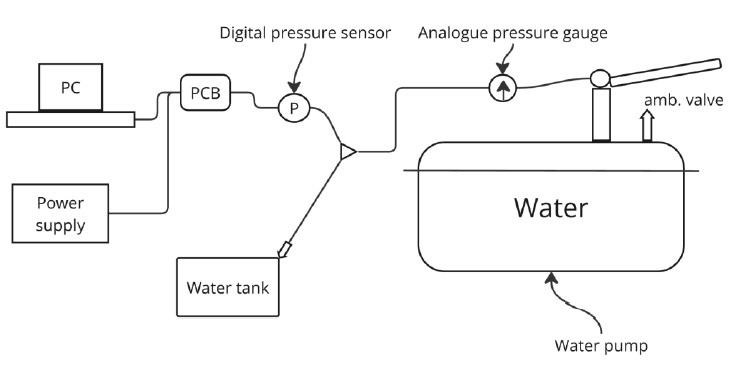
The team positioned the pressurised tank inside a safe container to protect against shrapnel or fluid jetting in the event of rupture. Next, they connected it to a water pump designed to exceed the required burst pressure through pressure-rated fittings and hoses. Pressure gauges and sensors continuously monitored the internal pressure. In addition, temperature sensors monitored ambient conditions. The team placed them near the tank, which is consistent with space-grade propellant tank testing practices.

Instrumentation and Monitoring

The team checked the system for leaks and functionality in advance and then filled it with water. After that, all instrumentation connected to a data acquisition system for continuous monitoring and recording throughout the test. 

Because the electronic pressure sensor was limited to 30 bar, the team monitored higher pressure levels using an analogue gauge. A schematic of the test setup is shown below.

fuel tank burst testing setup

Tank Burst Test Procedure

The test began with a leak check at 5.67 bar to confirm the system was secure. Pressure was then gradually increased until it reached the calculated Design Burst Pressure of 14.18 bar. At this stage, the team held the pressure for about two minutes to verify tank integrity in line with CubeSat safety requirements.

Because the digital sensor could only measure up to 30 bar, it was removed, and the system was depressurised before continuing with the analogue gauge. Afterwards, pressure increased steadily until the tank burst. The team recorded the exact burst pressure, along with time, temperature, and the location and type of failure. Throughout the test, the team continuously monitored the system and logged all data from a safe distance.

fuel tank

Failure Location and Structural Behaviour

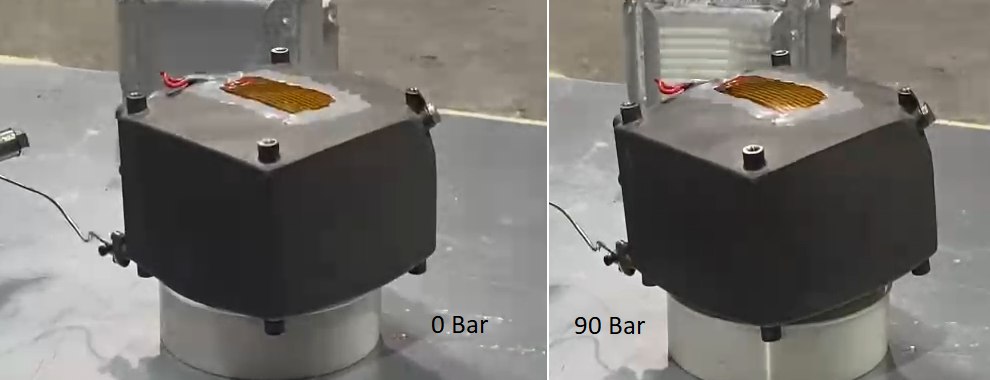
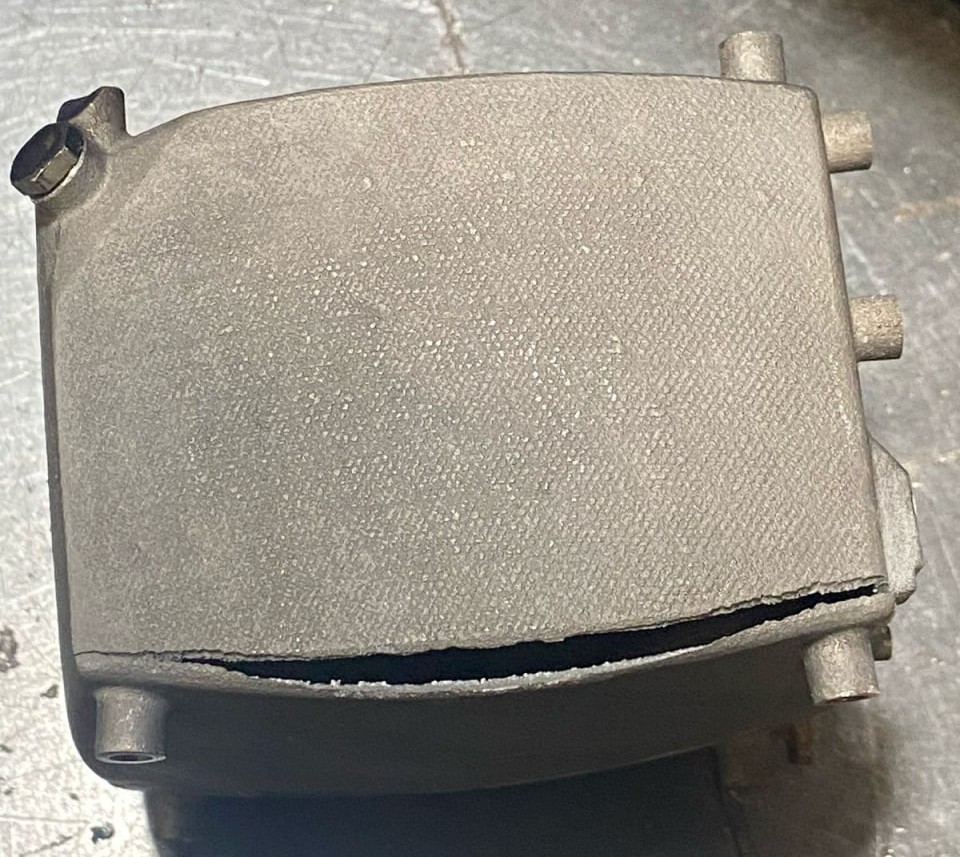
The tank was first pressurised up to 30 bar without rupture. After depressurisation and removal of the digital pressure sensors, the team re-pressurised the tank in a continuous event. The tank burst at 90 bar. Notably, this observed burst pressure far exceeds the required design burst pressure of 14.18 bar.

As a result, the test confirmed that the fuel tank is capable of exceeding the minimum requirement with a substantial margin, supporting CubeSat mission qualification and crewed mission safety.

tank burst test

Failure Mode and Stress Concentration

The failure happened along the edge of the tank, where stress concentrations are highest. It is consistent with the results of stress analysis. The tank edges and the centers of the smaller faces are the key areas of stress concentration.

Parameter
Required (DBP)
Actual Result
Safety Margin
Pressure (bar)
14.18 bar
90 bar
~ 6.3x
Standard
ANSI/AIAA S-080A-2018
Compliant
Temperature
20°C (Ambient)
20°C

In conclusion, the design burst pressure of 14.18 was successfully verified. The final burst pressure recorded was 90 bar. Therefore, the results demonstrate an excellent safety margin of the tank design for space-grade propellant tanks used in green propulsion systems.

About SteamJet Space Systems

SteamJet Space Systems is a leading UK-based provider of high-performance satellite propulsion solutions. We specialize in water-based thrusters designed specifically for CubeSats and Small Satellites (SmallSats), with a strong focus on water-based thruster safety.

By pioneering the use of green propellants and intelligent thermal engineering, SteamJet enables complex LEO (Low Earth Orbit) maneuvers — including orbital maintenance, collision avoidance, and de-orbiting — without the risks associated with toxic hydrazine or high-pressure cold gas systems, advancing green propulsion for space missions.


SteamJet Propulsion Technology

Our modular systems are engineered for seamless integration and maximum safety compliance:

Discover how SteamJet’s sustainable space propulsion innovations are providing the safety and reliability required for the next generation of crewed and robotic missions. Contact our engineering team for technical specifications and ICDs.
Longest In-Orbit Burn with Steam-Based Propulsion Set for Artemis II CubeSat

SteamJet space propulsion system

SteamJet Space Systems will demonstrate spacecraft propulsion during the upcoming Artemis II mission with an orbiting correction for South Korea’s K-RadCube satellite to prevent its re-entry into the atmosphere. The manoeuvre uses a straightforward application of water.

K-Rad Cube satellite, developed by South Korean NaraSpace, will be onboard NASA’s historic Artemis II mission, the first manned lunar mission in over 50 years. The CubeSat will face a challenge after it is deployed into a highly elliptical orbit. Its first perigee is within Earth’s upper atmosphere. Without orbital correction, the satellite will be lost.

That’s where SteamJet’s water thruster steps in.

“This mission is about demonstrating what water-based propulsion can do in high-stakes, real-world conditions,” said Marco Pavan, CEO of SteamJet Space Systems. “We’re performing a high-thrust, high-precision manoeuvre that was once reserved for chemical systems.”

Configuring the thruster to operate safely and efficiently over the prolonged burn presented one of the mission’s key challenges. For this reason, the team had to ensure the engine would not overheat. At the same time, the satellite needed to remain within safe temperature limits. In addition, sufficient heat was required to generate the needed thrust. All systems had to remain stable and operate smoothly for approximately 12 hours.

Mission Objective

The primary mission of the K-RadCube is to monitor cosmic radiation and analyse its effects on astronauts as it passes through the Van Allen radiation belts, located more than 1,000 kilometres above Earth. However, to extend its mission duration and avoid atmospheric re-entry after the first orbit, the satellite must raise its perigee to 200 km.

To achieve this, SteamJet’s spacecraft propulsion system will conduct a prolonged 12-hour burn, one of the longest single burns ever performed by a water-based thruster in space. The manoeuvre is intended to extend the operational mission lifespan.

Key Mission Parameters:

Launch Orbit: Highly elliptical, ~70,000 km apogee

Corrective Action: 12-hour prolonged burn to raise perigee to ~200 km

Propulsion System: SteamJet Thruster One (water-powered)

According to our calculations, the thruster will deliver more than 250 Ns of impulse, corresponding to roughly 170 g of water — about a quarter of the capacity of our tanksAs a result, a significant propellant margin remains for the mission.

SteamJet Water Thruster Powers Critical Artemis II CubeSat Maneuver

Redefining the Frontiers of Green Propulsion

Previously, CubeSats that operate in these harsh environments would have required chemical propulsion — a costly, toxic, and complex solution. In contrast, SteamJet’s spacecraft propulsion technology offers the same performance without the hazards, a scalable option for deep-space and high-energy orbit missions.

Overall, the mission is a demonstration of sustainable propulsion for demanding orbit applications, enabling future CubeSats to conduct complex missions that were not possible without sacrificing safety or sustainability.

About SteamJet Space Systems

SteamJet Space Systems is a UK-based space propulsion company offering high-performance, water-based thrusters for CubeSats and Small Satellites. By utilising green propellants and intelligent engineering, SteamJet enables complex in-space missions without resorting to toxic or high-pressure systems.

Detailed technical specifications, test data, and CAD models for the Steam Thruster One are available on the website. Discover how SteamJet innovations are shaping the future of sustainable satellite propulsion.

Sustainability: Innovation and Space Debris Management

CubeSat propulsion system reducing space debris

Today, the space sector is advancing rapidly. The number of launches and satellites in orbit is increasing. This creates fresh opportunities for commerce, research, and environmental monitoring. However, this growth also brings sustainability challenges — both on Earth and in space. One of the issues is a growing amount of orbital debris being generated. Therefore, it highlights the importance of CubeSat propulsion in reducing space debris and improving orbital sustainability.

The Space Debris Challenge

Space exploration is becoming more attainable for entrepreneurs and innovators. Furthermore, with the expansion of satellite constellations in both quantity and scale, numerous new items are being introduced into low Earth orbit—not only satellites but also space debris. This debris typically includes non-functional satellites and abandoned rocket stages. As a result, orbital overcrowding and long-term viability are growing concerns.

The space debris poses a threat of collision events and may ultimately hinder or render it unfeasible for satellites to function properly in the low Earth orbits utilized for scientific purposes and communications.

Commitment to Sustainable CubeSat Propulsion

At SteamJet, we believe the future depends on making responsible choices and exploring the stars without leaving unnecessary marks. To support this goal, our commitment is to adopt sustainable and eco-friendly propellants to reduce the effect on space environments.

SteamJet propulsion systems function solely in the space environment and pose no threat to the Earth’s atmosphere. They don’t contain hazardous or flammable materials that require special care when being installed on a satellite. Additionally, our engines activate solely in space, and unlike various other satellite types, they can be deployed from a spacecraft or space station. Their launch and functioning pose no risk to the crew.

CubeSat propulsion systems powered with water transform the modern approach to satellite mobility and help mitigate space debris in orbit. Moreover, they offer safe, cost-efficient, and environmentally responsible solutions. In particular, these systems enable precise orbit adjustments, maintain satellite positioning, support constellation coordination, and ensure end-of-life de-orbiting.

More technical information regarding the thrusters is available on our website. This includes specifications, performance data, and recent test results. Steam TunaCan Thruster and Steam Thruster One. Discover how SteamJet innovations are shaping the future of sustainable satellite propulsion.

SteamJet selected by MBRSC for its first PHI-Demo mission

CubeSat Propulsion system powered with water

In January, the Mohammed Bin Rashid Space Centre (MBRSC) announced the development of the PHI-Demo mission under the Payload Hosting Initiative. Furthermore, the Initiative aims at providing an effective satellite platform that can host payloads for multiple purposes. The project includes a 12U modular satellite platform that is going to be designed in partnership with OQ Technology and SteamJet Space Systems. Specifically, SteamJet Space Systems is company specialising in sustainable CubeSat propulsion. As a result, the UAE intends to strengthen its position in space innovations.

Sustainable CubeSat propulsion

Photo Source: MBRSC, https://mediaoffice.ae/en

SteamJet’s Role in PHI-Demo

Together with an innovative IoT communication payload, PHI-Demo’s main goal will be to test SteamJet’s environmentally friendly propulsion subsystem. In particular, the Steam Thruster One is going to showcase sustainable CubeSat propulsion in real mission conditions. The Steam Thruster One is a flexible water-powered resistojet. It provides high thrust — tens of times more than electric propulsion — while consuming very little power. Consequently, this makes it a significant innovation in sustainable CubeSat propulsion technology. Moreover, another major benefit of the Steam Thruster One is the possibility to customize its water tanks size and shape to meet the mission requirements. It also improves the subsystem final integration into the spacecra, further enhancing integration into the spacecraft and advancing CubeSat propulsion efficiency.

The mission launch date is scheduled for Q4 2022. According to the Director-General of the MBRSC, His Excellency Salem Humaid AlMarri, said that this collaboration gave more opportunities for countries and entities to deploy and operate their own satellites in space. In addition, it would contribute to the advancement of satellite-related technologies.

According to the Head of Payload Hosting Initiative of the MBRSC, Zakaria Al Shamsi, the space sector’s future relies on possibilities for cooperation. And the Payload Hosting Initiative means a strategic step for the space sector.

Mission Impact and Strategic Importance

Marco Pavan, CEO of SteamJet Space Systems expressed his appreciation to have been selected for the first PHI mission. Moreover, he sees the partnership with MBRSC as an essential step towards a greener and safer approach to propulsion in the small satellite industry.

The PHI-Demo mission demonstrates how sustainable CubeSat propulsion is shaping the future of eco-friendly, efficient, and safe satellite missions.

Last year Mohammed Bin Rashid Space Centre (MBRSC) and the United Nations Office for Outer Space Affairs (UNOOSA) announced the Payload Hosting Initiative (“PHI”) and the signing of the Memorandum of Understanding for satellite payload hosting. The program starts in 2022 and plans to hold two satellite missions annually.

About SteamJet Space Systems

SteamJet Space Systems is a UK-based space propulsion company offering high-performance, water-based thrusters for CubeSats and Small Satellites. By utilising green propellants and intelligent engineering, SteamJet enables complex in-space missions without resorting to toxic or high-pressure systems.

You can access detailed technical specifications, test data, and CAD models for our new space engines on our website. Steam TunaCan Thruster and Steam Thruster One. Discover how SteamJet innovations are shaping the future of sustainable satellite propulsion

SteamJet’ TunaCan Thrusters a part of the “Above the Clouds” mission

CubeSat in-Orbit Propulsion on the “Above the Clouds” Mission

Virgin Orbit announced the changes in the “Above the Clouds” mission where SteamJet Space Systems will participate with its CubeSat water propulsion thruster.

According to Virgin Orbit, the Spire CubeSat will join the smallsats of the Space Test Program and SatRevolution on the next LauncherOne mission. Notably, this will be the rocket’s fourth flight since the first launch in May 2020. Meanwhile, the “Above the Clouds” mission with a Virgin Orbit LauncherOne rocket is scheduled for launch on January 12, 2022 (UTC).

The mission “Above the Clouds” was first announced in November. At that time, the participants were the Defense Department’s Space Test Program (STP) and SatRevolution. SatRevolution is a Polish manufacturer of nanosatellite technologies. The satellite aimed to collect information about “micro” space debris in low Earth orbit. It will be done with the help of a short-range radar provided by Spire. Furthermore, SatRevolution planned to test two projects: STORK-3 as an imaging satellite and SteamSat-2, based on SteamJet’ TunaCan Thruster. SteamJet TunaCan Thruster is a compact resistojet with a unique water-powered propulsion technology, produced by SteamJet Space Systems. It demonstrates CubeSat in-orbit propulsion using a compact, water-powered resistojet designed for small satellite missions. Moreover, the TunaCan Thruster has been specifically designed for CubeSat platforms, keeping in mind all the limitations in terms of volume, power, and safety while enabling reliable in-orbit propulsion for CubeSats.

TunaCan Thruster for External CubeSat Installation

One of the key benefits of the SteamJet TunaCan Thruster is its external installation in the TunaCan volume, which sits outside the CubeSat structure. Therefore, it has the ability to deliver CubeSat in-orbit propulsion while occupying almost no internal satellite volume. In fact, it is the only propulsion unit in the market that needs almost no volume inside the satellite. Moreover, the TunaCan Thruster is environmentally friendly, as water is the main propellant, provides a high thrust, and has a low power consumption. For more details, technical information about the TunaCan Thruster is available on our website.

About SteamJet Space Systems

SteamJet Space Systems, based in the UK, develops high-performance, water-based thrusters for CubeSats and small satellites. By utilising green propellants and intelligent engineering, SteamJet enables complex in-space missions without resorting to toxic or high-pressure systems.

More technical information regarding the thrusters is available on our website. This includes specifications, performance data, and recent test results. Steam TunaCan Thruster and Steam Thruster One. Discover how SteamJet innovations are shaping the future of sustainable satellite propulsion.