
The Economics of Water Propulsion for LEO Constellations

Water-based propulsion system for CubeSat constellation management and orbital manoeuvres

Today, there are more and more satellite constellations in LEO. Dozens and hundreds of small satellites are launched for communications, Earth observation, internet services, and scientific research. However, the constellation management costs also increase.

It is becoming increasingly important for operators not only to launch satellites into orbit but also to ensure their operations are cost-effective. The price of the launch, satellite preparation, orbital manoeuvres, constellation maintenance, and safe deorbiting has to be taken into account.

The propulsion system is no longer just an engineering decision, but an economic one. The propulsion system affects not only the satellite’s capabilities but also the total cost of constellation management. The type of propulsion system determines the complexity of integration, safety requirements, launch preparation time, and the costs of subsequent satellite operations.

For a long time, electric propulsion was a default “advanced” solution in the space industry. Although this approach seems more like an expensive overengineering exercise for many LEO constellations.

Why Constellation Management Costs Are Increasing

Not only do launches happen more often, but LEO satellites also have limited service life. Thus, operators have to regularly launch new ones into orbit. This trend puts additional strain on satellite preparation, integration, and constellation management processes. On top of that, operators have to implement additional initiatives for decreasing space debris and safe deorbiting to comply with new space sustainability requirements.

The Hidden Operational Costs

Often, the main expenses are not connected to the launch itself. Once in orbit, a long operational phase begins, which requires ongoing costs.

One of the important goals is orbit maintenance. For this purpose, satellites regularly perform correctional manoeuvres. On top of that, there is also a growing need for collision avoidance manoeuvres. Orbits become more and more crowded, hence satellites have to change their trajectories to avoid collision and space debris.

End-of-life deorbiting is yet another major task. It is necessary to comply with current zero-debris mandates.

Moreover, operators have to manage satellite constellations. It requires infrastructure, automation, and constant monitoring.

Why Propulsion Choices Matter Economically

Commonly, the discussion on propulsion systems is focused on physics metrics rather than business metrics. However, high Isp does not generate revenue. What really matters are reliable deployment, operational simplicity, and manageable lifecycle costs. Electric propulsion is efficient, but it possesses high hidden costs in infrastructure and logistics.

For example, it is possible to estimate the “Xenon/EP Premium”, the additional capital and operational expenditure (CAPEX and OPEX), and compare it to water-based systems like SteamJet. Additional costs in EUR (€) for a typical 3U–12U CubeSat constellation may be estimated based on current market data and aerospace cost-estimation models.

1. CAPEX: Hardware & Integration Premium

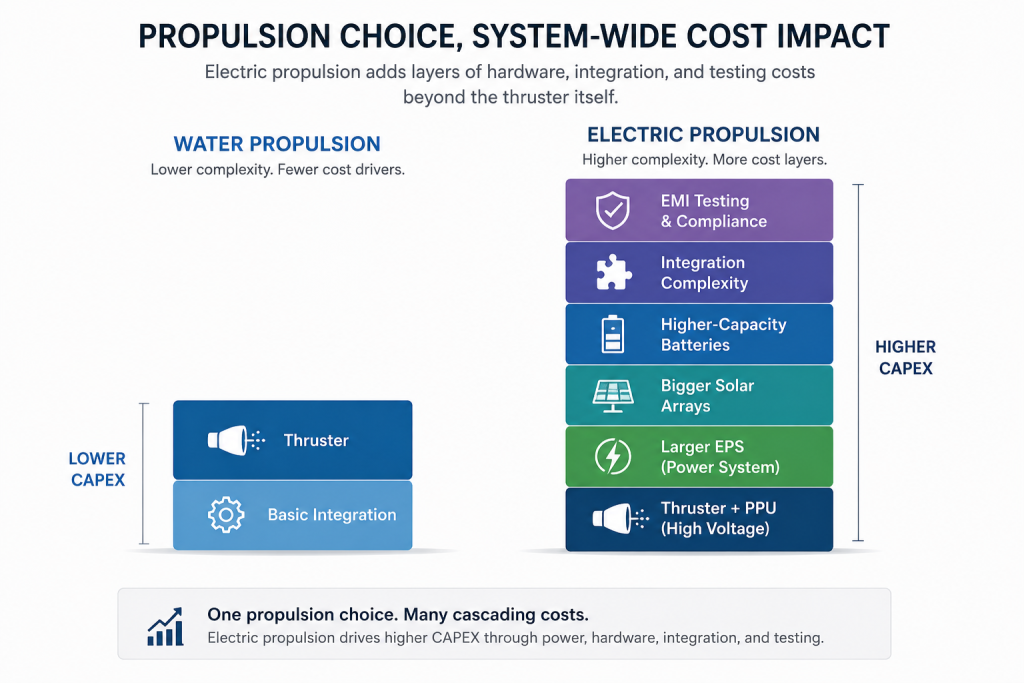
High-efficiency EP systems (Ion, Hall, FEEP) are significantly more complex than water-based electrothermal systems.

  • Thruster Unit & PPU: A space-qualified FEEP or Ion thruster typically starts at €40,000 to €80,000 per unit. A water-based thruster (electrothermal) generally ranges from €30,000 to €50,000.
    Additional Cost: +€10,000 to +€30,000 per satellite.
  • Power System Sizing (EPS): EP systems often require 40W–100W of peak power, necessitating larger deployable solar arrays and higher-capacity batteries. For a CubeSat, upgrading these components adds roughly €5,000 to €12,000.
  • EMI & Integration Testing: EP systems use high-voltage (kV) power processing units, which require rigorous Electromagnetic Interference (EMI) testing to ensure they don’t fry the satellite’s radio or sensors.
    Additional Testing Cost: +€5,000 to +€10,000.
Cost stack diagram comparing water propulsion and electric propulsion complexity in satellite constellation management
2. Propellant & Logistics Premium

While water is virtually free and can be handled in a standard laboratory environment, EP propellants (specifically Xenon) are a major budget line item.

  • Xenon Propellant: Current European prices for high-purity Xenon (March 2025 data) are approximately €1,950 per kg. For a small constellation fleet requiring 20kg of Xenon, this is an immediate €39,000 propellant cost. Water costs €0.
  • Specialised Fueling: Xenon requires high-pressure ground support equipment and certified technicians.
    Additional Handling Cost: +€2,000 to +€5,000 per launch.
3. OPEX: Operational & Monitoring Premium

The hidden costs then are amplified by the “low-thrust” nature of EP.

  • Collision Avoidance Manoeuvre Planning: Because EP provides very low thrust (micro-Newtons), collision avoidance must be planned days in advance. This requires higher-fidelity tracking data and more “man-hours” for ground-segment automation and mission analysis.
    Additional Labor Cost: Estimated +€2,000 to +€4,000 per satellite/year.
  • End-of-Life (Deorbiting) Duration: A water-based system can perform a high-thrust “deorbit pulse” to drop perigee quickly. EP systems may take months to spiral down, during which time the satellite must be actively monitored and tracked to comply with “Zero Debris” mandates.
    Extended Monitoring Cost: +€1,500 to +€3,000 per satellite.

When talking about satellite constellations, all these costs accumulate very fast. What may seem like an efficient propulsion solution in reality turns out to be a financial problem.

Financial Summary: EP vs. Water Propulsion

Cost Category
Estimated Additional Cost for EP (per satellite)
Hardware & Power (CAPEX)
€10,000 – €30,000
Propellant (Xenon 1kg benchmark)
€2,000 – €3,000
Testing & Integration
€5,000 – €10,000
Operations & Monitoring (OPEX)
€3,500 – €7,000 / year
TOTAL INITIAL PREMIUM
~€20,500 – €50,000

For a 10-satellite constellation, choosing Electric Propulsion instead of water could increase the budget by €205,000 to €500,000, plus ongoing operational premiums. For many LEO missions, it is no longer a question if water propulsion is technically suitable. The real question is how long operators can justify paying the electric propulsion premium.

Water Propulsion and Space Sustainability

Space sustainability is a vital part of constellation management. The more satellites are launched into orbit, the higher the risks of collisions and space debris.

Water propulsion helps operators with:

  • end-of-life deorbiting
  • decrease space debris
  • meet current debris mitigation requirements
  • enable safer management of large satellite constellations

It is crucial for LEO constellations, where even a few uncontrolled satellites may pose problems to the entire orbital infrastructure. Besides, preventing problems is cheaper than dealing with their consequences. Collisions, satellite loss, and emergency manoeuvres result in additional costs and risks for the mission.

That is why water propulsion helps not only to increase the safety of the mission, but also to decrease long-term operational costs of satellite constellation management.

About SteamJet Space Systems

SteamJet Space Systems is a leading UK-based provider of high-performance satellite propulsion solutions. We specialise in water-based thrusters designed specifically for CubeSats and Small Satellites (SmallSats), with a strong focus on water-based thruster safety.

By pioneering the use of green propellants and intelligent thermal engineering, SteamJet enables complex LEO (Low Earth Orbit) manoeuvres — including orbital maintenance, collision avoidance, and de-orbiting — without the risks associated with toxic hydrazine or high-pressure cold gas systems, advancing green propulsion for space missions.

Steamjet Propulsion Technology

Our modular systems are engineered for seamless integration and maximum safety compliance:

Steam TunaCan Thruster: A compact, high-efficiency solution for 1U-3U CubeSats.

Steam TunaTank Thruster: A safe, high-performance electrothermal propulsion system.

Steam Thruster One: Scalable propulsion for larger SmallSat constellations.

Discover how SteamJet’s sustainable space propulsion innovations are providing the safety and reliability required for the next generation of crewed and robotic missions. Contact our engineering team for technical specifications and ICDs.

Zero-Debris Mandates: Using Water Thrusters for Guaranteed Deorbit

Marco Pavan CEO of SteamJet Space - Expert in water-based satellite propulsion

In recent years, the number of satellites in orbit has increased significantly. It poses an important challenge, namely space debris. Discarded satellites, collision debris, and uncontrolled objects gradually fill orbit. On top of that, space debris complicates new missions.

Today it is not just an environmental issue. Regulators insist that satellites deorbit once their missions are complete. Without these guarantees, the launch may be denied, and the mission faces additional risks and restrictions.

Space debris is becoming a critical challenge for satellite missions, and it must be taken into account during the design phase.

The Growing Problem of Space Debris

Space debris refers to everything left in orbit after satellites have completed their missions: non-functional spacecraft, their fragments, debris from collisions, and even tiny particles. These are uncontrolled objects that remain in motion.

Why is it a problem:

  • The number of launches increased tremendously, particularly for CubeSats and small satellites
  • Low Earth orbit (LEO) rapidly becomes overcrowded. This phenomenon is also known as orbital congestion
  • More and more objects end up in orbit without a clear deorbiting plan

What are the risks:

  • Satellite collisions may damage or destroy valuable equipment
  • The Kessler effect is a chain reaction in which a single collision creates thousands of new pieces of debris
  • Mission failures and expensive satellite malfunctions

Debris mitigation is becoming a key factor in the design of any satellite mission.

Zero-Debris Regulations and Requirements

The requirements for satellite missions are becoming more and more strict. The deorbiting process used to be optional, but now it is a prerequisite. The FCC introduced a 5-year deorbit rule for LEO satellites, while ESA promotes sustainable mission design through its ESA Zero Debris Charter.

Post-mission disposal (PMD) means that the satellite has to deorbit at the end of the mission. Regulators often set specific deadlines. The general trend today is that space debris mitigation regulations are becoming more rigorous. Zero-debris mandates declare requirements to minimize a mission’s contribution to space debris.

These changes in regulations are important because without a clear deorbiting plan, the mission may not be approved. Also, insurance risks increase along with costs. And investors consider how well a mission aligns with new sustainability requirements and standards.

As a result, a well-thought-out and guaranteed deorbiting plan becomes not just a technical challenge, but an essential part of a successful mission.

Water Thrusters as a Reliable Deorbit Solution

Taking into account new requirements for reducing space debris, satellite operators need propulsion systems that allow for controlled and predictable deorbit. This is one of the reasons why water-based propulsion systems attract more attention today. One of its advantages is the capability to perform pre-calculated deorbit.

Safe and Non-Toxic Propellant

Unlike chemical thrusters, water is non-toxic. This means that integration, transportation, and storage are significantly simpler. On top of that, non-toxic satellite propulsion helps lower safety requirements for operating the satellite and reduces the number of restrictions during mission preparation.

Sufficient Thrust for Controlled Deorbit

For successful deorbiting, it is important not to just wait for passive decay. It may take years and depends on multiple factors. Steam TunaCan Thruster (ideal for 3U external mounting) and Thruster One (optimized for 6U-16U internal integration) allow for fast and controlled deorbit. The satellite receives enough thrust to carry out precise maneuver when it is necessary.

Water Propulsion Improves Deorbit Capability

Propulsion Type
Typical Specific Impulse (Isp)
Deorbit Capability
Propellant Safety
Traditional Cold Gas
~50–70 s
Limited for complex maneuvers
Usually safe
Water-Based Propulsion
~172 s
Reliable controlled deorbit
Non-toxic
Chemical Propulsion
Higher performance
High maneuverability
Toxic and complex

Designed for CubeSat and SmallSat Missions

Modern water thrusters are designed with the constraints of small satellites in mind:

  • compact size
  • limited power

These systems are perfect for CubeSat and SmallSat missions, where it is especially important to maintain a balance between performance, weight, and available space inside the satellite.

Unlike chemical thrusters that can leave residue on sensitive lenses or sensors, water vapor is “clean,” making it a primary SEO differentiator for Earth Observation (EO) missions.

The space debris problem is a new reality for the industry. The number of satellites grows, which means that deorbit requirements become strict. Today, compliance is no longer just an added benefit, but an essential part of any modern mission. Water propulsion systems help make this process simpler and more reliable. They enable controlled deorbiting, simplify compliance with new requirements, and provide greater control over the mission throughout its entire lifecycle.

About SteamJet Space Systems

SteamJet Space Systems is a leading UK-based provider of high-performance satellite propulsion solutions. We specialise in water-based thrusters designed specifically for CubeSats and Small Satellites (SmallSats), with a strong focus on water-based thruster safety.

By pioneering the use of green propellants and intelligent thermal engineering, SteamJet enables complex LEO (Low Earth Orbit) manoeuvres — including orbital maintenance, collision avoidance, and de-orbiting — without the risks associated with toxic hydrazine or high-pressure cold gas systems, advancing green propulsion for space missions.

Steamjet Propulsion Technology

Our modular systems are engineered for seamless integration and maximum safety compliance:

Steam TunaCan Thruster: A compact, high-efficiency solution for 1U-3U CubeSats.

Steam TunaTank Thruster: A safe, high-performance electrothermal propulsion system.

Steam Thruster One: Scalable propulsion for larger SmallSat constellations.

Discover how SteamJet’s sustainable space propulsion innovations are providing the safety and reliability required for the next generation of crewed and robotic missions. Contact our engineering team for technical specifications and ICDs.

Scale Your Mission with TunaTank: Higher Performance Thruster for CubeSats

CubeSat propulsion thruster TunaTank

Most modern CubeSat propulsion systems are designed to be compact and provide basic functionality. However, when the mission becomes more complicated, it is the propulsion system that begins to limit the satellite’s capabilities.

Firstly, it is the low thrust, which leads to slow maneuvers and reduced orbital control. Secondly, the volume of propellant is constrained. Every centimeter counts when it comes to CubeSats. Standard propellant tanks take up useful space that could have been used for payload. As a result, less propellant is carried — and the mission becomes shorter or less flexible.

This creates the need for a compromise. Either more propellant and better maneuverability, or more payload. Conventional solutions do not allow both objectives to be achieved simultaneously. Consequently, the design becomes more complicated, and the missions become less efficient.

TunaTank: A New Approach to CubeSat Propulsion

TunaTank is a new kind of propulsion system for CubeSats. It resolves the main issues with the traditional systems. TunaTank provides better capabilities without increasing the satellite’s size through its semi-external design.

The propulsion system is divided into two parts. The tank is located inside the satellite, taking up the free space that usually remains available. And the thruster itself is placed within the deployer — the so-called tunacan. This design allows for efficient use of space.

Unlike customary CubeSat propulsion systems, TunaTank does not require choosing between propellant volume and payload. It helps to store more propellant and keep the useful space inside without sacrificing the thrust power.

Essentially, it is a novel approach to design. Instead of trying to operate within the constraints, it utilizes all available space, inside and out, to expand the mission’s capabilities.

Flexible Tank Design Without Membranes

TunaTank has a 3D-printed tank without a membrane. This significantly improves the design flexibility. It is possible to create a custom-printed tank for a specific satellite. Thus, the shape, internal layout, and mission objectives are taken into account.

The system itself is divided into two parts. A single unit, the so-called “head”, is mounted on the outside. It includes the control system, heat exchanger, valves, and filling assembly. This block is installed within the deployer.

Only the tank is inside the satellite. It may be printed in almost any shape to ensure that the available space is filled as efficiently as possible.

It is also important to note that this technology has already been put to the test and has proven to be reliable and effective in operation.

Unlocking New Opportunities for CubeSat Missions

TunaTank allows for utilizing available space in the most efficient way, instead of enduring the limitations. It leads to faster maneuvers, more propellant, and improved flexibility in terms of mission control. The satellite may operate longer, perform complicated tasks, and adapt to changes in the orbit.

At the same time, the integration process becomes simpler. There is no need for a complicated fuelling process and working with toxic substances. As a result, reduced costs and fewer potential risks.

TunaTank lowers the barriers to entry and makes more complex missions accessible. Thus, it opens up new opportunities to scale up CubeSat missions.

About SteamJet Space Systems

SteamJet Space Systems is a leading UK-based provider of high-performance satellite propulsion solutions. We specialise in water-based thrusters designed specifically for CubeSats and Small Satellites (SmallSats), with a strong focus on water-based thruster safety.

By pioneering the use of green propellants and intelligent thermal engineering, SteamJet enables complex LEO (Low Earth Orbit) manoeuvres — including orbital maintenance, collision avoidance, and de-orbiting — without the risks associated with toxic hydrazine or high-pressure cold gas systems, advancing green propulsion for space missions.

Steamjet Propulsion Technology

Our modular systems are engineered for seamless integration and maximum safety compliance:

Steam TunaCan Thruster: A compact, high-efficiency solution for 1U-3U CubeSats.

Steam Thruster One: Scalable propulsion for larger SmallSat constellations.

Discover how SteamJet’s sustainable space propulsion innovations are providing the safety and reliability required for the next generation of crewed and robotic missions. Contact our engineering team for technical specifications and ICDs.