Fuelling the CubeSat at the Customer’s Site with Water Propulsion

Thruster One water-based thruster for CubeSats compact propulsion system for small satellites

Fuelling the satellite is a very important step in the mission. This process directly affects whether the satellite will function properly in space.

However, this process is often complicated and demands strict safety regulations. In particular, when the toxic substances are used. For CubeSats and small satellites, this stage becomes even more delicate due to limited resources and compact design.

In contrast, water propulsion simplifies the fueling procedure. It makes the process easier and safer than other traditional approaches.

Challenges of Satellite Fuelling

Traditional propellants make the fuelling process more complicated and demanding.

Toxic propellants
Hazardous chemical components are often used and must be handled with great caution.

Specialized conditions
Fueling takes place in designated areas equipped with systems to monitor environmental conditions and pressure, as well as personnel safety measures.

Complex logistics
Toxic fuel has to be stored, transported, and prepared. All of this requires additional resources.

Technical personnel
The personnel must be trained, certified, and experienced in handling hazardous components.

The fuelling process becomes expensive, long, and complicated, especially for small satellites. That is precisely why there is a growing focus on simpler and safer solutions, such as water propulsion.

What Is Water Propulsion for CubeSats

Water propulsion is a type of propulsion system that uses water as a propellant. The operating principle is simple. First, the system heats the water. Then, the water turns into steam. As the steam exits, it generates thrust. As a result, this approach is considered to be a safe alternative.

Fuelling a CubeSat with Water Propulsion

Water significantly simplifies the fueling process compared to other options. First, engineers prepare the propulsion system. Next, they fill the tank with water. After that, they perform a leak test.

In the final stage, the system is integrated into the satellite and prepared for launch. Overall, this process involves fewer steps. It is also safer and easier to manage.
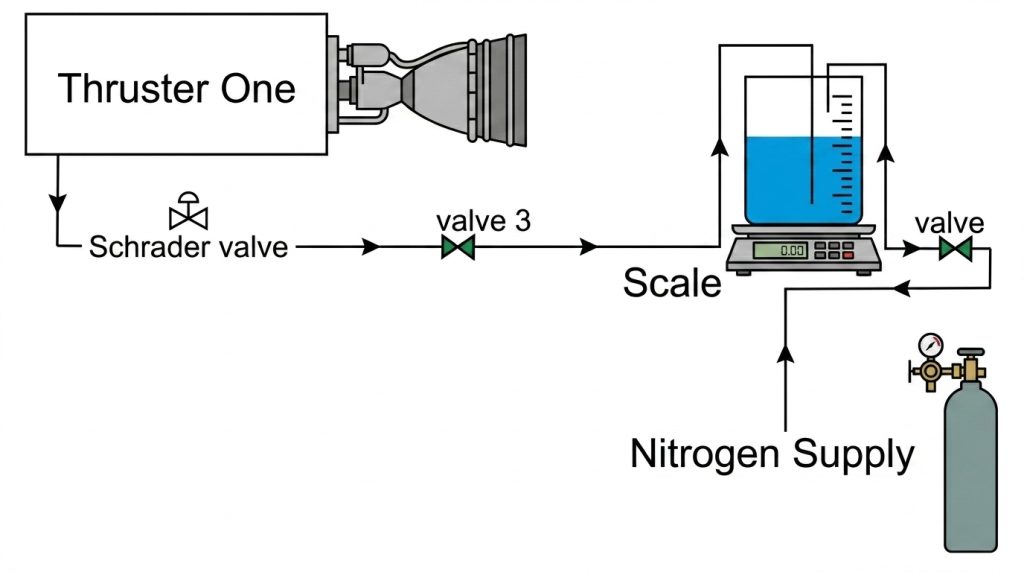
Water propulsion fuelling diagram for CubeSat showing Thruster One, tank, valves, nitrogen pressure system, and fuel flow process

The diagram shows how Thruster One is fuelled with water. The fuel is stored in a tank connected to a scale and is fed into Thruster One. Nitrogen from the cylinder creates pressure in the tank, causing the fuel to flow through the line via Valve 3 and the Schrader valve into the engine. The scale indicates how much fuel has been dispensed from the tank, so it is used to monitor the refueling volume. When the required amount of fuel has been delivered, the valves close and refueling stops.

Benefits of On-Site Fuelling with Water Propulsion

  • Safety
    Water is not a toxic component, thus fuelling becomes much safer for people and equipment.
  • Simplicity
    The fuelling system is simple and doesn’t demand any specialized procedures or conditions.
  • Non-hazardous
    There is no need to handle hazardous chemicals, which reduces safety requirements.
  • On-site fuelling
    Refueling can be performed directly at the customer’s laboratory, without the need for specialized facilities.

The main advantage is that there is no hazardous handling: no need to work with hazardous substances, which means fewer risks and a simpler process overall.

All of this is particularly important for CubeSat missions:

Speeds up launch — fewer complex procedures, faster preparation

Reduces costs — no need for expensive systems or handling hazardous materials

Simplifies integration — easier to integrate the system into a satellite

Fewer barriers for customers — no specialized infrastructure or complex preparation required

Ultimately, water propulsion offers a simpler and more flexible approach to launching satellites and makes space missions more accessible.

About SteamJet Space Systems

SteamJet Space Systems is a leading UK-based provider of high-performance satellite propulsion solutions. We specialise in water-based thrusters designed specifically for CubeSats and Small Satellites (SmallSats), with a strong focus on water-based thruster safety.

By pioneering the use of green propellants and intelligent thermal engineering, SteamJet enables complex LEO (Low Earth Orbit) manoeuvres — including orbital maintenance, collision avoidance, and de-orbiting — without the risks associated with toxic hydrazine or high-pressure cold gas systems, advancing green propulsion for space missions.

Steamjet Propulsion Technology

Our modular systems are engineered for seamless integration and maximum safety compliance:

Steam TunaCan Thruster: A compact, high-efficiency solution for 1U-3U CubeSats.

Steam Thruster One: Scalable propulsion for larger SmallSat constellations.

Discover how SteamJet’s sustainable space propulsion innovations are providing the safety and reliability required for the next generation of crewed and robotic missions. Contact our engineering team for technical specifications and ICDs.

Bi-Propellant Chemical Propulsion for Small Satellites

water-based propulsion system for small satellites using safe propellant

Benefits, Challenges, and Alternatives

A bi-propellant chemical propulsion is a system that utilizes two components  – fuel and oxidizer. Once they come into contact, the ignition occurs and delivers thrust.

This type of thruster is often used for satellites and in deep space. They are used for maneuvers and orbit correction.

Bi-propellant chemical thrusters are a solution that is used often because they can generate high thrust and respond quickly. These characteristics make them indispensable for complex and precise space missions.

What Is a Bi-Propellant Chemical Propulsion?

Unlike other types of thrusters, bi-propellant chemical thrusters use two different components. In the hypergolic case,two separate propellants are injected into the combustion chamber, where they react and ignite. As a result, the chemical reaction generates high-temperature and high-pressure gas. Non-hypergolic propellants require dedicated spark-ignition hardware, which adds mass and software complexity to the CubeSat bus, or catalytic system to ignite.

The term “bi-propellant” refers precisely to the use of two components (bi = two): fuel and oxidizer. This allows for greater thrust compared to other types of engines.

Hydrazine and monomethylhydrazine are the most common propellants. Nitrogen tetroxide is usually utilized as an oxidizer. These components are very effective and produce a powerful thrust. However, they are toxic and require strict storage and handling conditions.

Currently, there are safer propellant options. For example, nitrous oxide and propene. They are less toxic and easier to handle. It allows for the reduction of the risks and costs of the missions. These propellants are much better suited for small satellites. While these alternatives reduce toxicity risks, they shift the engineering burden toward high-pressure fluid management and complex thermal conditioning to prevent phase changes in the feed lines.

How Bi-Propellant Chemical Thrusters Work

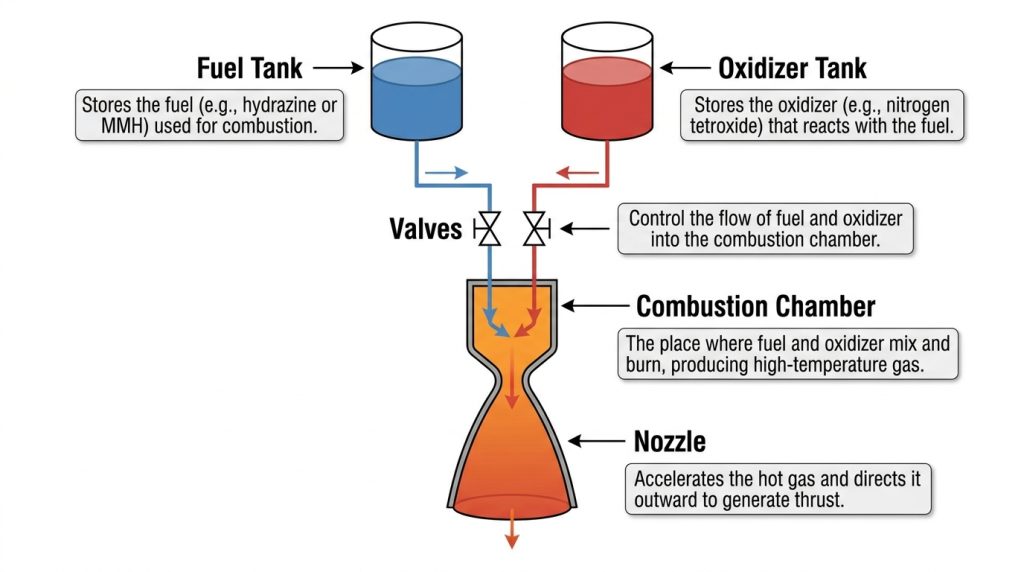
bi-propellant chemical propulsion diagram showing fuel and oxidizer interaction

This type of thruster operates due to the precise interaction of the two components. Propellant and oxidizer must be stored separately and delivered into the combustion chamber at the right moment. Valves regulate the flow and ensure the correct ratio for effective combustion.

This configuration allows for high power output and rapid changes in thrust, but requires a complex design and precise system control.

Advantages of Bi-Propellant Thrusters

Bi-propellant chemical thrusters are valued for their high power and reliability:

  • High thrust
    These thrusters are capable of generating high thrust in a short time. It is important for complicated and energy-demanding maneuvers.
  • Quick response
    The system turns on and off rapidly to guarantee the precise control of the thrust.
  • Perfect for maneuvering
    Orbit correction and other complex applications in space.

Limitations of Bi-Propellant Thrusters

Despite their high power, bi-propellant thrusters have significant limitations. Especially when it comes to the small satellites.

  • Toxic propellants
    The components used for combustion are dangerous for people and require strict safety measures.
  • Complicated storage system
    Propellant and oxidizer have to be stored separately. Also, it is important to maintain pressure and temperature, which makes the design more sophisticated.
  • Thermal Management
    For CubeSats, the structural interface must act as a thermal break to protect the bus electronics  from “thermal soakback”, and the software must include “thermal wait” periods between pulses to allow for heat dissipation.
  • High cost
    Due to their complex systems and safety requirements, these thrusters are expensive.
  • Safety challenges
    Toxic components increase risks at all the operating stages.
  • Sophisticated integration
    Installation of this kind of thruster requires more resources and time, particularly for small satellites.

Bi-propellant thrusters are not the most convenient solution for CubeSats and small satellites, where simplicity, safety, and affordability are of the utmost importance.

Bi-Propellant vs Other Propulsion Systems

There are various types of propulsion systems available today.

The monopropellant system utilizes one component, the design is simpler, but the thrust is not as powerful.

Cold gas propulsion is the least complicated system. It is safe and reliable, but the efficiency is low.

Water-based propulsion is a modern and safe solution. Instead of toxic propellant, it uses water. Thus, it is easier to store and suits well for CubeSats and small satellites.

Bi-Propellant vs Water-Based Propulsion

Parameter
Bi-Propellant
Water-Based
Propellant
Toxic chemicals
Water
Complexity
Very high
Low
Safety
Low
High
Cost
High
Low
Integration
Complex
Simple

When to Choose a Bi-Propellant Thruster

Bi-propellant chemical thrusters are a powerful and effective solution, however they are not versatile. This system works well for large satellites and sophisticated missions that demand high thrust and rapid response. Although, for small satellites it usually turns out to be too complicated, expensive, and demanding in terms of safety concerns. If simplicity, low cost, safe operation, and quick integration are crucial for the mission, it is better to consider other alternatives.

When Water-Based Propulsion Is a Better Choice

Compact size and simple operations are vital for CubeSats and small satellites. Water-based propulsion systems are much easier to integrate, hence it is usually more suitable for missions that have limited resources. Water-based systems, like those from SteamJet, offer superior “volumetric specific impulse” because water can be stored unpressurized in conformally shaped tanks.

About SteamJet Space Systems

SteamJet Space Systems is a leading UK-based provider of high-performance satellite propulsion solutions. We specialise in water-based thrusters designed specifically for CubeSats and Small Satellites (SmallSats), with a strong focus on water-based thruster safety.

By pioneering the use of green propellants and intelligent thermal engineering, SteamJet enables complex LEO (Low Earth Orbit) manoeuvres — including orbital maintenance, collision avoidance, and de-orbiting — without the risks associated with toxic hydrazine or high-pressure cold gas systems, advancing green propulsion for space missions.

Steamjet Propulsion Technology

Our modular systems are engineered for seamless integration and maximum safety compliance:

Steam TunaCan Thruster: A compact, high-efficiency solution for 1U-3U CubeSats.

Steam Thruster One: Scalable propulsion for larger SmallSat constellations.

Discover how SteamJet’s sustainable space propulsion innovations are providing the safety and reliability required for the next generation of crewed and robotic missions. Contact our engineering team for technical specifications and ICDs.
Hall-effect Thruster: Electric Propulsion for CubeSats and Small Satellites

Thruster One in the foil

A Hall thruster, or Hall-effect thruster, is a type of electric propulsion system often used in space for satellite navigation. It generates thrust by accelerating charged particles, typically xenon.

This type of thruster is usually utilized for various tasks:

  • CubeSat and small satellite missions in deep space
  • orbit correction
  • station keeping

Hall-effect thrusters are among the most widely used electric propulsion technologies. Its effectiveness and stability make it suitable for long-duration space missions.

What Is a Hall-effect Thruster?

A Hall-effect thruster is an electric thruster that doesn’t burn fuel, but functions due to the acceleration of charged particles (ions).

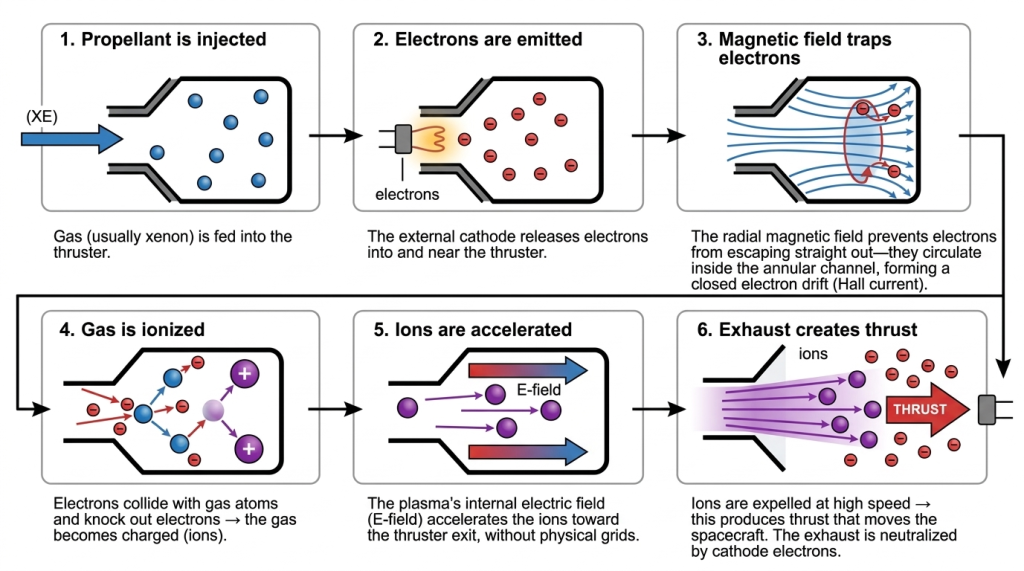
The operating principle is based on electric thrust. A radial magnetic field traps electrons that ionize the propellant inside the thruster. After that, these positive ions are accelerated with electric and magnetic fields, creating thrust.

The name “Hall” is connected to the Hall effect. It is a physics phenomenon that helps to control electrons in the thruster, which in turn makes the acceleration process more efficient.

How Hall-effect Thrusters Work

Hall Thruster Scheme: Step-by-Step Electric Propulsion Process

Advantages of Hall Thrusters

Hall-effect thrusters have several important advantages:

  • High efficiency specific impulse. These thrusters use less propellant compared to other types. Thus, they can operate longer with the same amount of propellant.
  • Stable thrust. These thrusters provide stable and predictable thrust, which is crucial for precise maneuvering in space.
  • Suitable for long-duration missions. Due to its stability and efficiency, these thrusters are well prepared to perform in missions that last months and even years.

Limitations of Hall Thrusters

Although hall-effect thrusters are very efficient, they too have a number of limitations. Especially when it comes to CubeSats and small satellites.

  • Xenon is an expensive gas that is not easy to store and transport in space.
  • A complicated system to inject the propellant, which makes the design more sophisticated.
  • Over time, the thruster’s internal walls wear out due to channel erosion. It shortens the service life.
  • This type of thruster demands significant electric resources that are not always available in small satellites.
  • Not always suitable for CubeSats.

Alternatives to Hall-effect Thrusters

There are various propulsion systems that create thrust in space.

Cold gas – simple systems that release gas. It is safe, but low efficiency.

Chemical propulsion – traditional propulsion systems. They are powerful, but expensive and complicated for small satellites.

Ion thrusters – electric systems similar to Hall-effect thrusters. These types of thrusters are effective; they demand advanced equipment and rare gases.

Water-based propulsion – a safe and available alternative. They use water instead of xenon; they are easier to store and work well for CubeSats and small satellites.

Water-Based Thrusters vs Hall Thrusters

Parameter
Hall Thruster
Water-Based Thruster
Propellant
Xenon
Water
Complexity
High
Lower
Cost
High
Low
Safety
Moderate
High
Storage
Complex
Simple

Hall-effect thrusters are well-suited for high-power missions that demand high thrust. Also, deep space and long-duration missions, where the thruster is expected to perform for months and even years.

Water-based thrusters are especially compatible with CubeSats and small satellites. They are perfect for cost-sensitive missions that require rapid deployment and simplicity in operations.

Hall-effect thrusters are powerful, but complicated and expensive thrusters. The space electric propulsion market is evolving, with an increasing focus on simpler and more affordable solutions. Water-based propulsion is a practical alternative, especially for small satellites and CubeSats.

About SteamJet Space Systems

SteamJet Space Systems is a leading UK-based provider of high-performance satellite propulsion solutions. We specialise in water-based thrusters designed specifically for CubeSats and Small Satellites (SmallSats), with a strong focus on water-based thruster safety.

By pioneering the use of green propellants and intelligent thermal engineering, SteamJet enables complex LEO (Low Earth Orbit) manoeuvres — including orbital maintenance, collision avoidance, and de-orbiting — without the risks associated with toxic hydrazine or high-pressure cold gas systems, advancing green propulsion for space missions.

Steamjet Propulsion Technology

Our modular systems are engineered for seamless integration and maximum safety compliance:

Steam TunaCan Thruster: A compact, high-efficiency solution for 1U-3U CubeSats.

Steam Thruster One: Scalable propulsion for larger SmallSat constellations.

Discover how SteamJet’s sustainable space propulsion innovations are providing the safety and reliability required for the next generation of crewed and robotic missions. Contact our engineering team (link) for technical specifications and ICDs.