
SteamJet Water Thruster Selected for Artemis II CubeSat Critical Orbit Correction

SteamJet Water Thruster Powers Critical Artemis II CubeSat Maneuver

UK-based startup SteamJet Space Systems has been selected to provide the propulsion unit for an ambitious CubeSat mission flying as part of Artemis II, NASA’s first crewed return to the Moon in more than 50 years. The mission represents a major milestone for both SteamJet and sustainable in-space propulsion technologies.

The CubeSat, developed by South Korea’s NaraSpace, will operate in a highly elliptical Earth orbit. Once released, SteamJet’s water-based propulsion system will play a critical role in preventing atmospheric re-entry and enabling the spacecraft to carry out its scientific mission.

SteamJet Propulsion Supporting the Artemis II Mission

“Our participation in a mission that is part of NASA’s Artemis II programme is a major milestone for our team,” said Marco Pavan, CEO of SteamJet Space Systems.

“This selection validates our technology as both sustainable and capable of operating in complex orbital environments. It demonstrates that CubeSats and small satellites no longer need to compromise on performance to adopt green propulsion solutions.”

The CubeSat, named K‑RadCube, will initially be placed into a highly elliptical orbit with an apogee of approximately 70,000 km and a critically low perigee. Without corrective manoeuvres, the spacecraft would re-enter Earth’s atmosphere during its very first orbit.

High-Performance Orbital Manoeuvre Using Water-Based Propulsion

Traditionally, only chemical propulsion systems, with their high thrust and specific impulse, could perform such rapid and demanding orbital corrections. SteamJet’s propulsion system however, achieves comparable performance using water as propellant.

Shortly after deployment, the thruster will execute a continuous 12-hour burn to raise the perigee to approximately 200 km. This manoeuvre will prevent atmospheric re-entry and allow the spacecraft to operate safely within Earth’s radiation belts.

If successful, this operation will represent one of the longest continuous in-orbit burns ever performed by a water-based propulsion system, setting a new benchmark for sustainable in-space propulsion.
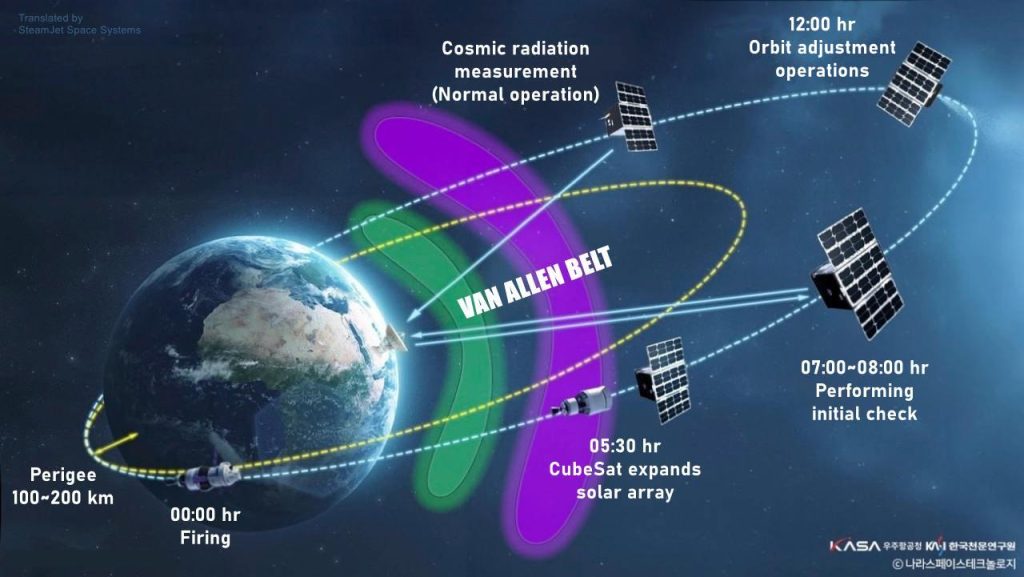
SteamJet Water Thruster Powers Critical Artemis II CubeSat Maneuver

Key Objectives of the SteamJet Thruster on Artemis II

 
  1. Perigee correction to approximately 200 km
  2. Orbit adjustment and stabilisation
  3. Extension of the CubeSat operational lifetime
This mission therefore demonstrates how sustainable propulsion technologies can now support advanced orbital operations for CubeSats and small satellites. SteamJet’s system delivers high performance without the use of toxic or high-pressure propellants, offering a safer and greener alternative to traditional chemical propulsion.
About SteamJet Space Systems

SteamJet Space Systems is a UK-based startup developing water-based propulsion systems for CubeSats and Small Satellites. Its proprietary steam-generation technology offers a green, safe, and sustainable alternative for in-space manoeuvres, enabling precise orbital control without the use of toxic or high-pressure propellants.

Detailed technical specifications, test data, and CAD models for the Steam Thruster One are available on the website. Discover how SteamJet innovations are shaping the future of sustainable satellite propulsion.

From Classroom to Orbit: Train Future Engineers with SteamJet CubeSat Propulsion Systems

CubeSat propulsion systems for education

Today, the space industry is developing rapidly, which presents additional challenges to academic programs. It is no longer sufficient to teach theory to students who train for careers in aerospace, satellite operations, and mission control. They need hands-on, practical experience with real CubeSat propulsion systems. However, many university programs still offer simulation-based learning in a classroom, which leads to a critical gap between education and actual spaceflight experience.

The Aerospace Education Gap in CubeSat Propulsion

Many universities worldwide provide excellent fundamental knowledge in orbital mechanics, control systems, satellite design, and mission planning. Students run simulations, model satellite behaviors, and plan maneuvers. But many recent graduates find themselves not fully prepared for real-world in-orbit operations.

This gap between theory and practice is particularly noticeable in areas like CubeSat propulsion technology, trajectory optimization, and satellite navigation. Lack of operational experience may lead to expensive mistakes. Thus, it is clear that students need earlier access to real spacecraft systems.

Why Hands-On CubeSat Propulsion Training Matters

There is a big difference between simulation and operating a thruster in orbit. When students install thrusters, test them, and eventually operate them in flight, they gain invaluable technical and problem-solving skills, as well as build professional confidence. These kinds of skills and approaches are impossible to teach only through software tools.

Real-life experience with propulsion systems allows students to practice mission-critical roles:

  • Planning and executing orbital maneuvers
  • Monitoring system performance
  • Diagnosing and responding to challenges in real-time

Steam-Based CubeSat Propulsion for Universities

Steam-based propulsion systems are a perfect fit for educational programs. Our technology uses safe, non-toxic water propulsion and operates at low pressure. Hence, it is ideal for student programs where simplicity, safety, and accessibility matter most.

  • No hazardous materials – water is safe to handle and doesn’t require specialized certification
  • Low-pressure operation – reduces lab and integration risks
  • CubeSat-compatible – designed for small satellite missions
  • Simple electronics – easy to integrate and operate with limited resources

Real Missions for Future Engineers

By working with spacecraft propulsion systems students receive experience with a full mission lifecycle, and they learn to make decisions that have real consequences. This kind of training builds precisely the expertise that the current aerospace industry demands.

Whether your university is launching its first CubeSat or expanding a satellite program, SteamJet offers a tangible path to professional-level experience. Our systems give student teams the chance to build, test, and fly real space propulsion — all while staying safe and budget-friendly.

Interested in integrating space propulsion training into your university’s program? We’re here to help. Contact SteamJet to learn how our technology can support your student satellite missions and help bridge the gap between theoretical education and practical, real-world spacecraft operations.

We offer a special program and pricing for universities and academic institutions — making it easier to bring real propulsion systems to your students. Learn more about our Academia program for universities and academic institutions.

Detailed technical specifications, test data, and CAD models for our new space engines are available on our website. Steam TunaCan Thruster and Steam Thruster One. Discover how SteamJet innovations are shaping the future of sustainable satellite propulsion.