
University-led CubeSat missions have become an established pathway for practical space engineering education. To give an example, NASA’s CubeSat Launch Initiative has selected 228 missions, including 183 that have launched. Today, many universities worldwide prepare the next generation of space engineers with a strong theoretical background. However, research titled Aerospace Engineering Skills Gap Analysis: What Employers Want vs What Degree Programs Teach identifies a mismatch between academic curricula and industry needs. The study highlights limited opportunities to develop practical skills and gain professional experience during university studies, pointing to the need for more hands-on learning opportunities in space engineering.
Research on skills gaps in the space sector has identified limited opportunities for students to gain practical experience and develop industry-relevant skills during their studies. Consequently, graduates may enter the workforce without sufficient exposure to real spacecraft propulsion hardware, satellite subsystem integration, or hands-on testing. Providing access to practical training equipment can help universities address this challenge.
The Challenge of Acquiring Practical Spaceflight Experience
When preparing for careers in astrodynamics and satellite operations, students use computer modelling and simulations to study orbital dynamics, plan manoeuvres, and analyse spacecraft behaviour. However, simulations cannot fully reproduce the practical aspects of working with physical propulsion hardware. Testing a manoeuvre with real equipment also requires students to account for actual system parameters, measurement uncertainties, and actuator limitations. Combining simulation-based exercises with hands-on experiments can therefore help students connect theoretical knowledge with the practical demands of spacecraft operations.
As a result, graduates may enter the industry with limited hands-on experience with actual spacecraft propulsion systems. When working on complex space missions, they must apply their theoretical knowledge to real hardware, account for practical engineering constraints, and interpret data from physical systems. Gaining this experience during university studies can help students prepare for the technical challenges they may encounter in their professional careers.
Why Water-Based Thrusters Are Ideal for Academic CubeSat Missions
For this reason, SteamJet water propulsion thrusters are a natural fit for student satellite missions led by universities and research teams. They’re easy to work with, inherently safe, and designed to lower the barriers to real in-orbit learning — without the complications that come with traditional space propulsion systems.
Key Advantages of Water Propulsion for Universities:
- Water-based propellant – SteamJet TunaCan uses water as a non-hazardous propellant and operates with a low-pressure liquid system. Its design follows NASA GSFC-STD-7000A and ESA ECSS-E-ST-10-03C standards, supporting its integration into small satellite missions.
- Low-pressure operation makes it safe for classroom and lab environments.
- The satellite thruster mounts externally, preserving internal CubeSat volume for payloads.
- Simple electronics ensure quick integration with educational and research systems.
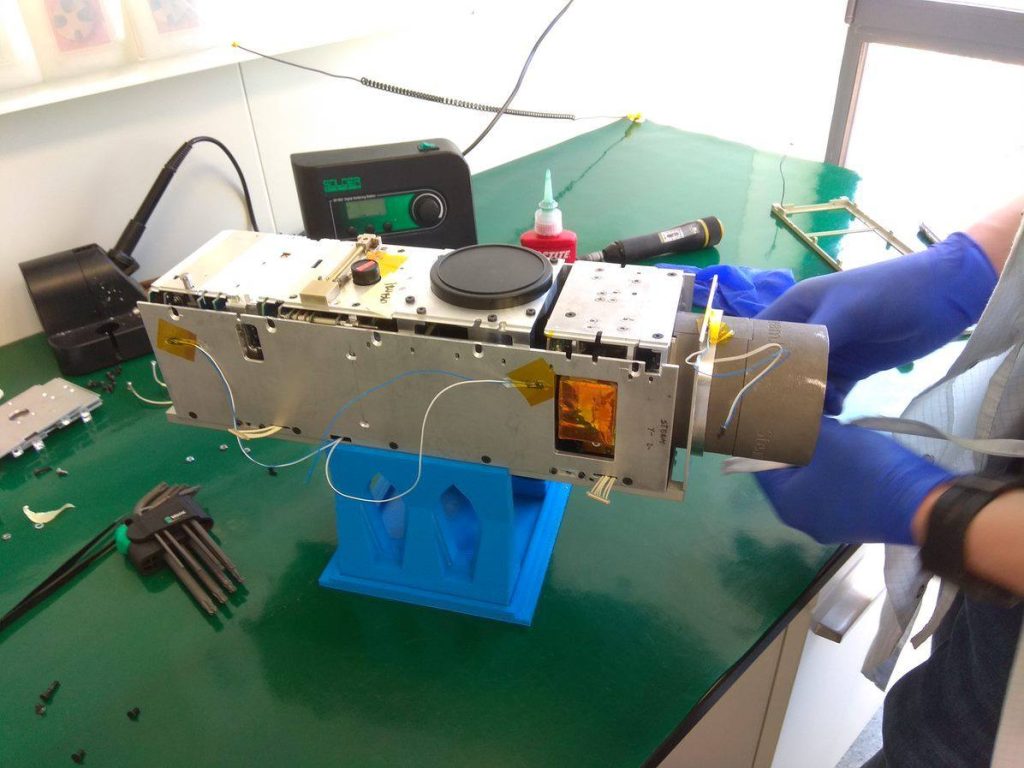
By incorporating SteamJet systems, universities enable students to engage directly with real spacecraft propulsion hardware — giving them an experience that goes far beyond simulation.
Applications in Academic Programs
1. Training the Next Generation of Satellite Control Operators
In practice, future mission planners and satellite control operators can work directly with orbital dynamics and propulsion systems, building the critical skills required for satellite trajectory planning and spacecraft navigation.
2. Hands-On Experience with Spacecraft Propulsion
As a result, SteamJet systems allow students to practice orbital manoeuvres and trajectory planning, helping them gain real experience in spacecraft propulsion control and mission execution.
3. Satellite Constellation Deployment
Additionally, student teams get the chance to manage satellite constellations, learning to coordinate cluster behaviour and positioning.
4. Orbit Optimisation
In many cases, educational missions are often launched as secondary payloads; hence, they begin in suboptimal positions. CubeSat propulsion systems provide a chance for students to perform orbit adjustments.
5. Proximity Operations
Finally, using CubeSat thruster units, students can simulate close-range manoeuvres, alignment, and docking preparation.
Next Generation of Space Engineers
The next wave of space innovation depends on empowering students with more than theory. By giving them access to new space engines and operational space propulsion systems, academic institutions play a direct role in shaping mission-ready professionals.
SteamJet’s spacecraft propulsion technologies — including the TunaCan Thruster and Thruster One — offer a safe, effective foundation for experiential learning. These systems are specifically developed to support the growing needs of small satellite programs and to drive innovation in satellite propulsion across the academic landscape.
Ready to Bring In-Orbit Propulsion to Your Classroom?
Interested in integrating space propulsion training into your university’s program? We’re here to help. Contact SteamJet to learn how our technology can support your student satellite missions and help bridge the gap between theoretical education and practical, real-world spaceflight. Learn more about our Academia program for universities and academic institutions.
About SteamJet Space Systems
SteamJet Space Systems is a leading UK-based provider of high-performance satellite propulsion solutions. We specialise in water-based propulsion solutions designed specifically for CubeSats and Small Satellites (SmallSats), prioritising operational safety and rapid launch integration.
By pioneering the use of green propellants and intelligent thermal engineering, SteamJet enables complex LEO (Low Earth Orbit) manoeuvres — including orbital maintenance, collision avoidance, and de-orbiting — without the risks associated with toxic hydrazine or high-pressure cold gas systems, advancing green propulsion for space missions.
Steamjet Propulsion Technology
Our modular systems are engineered for seamless integration and maximum safety compliance:
SteamJet TunaCan Thruster: A compact, high-efficiency solution for 1U-3U CubeSats.
SteamJet TunaTank Thruster: A safe, high-performance electrothermal propulsion system.
SteamJet Thruster One: Scalable propulsion for larger SmallSat constellations.
Discover how SteamJet’s sustainable space propulsion innovations are providing the safety and reliability required for the next generation of crewed and robotic missions. Contact our engineering team for technical specifications and ICDs.