
In-space propulsion systems are in high demand because they allow small satellites to achieve attitude and orbit control, maneuver and ensure end-of-life deorbiting. Various types of space propulsion systems are currently available and it is important to consider which option is more suitable for a specific mission. Not only do satellite thrusters introduce a spectrum of new possibilities and capabilities to the space mission, but they also help manage space traffic and prevent the increase of debris.
Space propulsion systems may be broadly categorized into chemical, electric, and cold-gas systems. Selecting the most fitting thruster is a vital step for any space mission that requires in-space maneuverability and control.
Space Propulsion Systems
Chemical Systems
In thrusters that utilize chemical propellant a chemical reaction occurs to create gas, which expands and is released to generate thrust. Different chemicals are usually used as propellant, including hydrazine, ammonium dinitramide (ADN) and AF-M315E to name a few. Some systems are monopropellant, meaning that they operate with a single chemical, and others are bi-propellant, using a mixture of two.
Despite their wide usage and reliability, chemical space propulsion systems have certain drawbacks that can limit their effectiveness. Namely, many chemical propellants are toxic and hazardous to the spacecraft and the environment. Also, these systems may be expensive, and complicated in terms of installation and handling of toxic materials.
Electric Propulsion Systems
In this type of space propulsion system electric or magnetic force is utilized to expel a propellant. As a result, a propulsive force in the opposite direction is generated. They generally offer a higher specific impulse compared to the chemical ones. Thus, less propellant is required and higher mass efficiency is provided.
Electric space propulsion systems require a substantial power source, which leads to a more complicated design that includes processing and control units. Overall, this increases the thruster weight.
Cold-gas Propulsion Systems
Cold-gas space propulsion systems are widely used and their operating principle is based on expanding an inert, pressurised gas to generate thrust. This type of system is relatively inexpensive and provides high reliability. Their main disadvantage is the limited total impulse capability.
Water-based Propulsion Systems
Water-based space propulsion systems vary depending on the technology used to generate thrust. They are safe, affordable, and environmentally friendly. The main propellant is water, which is non-toxic, stable, and easy to handle.
At SteamJet Space we manufacture water-based compact electrothermal propulsion systems for micro and nanosatellites. Their operating principle is based on the fuel that is heated electrically into superheated steam and then ejected through a supersonic nozzle. The high temperature reached by the steam allows to achieve a high Specific Impulse.
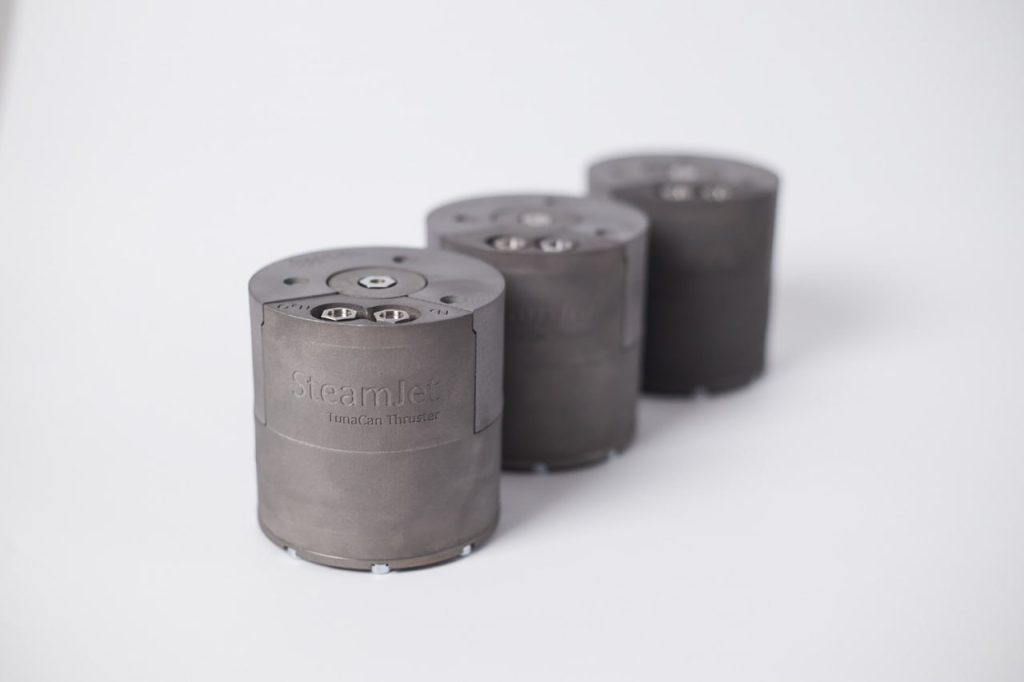
Tunacan Thruster is optimal for CubeSats taking no space inside the satellite and needs less than 20W to be operated.
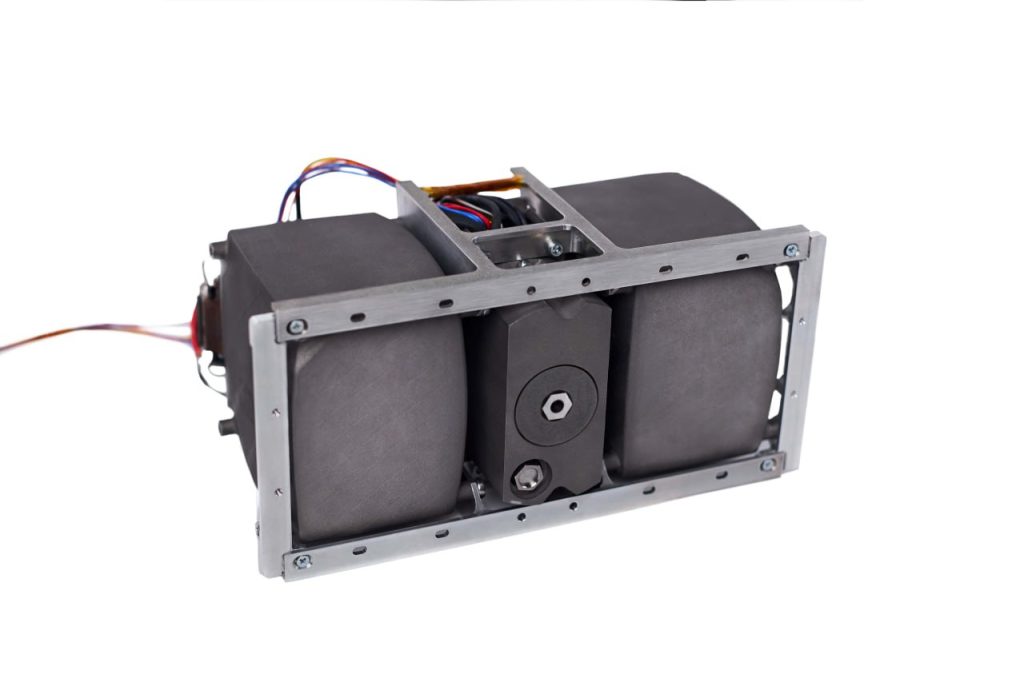
Thruster One is optimal for large CubeSats and Small Satellites having a flexible customizable design and also needing less than 20W.
SteamJet thrusters are safe because there are no toxic or flammable substances. They provide performance similar to chemical propulsion. On top of that, they require low power consumption, focused on the Small Satellite power restrictions.
About SteamJet Space Systems
SteamJet Space Systems is a leading UK-based provider of high-performance satellite propulsion solutions. We specialise in water-based propulsion solutions designed specifically for CubeSats and Small Satellites (SmallSats), prioritising operational safety and rapid launch integration.
By pioneering the use of green propellants and intelligent thermal engineering, SteamJet enables complex LEO (Low Earth Orbit) manoeuvres — including orbital maintenance, collision avoidance, and de-orbiting — without the risks associated with toxic hydrazine or high-pressure cold gas systems, advancing green propulsion for space missions.
Steamjet Propulsion Technology
Our modular systems are engineered for seamless integration and maximum safety compliance:
SteamJet TunaCan Thruster: A compact, high-efficiency solution for 1U-3U CubeSats.
SteamJet TunaTank Thruster: A safe, high-performance electrothermal propulsion system.
SteamJet Thruster One: Scalable propulsion for larger SmallSat constellations.
Discover how SteamJet’s sustainable space propulsion innovations are providing the safety and reliability required for the next generation of crewed and robotic missions. Contact our engineering team for technical specifications and ICDs.