
A Hall thruster, or Hall-effect thruster, is a type of electric propulsion system often used in space for satellite navigation. It generates thrust by accelerating charged particles, typically xenon.
This type of thruster is usually utilized for various tasks:
- CubeSat and small satellite missions in deep space
- orbit correction
- station keeping
Hall-effect thrusters are among the most widely used electric propulsion technologies. Its effectiveness and stability make it suitable for long-duration space missions.
What Is a Hall-effect Thruster?
A Hall-effect thruster is an electric thruster that doesn’t burn fuel, but functions due to the acceleration of charged particles (ions).
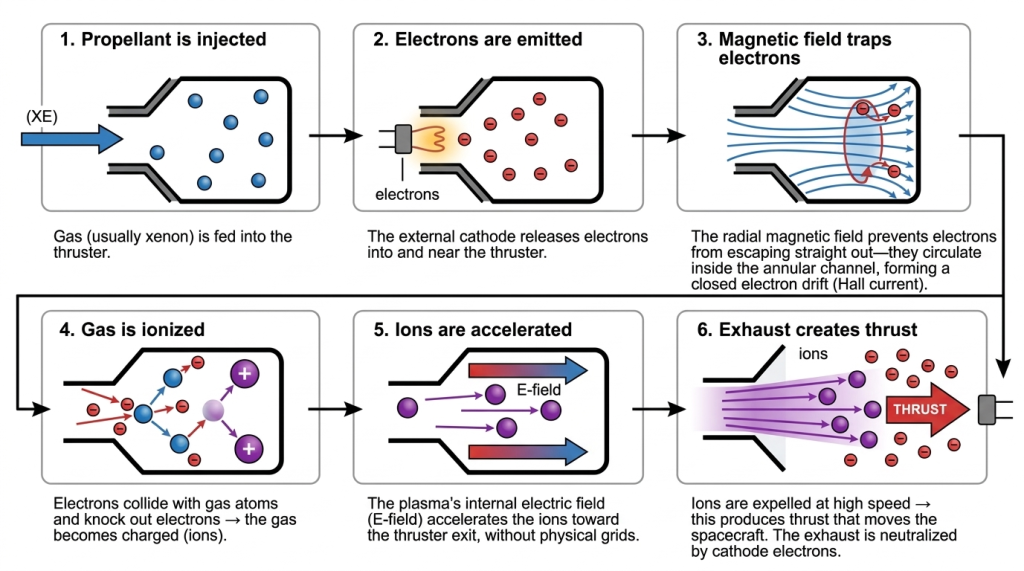
The operating principle is based on electric thrust. A radial magnetic field traps electrons that ionize the propellant inside the thruster. After that, these positive ions are accelerated with electric and magnetic fields, creating thrust.
The name “Hall” is connected to the Hall effect. It is a physics phenomenon that helps to control electrons in the thruster, which in turn makes the acceleration process more efficient.
How Hall-effect Thrusters Work
Advantages of Hall Thrusters
Hall-effect thrusters have several important advantages:
- High efficiency specific impulse. These thrusters use less propellant compared to other types. Thus, they can operate longer with the same amount of propellant.
- Stable thrust. These thrusters provide stable and predictable thrust, which is crucial for precise maneuvering in space.
- Suitable for long-duration missions. Due to its stability and efficiency, these thrusters are well prepared to perform in missions that last months and even years.
Limitations of Hall Thrusters
Although hall-effect thrusters are very efficient, they too have a number of limitations. Especially when it comes to CubeSats and small satellites.
- Xenon is an expensive gas that is not easy to store and transport in space.
- A complicated system to inject the propellant, which makes the design more sophisticated.
- Over time, the thruster’s internal walls wear out due to channel erosion. It shortens the service life.
- This type of thruster demands significant electric resources that are not always available in small satellites.
- Not always suitable for CubeSats.
Alternatives to Hall-effect Thrusters
There are various propulsion systems that create thrust in space.
Cold gas – simple systems that release gas. It is safe, but low efficiency.
Chemical propulsion – traditional propulsion systems. They are powerful, but expensive and complicated for small satellites.
Ion thrusters – electric systems similar to Hall-effect thrusters. These types of thrusters are effective; they demand advanced equipment and rare gases.
Water-based propulsion – a safe and available alternative. They use water instead of xenon; they are easier to store and work well for CubeSats and small satellites.
Water-Based Thrusters vs Hall Thrusters
Parameter | Hall Thruster | Water-Based Thruster |
|---|---|---|
Propellant | Xenon | Water |
Complexity | High | Lower |
Cost | High | Low |
Safety | Moderate | High |
Storage | Complex | Simple |
Hall-effect thrusters are well-suited for high-power missions that demand high thrust. Also, deep space and long-duration missions, where the thruster is expected to perform for months and even years.
Water-based thrusters are especially compatible with CubeSats and small satellites. They are perfect for cost-sensitive missions that require rapid deployment and simplicity in operations.
Hall-effect thrusters are powerful, but complicated and expensive thrusters. The space electric propulsion market is evolving, with an increasing focus on simpler and more affordable solutions. Water-based propulsion is a practical alternative, especially for small satellites and CubeSats.
About SteamJet Space Systems
SteamJet Space Systems is a leading UK-based provider of high-performance satellite propulsion solutions. We specialise in water-based thrusters designed specifically for CubeSats and Small Satellites (SmallSats), with a strong focus on water-based thruster safety.
By pioneering the use of green propellants and intelligent thermal engineering, SteamJet enables complex LEO (Low Earth Orbit) manoeuvres — including orbital maintenance, collision avoidance, and de-orbiting — without the risks associated with toxic hydrazine or high-pressure cold gas systems, advancing green propulsion for space missions.
Steamjet Propulsion Technology
Our modular systems are engineered for seamless integration and maximum safety compliance:
Steam TunaCan Thruster: A compact, high-efficiency solution for 1U-3U CubeSats.
Steam Thruster One: Scalable propulsion for larger SmallSat constellations.
Discover how SteamJet’s sustainable space propulsion innovations are providing the safety and reliability required for the next generation of crewed and robotic missions. Contact our engineering team (link) for technical specifications and ICDs.