
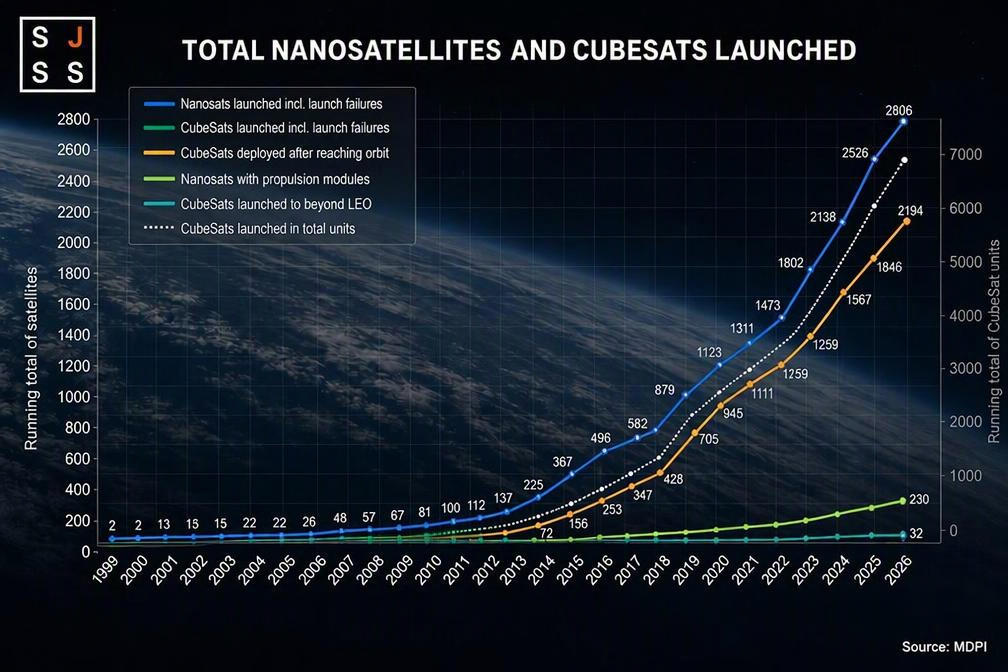
CubeSat propulsion systems are becoming an essential capability for modern small satellite missions. As CubeSats evolve from simple technology demonstrations to operational spacecraft, propulsion is required to maintain and adjust orbits, perform collision avoidance manoeuvres, manage satellite constellations, and enable controlled de-orbiting at the end of the mission.
The rapid growth of low Earth orbit activity has increased congestion and raised the importance of safe and sustainable propulsion solutions. Reliable propulsion is now a key enabler for mission longevity, regulatory compliance, and responsible use of space.
Water-Based CubeSat Propulsion for Sustainable Space Missions
Water-based propulsion is a breakthrough technology designed to improve both mission capability and sustainability. These systems use water as the primary propellant, converting it into thrust through thermal or resistive processes. By avoiding toxic chemicals, water-powered propulsion offers a safer and more environmentally responsible alternative to conventional propulsion technologies. In practice, these advantages translate into longer mission lifetimes and greater flexibility in orbital manoeuvres.
Configuration | Service life | Orbital change |
|---|---|---|
Without a propulsion system | 1.6 years | None |
SteamJet Thruster One | 8.3 years | ±170 km |
SteanJet TunaCan | 3 years |
±35 km |
Using water as a propellant makes propulsion systems easier to integrate, more affordable to operate, and safer to handle during manufacturing, testing, and launch preparation.
Low-Pressure Water as a Safe Propellant for CubeSat Propulsion
The choice of propellant has a major impact on the safety and cost of CubeSat propulsion systems. The hazards vary by substance: hydrazine, for example, is highly toxic, so its handling requires specific precautions. During fueling, hydrazine must be transported in a special tank; fueling requires leak detectors and emergency breathing equipment, evacuation of non-essential personnel, and operators wearing SCAPE suits supplied with air from outside the building (“Hydrazine: Toxic for Humans, but Satellites Love It”). These risks require strict safety procedures and often increase integration complexity and mission costs.
Water is a non-toxic, chemically stable, and widely available propellant. When used in low-pressure propulsion systems, it significantly reduces safety concerns while still providing reliable thrust for orbit control and manoeuvring. This makes water particularly well suited for CubeSat propulsion.
CubeSats are frequently launched as secondary payloads alongside larger spacecraft. In these shared launch environments, propulsion systems using hazardous propellants can pose risks to other payloads and to the launch vehicle. Water-based CubeSat propulsion minimises these risks while maintaining compatibility with rideshare missions.
Common Propulsion Use Cases
Modern propulsion systems enable a wide range of mission-critical operations that were previously difficult or impossible for small spacecraft:
- Collision Avoidance
Propulsion allows spacecraft to quickly change orbit in case of possible collision with another space object - Orbit Insertion and Correction
Propulsion allows spacecraft to reach and fine-tune their target orbit after deployment, improving mission accuracy and flexibility. - Orbit Maintenance
Atmospheric drag in low Earth orbit gradually reduces altitude. Propulsion compensates for this effect, helping maintain orbital parameters and extend mission lifetime. - Constellation Management
For missions involving multiple satellites, propulsion enables precise spacing, phasing, and formation control, allowing coordinated constellation operations. - End-of-Life De-Orbiting
Responsible space operations require controlled disposal. Propulsion systems provide the capability to safely de-orbit spacecraft, reducing long-term space debris.
About SteamJet Space Systems
SteamJet Space Systems is a leading UK-based provider of high-performance satellite propulsion solutions. We specialise in water-based propulsion solutions designed specifically for CubeSats and Small Satellites (SmallSats), prioritising operational safety and rapid launch integration.
By pioneering the use of green propellants and intelligent thermal engineering, SteamJet enables complex LEO (Low Earth Orbit) manoeuvres — including orbital maintenance, collision avoidance, and de-orbiting — without the risks associated with toxic hydrazine or high-pressure cold gas systems, advancing green propulsion for space missions.
Steamjet Propulsion Technology
Our modular systems are engineered for seamless integration and maximum safety compliance:
SteamJet TunaCan Thruster: A compact, high-efficiency solution for 1U-3U CubeSats.
SteamJet TunaTank Thruster: A safe, high-performance electrothermal propulsion system.
SteamJet Thruster One: Scalable propulsion for larger SmallSat constellations.
Discover how SteamJet’s sustainable space propulsion innovations are providing the safety and reliability required for the next generation of crewed and robotic missions. Contact our engineering team for technical specifications and ICDs.