
In January, the Mohammed Bin Rashid Space Centre (MBRSC) announced the development of the PHI-Demo mission under the Payload Hosting Initiative. Furthermore, the Initiative aims at providing an effective satellite platform that can host payloads for multiple purposes. The project includes a 12U modular satellite platform that is going to be designed in partnership with OQ Technology and SteamJet Space Systems. Specifically, SteamJet Space Systems is company specialising in sustainable CubeSat propulsion. As a result, the UAE intends to strengthen its position in space innovations.
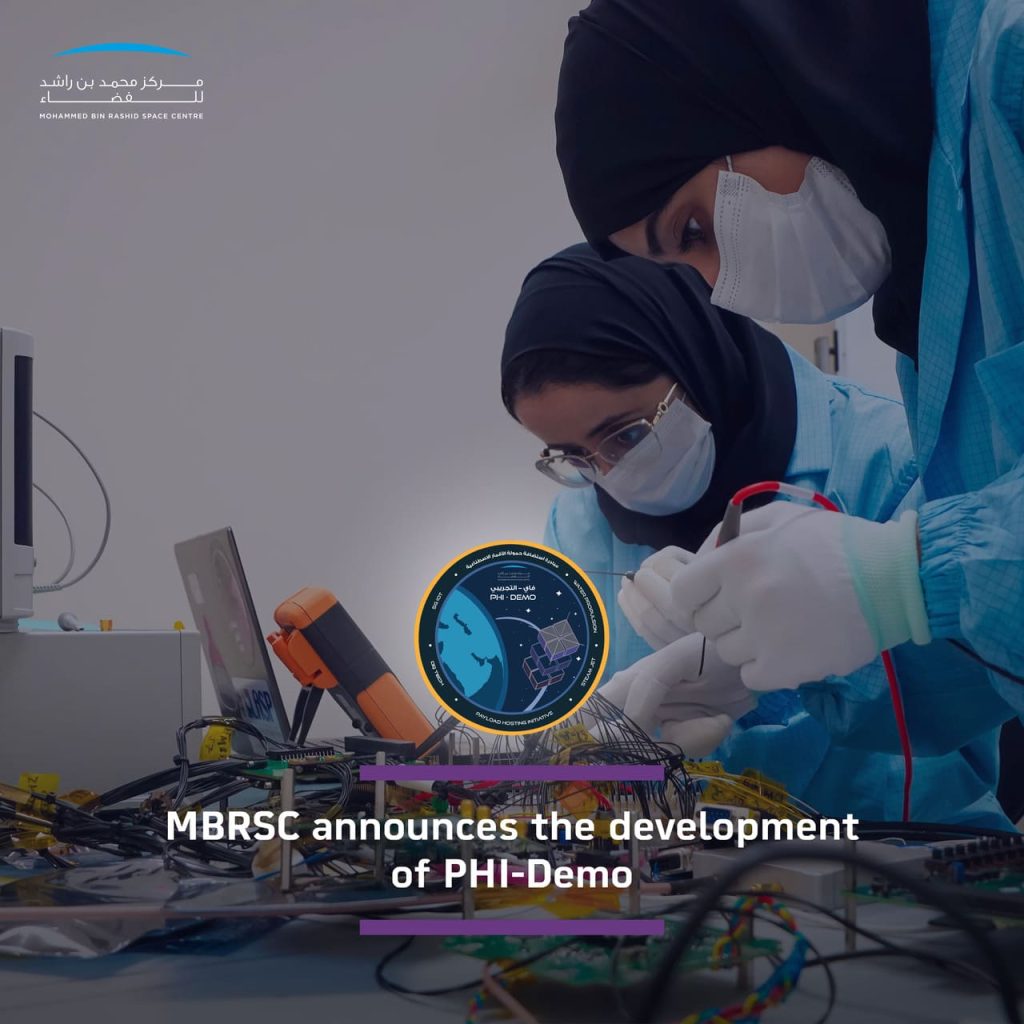
Photo Source: MBRSC, https://mediaoffice.ae/en
SteamJet’s Role in PHI-Demo
Together with an innovative IoT communication payload, PHI-Demo’s main goal will be to test SteamJet’s environmentally friendly propulsion subsystem. In particular, the Thruster One is going to showcase sustainable CubeSat propulsion in real mission conditions. Thruster One is a flexible water-powered resistojet. It provides high thrust — tens of times more than electric propulsion — while consuming very little power. Consequently, this makes it a significant innovation in sustainable CubeSat propulsion technology. Moreover, another major benefit of the Thruster One is the possibility to customize its water tanks size and shape to meet the mission requirements. It also improves the subsystem final integration into the spacecra, further enhancing integration into the spacecraft and advancing CubeSat propulsion efficiency.
The mission launch date is scheduled for Q4 2022. According to the Director-General of the MBRSC, His Excellency Salem Humaid AlMarri, said that this collaboration gave more opportunities for countries and entities to deploy and operate their own satellites in space. In addition, it would contribute to the advancement of satellite-related technologies.
According to the Head of Payload Hosting Initiative of the MBRSC, Zakaria Al Shamsi, the space sector’s future relies on possibilities for cooperation. And the Payload Hosting Initiative means a strategic step for the space sector.
Mission Impact and Strategic Importance
Marco Pavan, CEO of SteamJet Space Systems expressed his appreciation to have been selected for the first PHI mission. Moreover, he sees the partnership with MBRSC as an essential step towards a greener and safer approach to propulsion in the small satellite industry.
The PHI-Demo mission demonstrates how sustainable CubeSat propulsion is shaping the future of eco-friendly, efficient, and safe satellite missions.
Last year Mohammed Bin Rashid Space Centre (MBRSC) and the United Nations Office for Outer Space Affairs (UNOOSA) announced the Payload Hosting Initiative (“PHI”) and the signing of the Memorandum of Understanding for satellite payload hosting. The program starts in 2022 and plans to hold two satellite missions annually.
About SteamJet Space Systems
SteamJet Space Systems is a leading UK-based provider of high-performance satellite propulsion solutions. We specialise in water-based propulsion solutions designed specifically for CubeSats and Small Satellites (SmallSats), prioritising operational safety and rapid launch integration.
By pioneering the use of green propellants and intelligent thermal engineering, SteamJet enables complex LEO (Low Earth Orbit) manoeuvres — including orbital maintenance, collision avoidance, and de-orbiting — without the risks associated with toxic hydrazine or high-pressure cold gas systems, advancing green propulsion for space missions.
Steamjet Propulsion Technology
Our modular systems are engineered for seamless integration and maximum safety compliance:
SteamJet TunaCan Thruster: A compact, high-efficiency solution for 1U-3U CubeSats.
SteamJet TunaTank Thruster: A safe, high-performance electrothermal propulsion system.
SteamJet Thruster One: Scalable propulsion for larger SmallSat constellations.
Discover how SteamJet’s sustainable space propulsion innovations are providing the safety and reliability required for the next generation of crewed and robotic missions. Contact our engineering team for technical specifications and ICDs.