
SteamJet Space Systems will demonstrate spacecraft propulsion during the upcoming Artemis II mission with an orbiting correction for South Korea’s K-RadCube satellite to prevent its re-entry into the atmosphere. The manoeuvre uses a straightforward application of water.
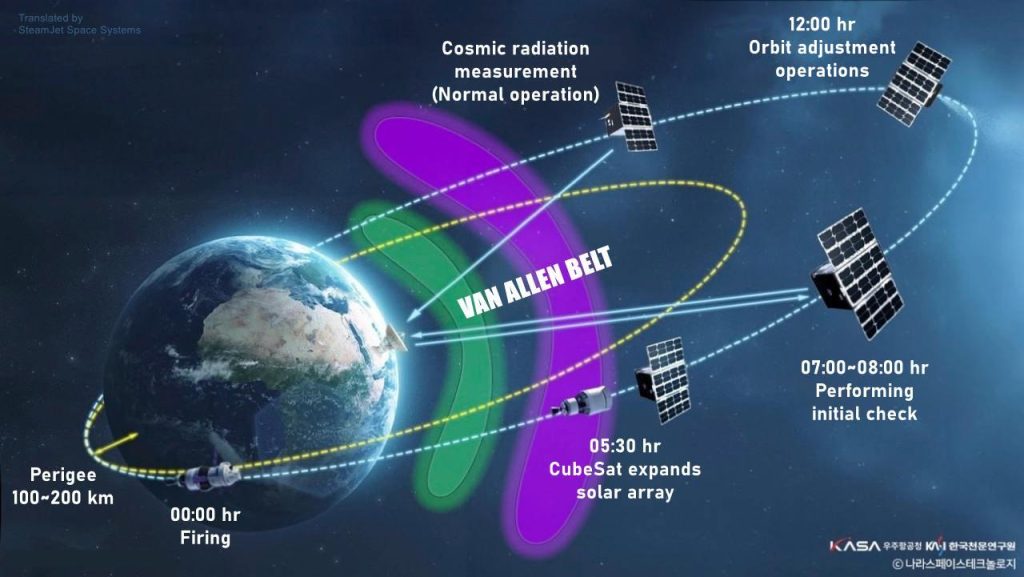
K-Rad Cube satellite, developed by South Korean NaraSpace, will be onboard NASA’s historic Artemis II mission, the first manned lunar mission in over 50 years. The CubeSat will face a challenge after it is deployed into a highly elliptical orbit. Its first perigee is within Earth’s upper atmosphere. Without orbital correction, the satellite will be lost.
That’s where SteamJet’s water thruster steps in.
“This mission is about demonstrating what water-based propulsion can do in high-stakes, real-world conditions,” said Marco Pavan, CEO of SteamJet Space Systems. “We’re performing a high-thrust, high-precision manoeuvre that was once reserved for chemical systems.”
Configuring the thruster to operate safely and efficiently over the prolonged burn presented one of the mission’s key challenges. For this reason, the team had to ensure the engine would not overheat. At the same time, the satellite needed to remain within safe temperature limits. In addition, sufficient heat was required to generate the needed thrust. All systems had to remain stable and operate smoothly for approximately 12 hours.
Mission Objective
The primary mission of the K-RadCube is to monitor cosmic radiation and analyse its effects on astronauts as it passes through the Van Allen radiation belts, located more than 1,000 kilometres above Earth. However, to extend its mission duration and avoid atmospheric re-entry after the first orbit, the satellite must raise its perigee to 200 km.
To achieve this, SteamJet’s spacecraft propulsion system will conduct a prolonged 12-hour burn, one of the longest single burns ever performed by a water-based thruster in space. The manoeuvre is intended to extend the operational mission lifespan.
Key Mission Parameters:
Launch Orbit: Highly elliptical, ~70,000 km apogee
Corrective Action: 12-hour prolonged burn to raise perigee to ~200 km
Propulsion System: SteamJet Thruster One (water-powered)
According to our calculations, the thruster will deliver more than 250 Ns of impulse, corresponding to roughly 170 g of water — about a quarter of the capacity of our tanks. As a result, a significant propellant margin remains for the mission.
Redefining the Frontiers of Green Propulsion
Previously, CubeSats that operate in these harsh environments would have required chemical propulsion — a costly, toxic, and complex solution. In contrast, SteamJet’s spacecraft propulsion technology offers the same performance without the hazards, a scalable option for deep-space and high-energy orbit missions.
Overall, the mission is a demonstration of sustainable propulsion for demanding orbit applications, enabling future CubeSats to conduct complex missions that were not possible without sacrificing safety or sustainability.
About SteamJet Space Systems
SteamJet Space Systems is a leading UK-based provider of high-performance satellite propulsion solutions. We specialise in water-based propulsion solutions designed specifically for CubeSats and Small Satellites (SmallSats), prioritising operational safety and rapid launch integration.
By pioneering the use of green propellants and intelligent thermal engineering, SteamJet enables complex LEO (Low Earth Orbit) manoeuvres — including orbital maintenance, collision avoidance, and de-orbiting — without the risks associated with toxic hydrazine or high-pressure cold gas systems, advancing green propulsion for space missions.
Steamjet Propulsion Technology
Our modular systems are engineered for seamless integration and maximum safety compliance:
SteamJet TunaCan Thruster: A compact, high-efficiency solution for 1U-3U CubeSats.
SteamJet TunaTank Thruster: A safe, high-performance electrothermal propulsion system.
SteamJet Thruster One: Scalable propulsion for larger SmallSat constellations.
Discover how SteamJet’s sustainable space propulsion innovations are providing the safety and reliability required for the next generation of crewed and robotic missions. Contact our engineering team for technical specifications and ICDs.