
How to Simplify CubeSat Propulsion for Academic Space Missions
CubeSat propulsion solution for academic missions is a growing priority for universities developing student-led space programs. While integrating propulsion into a CubeSat may seem straightforward in theory, the reality is often far more complex — particularly for student teams and university-based research groups. Many conventional spacecraft propulsion systems are too large, require intricate handling procedures, or demand specialized expertise and equipment. These barriers can lead to project delays and increased costs.
At SteamJet Space, we believe that satellite propulsion should enable mission success — not stand in its way.
TunaCan is a compact, water-based satellite thruster tailored specifically for academic CubeSat missions and early-stage research programs. The system delivers safe operation, simple integration, and full compatibility with existing CubeSat propulsion workflows.
Why CubeSat Propulsion Often May Be Challenging
Implementing CubeSat propulsion systems presents particular difficulties for academic teams. In particular, the following factors often create challenges:
- Limited space and volume: many thrusters are too large for a CubeSat, reducing available space for payloads and other mission-critical systems.
- Safety and handling requirements: high-pressure tanks and hazardous propellants require additional safety and regulatory measures.
- Complex system integration: smaller and less-experienced teams face different issues with numerous requirements, timelines, and more.
These factors are especially pronounced for student-led projects and early-career researchers because the resources are limited and timelines are quite tight. In such cases, a CubeSat propulsion system that requires months of integration time may not be the most efficient solution.
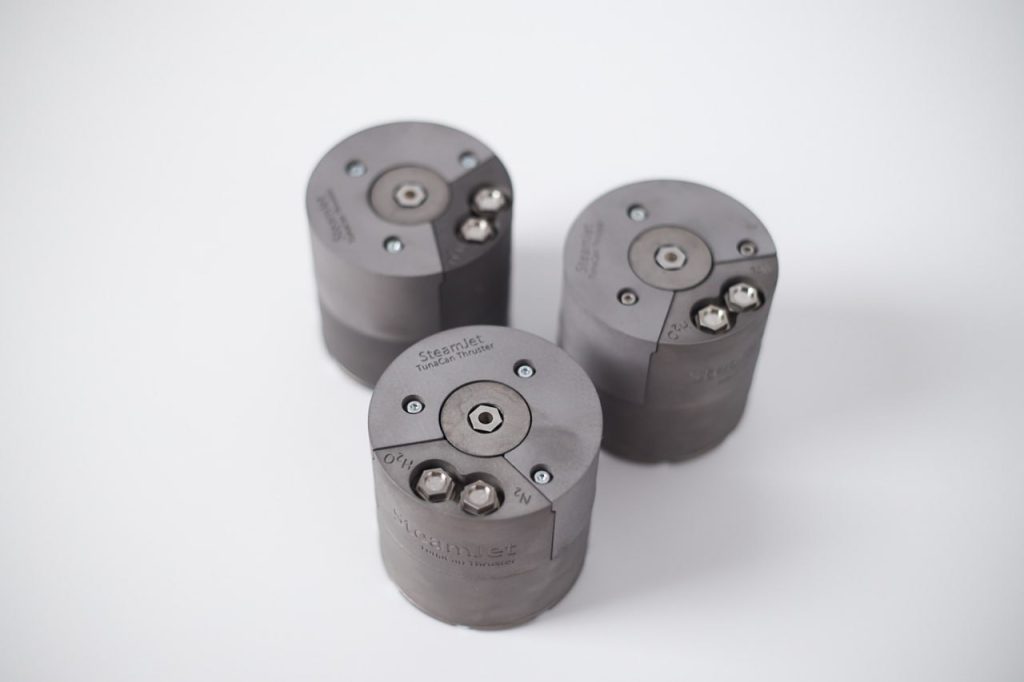
TunaCan Thruster: A New CubeSat Propulsion Solution
TunaCan is a satellite thruster with a simple integration that doesn’t compromise its functionality. Our compact, water-based CubeSat propulsion system allows for eliminating many traditional barriers associated with satellite thrusters.
Main advantages:
- First, the TunaCan thruster mounts outside of the satellite, therefore, it preserves valuable internal space for payloads. Some carriers integrate it inside a specific type of small satellite deployer.
- In addition, TunaCan satellite thruster utilizes water as its propellant making it safe for academic environments and lab settings because there are no risks associated with high-pressure tanks and hazardous materials.
- Moreover, straightforward integration requires minimal preparation time.
- Finally, the system supports diverse mission applications with advanced performance and operational flexibility.
The TunaCan satellite thruster provides a dependable CubeSat propulsion solution ready for a wide range of student satellite missions and academic CubeSat missions.
CubeSat Propulsion Solution Available for University Missions
TunaCan satellite thruster is a flight-proven solution designed to offer high functionality, safety, and simple integration – all at a cost accessible to universities and research institutions. You can find all the technical documentation and CAD models on our website. If your mission requires reliable, low-complexity propulsion, we’d be happy to help. TunaCan satellite thruster is a perfect CubeSat propulsion solution for university teams – reach out to learn how the TunaCan CubeSat thruster can power your next academic space mission.
About SteamJet Space Systems
SteamJet Space Systems is a leading UK-based provider of high-performance satellite propulsion solutions. We specialise in water-based propulsion solutions designed specifically for CubeSats and Small Satellites (SmallSats), prioritising operational safety and rapid launch integration.
By pioneering the use of green propellants and intelligent thermal engineering, SteamJet enables complex LEO (Low Earth Orbit) manoeuvres — including orbital maintenance, collision avoidance, and de-orbiting — without the risks associated with toxic hydrazine or high-pressure cold gas systems, advancing green propulsion for space missions.
Steamjet Propulsion Technology
Our modular systems are engineered for seamless integration and maximum safety compliance:
SteamJet TunaCan Thruster: A compact, high-efficiency solution for 1U-3U CubeSats.
SteamJet TunaTank Thruster: A safe, high-performance electrothermal propulsion system.
SteamJet Thruster One: Scalable propulsion for larger SmallSat constellations.
Discover how SteamJet’s sustainable space propulsion innovations are providing the safety and reliability required for the next generation of crewed and robotic missions. Contact our engineering team for technical specifications and ICDs.