
CubeSat mobility refers to the ability of a small cube-shaped satellite to control its movement in orbit. In particular, it means that the satellite is capable of:
- change the altitude and position;
- maintain the orbit;
- perform manoeuvres and operate in a formation;
- end-of-mission deorbit.
The main limitations of CubeSat mobility in low Earth orbit (LEO) are fuel supply, low thrust, atmospheric drag, and the limited capabilities of its onboard systems. Therefore, when selecting the propulsion system, it is important to take into account multiple factors. Namely, the mass of the satellite, available power, orientation system, navigation accuracy, mission duration, and safety requirements. Thus, even if the thruster has good performance characteristics, this does not guarantee high satellite manoeuvrability.
1. Limited Delta-V Restricts the Number of Orbital Manoeuvres
A CubeSat has a small fuel supply and, consequently, a limited supply of delta-v, the total velocity it can change using its thruster. On top of that, a small satellite can perform only a limited number of manoeuvres. Orbital changes become restricted, and certain tasks may be impossible, for example, rapid deorbit.
It is possible to use a propulsion system with high thrust, plan manoeuvres in advance, and choose an orbit that requires less fuel. However, this type of propulsion system typically requires more space, power, and budget. That is why it is important to select the thruster based on the number of manoeuvres required, the necessary orbital changes, and the total duration of the mission.
2. Low Thrust Makes Manoeuvres Slower and Harder to Plan
The CubeSat’s propulsion system generates only a small amount of thrust, so the satellite cannot quickly change its orbit. Hence, manoeuvres take a long time and require precise planning. During that time, the satellite’s orbit may change due to atmospheric drag or other factors.
There are a few solutions, for example, to calculate the trajectory in advance or perform manoeuvres in small steps. Also, it is possible to use a more powerful thruster if the satellite’s design allows it. However, increasing thrust typically leads to an increase in mass, power consumption, and system complexity. Low thrust, on the other hand, conserves resources but makes manoeuvres slower.
3. Atmospheric Drag Lowers the Orbit and Shortens the Mission
Atmospheric drag in low Earth orbit causes the CubeSat to gradually slow down. As a result, the satellite’s orbit is declining, and its operational life is shortening. Additional manoeuvres may be required to maintain the desired altitude. There are a few answers to this issue: to choose a higher orbit, reduce the satellite’s surface area, and periodically adjust its orbit using the thruster. However, a higher orbit extends the mission’s duration but requires more energy to reach it and subsequently deorbit. A reduction in surface area may limit the placement of solar panels and equipment.
Thus, it is important to take into account the orbital altitude, the size and mass of the CubeSat, the allowable mission duration, and the available delta-v for orbital corrections.
4. Power Constraints Limit Propulsion and Onboard System Performance
The CubeSat propulsion system and other systems require a lot of power, but the supply is limited. If there is insufficient power, manoeuvres may be postponed or not completed. The performance of communications, instruments, and control systems may also be reduced.
It is possible to install more efficient solar panels and batteries, and only perform manoeuvres when the charge level is sufficient. A more powerful system increases the satellite’s mass, size, and cost. Limiting power consumption reduces the capabilities of the thruster and other systems. Engineers take into account the power required to operate the thruster and equipment, the available energy from the solar panels, and the duration of the manoeuvres.
5. Limited Propellant Volume Restricts Manoeuvre Capability
CubeSats don’t have much space for a fuel tank. On top of that, the propellant needs to be stored safely and kept in good working condition. If there is not enough propellant, the satellite will not be able to perform all of its planned manoeuvres. A leak or malfunction in the fuel tank could completely disable the thruster. Usually, a compact tank and reliable valves are used. Also, the system is checked for leaks in advance.
6. Collision Avoidance and End-of-Life Disposal Ensure Mission Safety
А CubeSat may come into proximity with another spacecraft or space debris in orbit. Once its mission is complete, it must also safely leave orbit. A collision could damage or completely disable the CubeSat. Furthermore, if the small satellite remains in orbit after the end of the mission, it turns into additional space debris.
More propellant and equipment improve reliability but increase the mass, cost, and complexity of the CubeSat. A simpler system is cheaper but offers fewer options for course correction. Hence, there are a number of factors to take into account. Namely, orbit altitude, probability of collision, propellant supply, and the requirements for the small satellite deorbiting timeline.
“If CubeSats continue to be launched into long-lived orbits without any means of disposing of them, then they will contribute to the growing space debris hazard. This is not a responsible or sustainable practice, in my view.”- Dr Hugh Lewis, Head of the Astronautics Research Group at the University of Southampton and a leading European space debris expert.
Source: Space debris expert warns of increasing small satellite collision risk
Key Takeaways
- A CubeSat’s mobility in orbit control is limited by its small fuel supply, low thrust, and lack of power.
- Manoeuvres should be planned, as they can take a long time.
- When selecting an orbit, it is important to take into account atmospheric drag and the satellite’s operational lifespan.
- The propulsion system must be compact, leak-proof, and safe.
- To ensure the mission’s safety, measures must be taken in advance to prevent collisions and the small satellite from leaving its orbit.
- The main trade-off is between the capabilities of a CubeSat and the constraints on mass, size, power, and cost.
About SteamJet Space Systems
SteamJet Space Systems is a leading UK-based provider of high-performance satellite propulsion solutions. We specialise in water-based propulsion solutions designed specifically for CubeSats and Small Satellites (SmallSats), prioritising operational safety and rapid launch integration.
By pioneering the use of green propellants and intelligent thermal engineering, SteamJet enables complex LEO (Low Earth Orbit) manoeuvres — including orbital maintenance, collision avoidance, and de-orbiting — without the risks associated with toxic hydrazine or high-pressure cold-gas systems, thereby advancing green propulsion for space missions.
Steamjet Propulsion Technology
Our modular systems are engineered for seamless integration and maximum safety compliance:
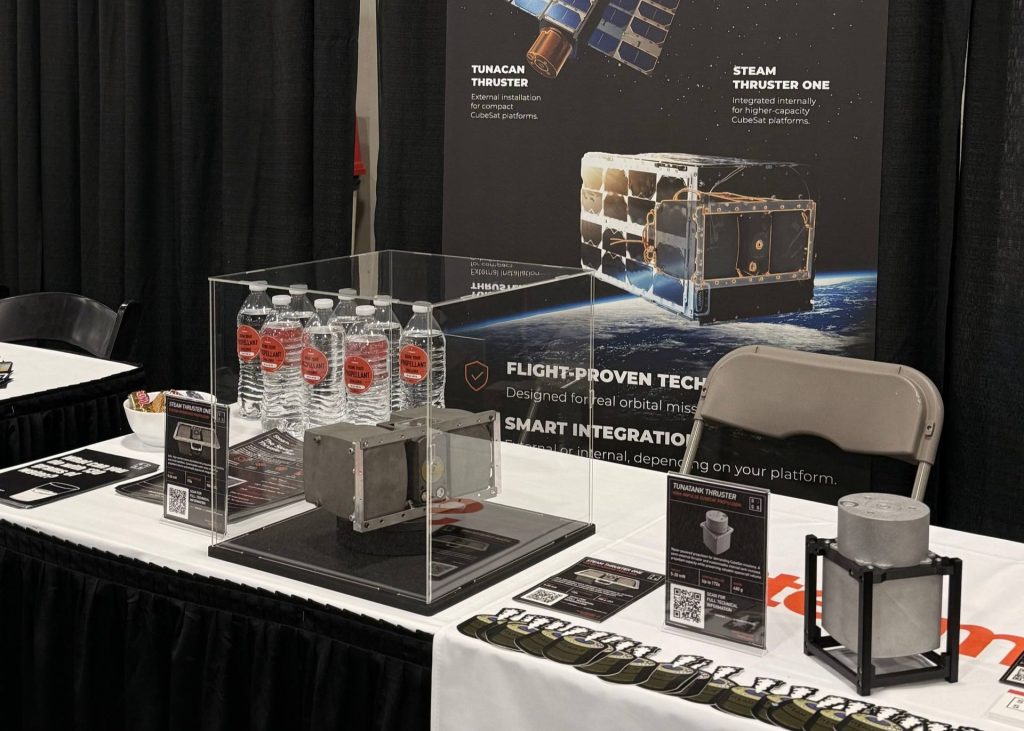
Steamjet TunaCan Thruster: A compact, high-efficiency solution for 1U-3U CubeSats.
Steamjet TunaTank Thruster: A safe, high-performance electrothermal propulsion system.
Steamjet Thruster One: Scalable propulsion for larger SmallSat constellations.
Discover how SteamJet’s sustainable space propulsion innovations are providing the safety and reliability required for the next generation of crewed and robotic missions. Contact our engineering team for technical specifications and ICDs.